



Story by Memory Chamisa
PRESIDENT Emmerson Mnangagwa has rallied global leaders and institutions to maximise the potential of agricultural and food systems to nourish the world’s population to end global hunger.
This emerged at a High-Level Political Forum on Global Action Against Hunger in Addis Ababa, Ethiopia.
With erratic weather patterns disrupting food production, unified climate action on building climate resilience is integral to securing food security.
President Emmerson Mnangagwa, who was represented by the Minister of Lands, Agriculture, Water, Fisheries and Rural Development, Dr Anxious Masuka, underscored the importance of farmers being innovative, efficient, and adaptable to counter the impact of climate change.
“Against a backdrop of the quadrivariate challenges of climate change, conflicts, macroeconomic turmoil, and pandemics, Africa must craft bold and robust policies and implement radical and transformative strategies to end hunger and improve livelihoods of our predominantly rural population, with a sharper focus and more urgent attention on women, youths and the marginalised.
“It is in this regard that my government has crafted the Agriculture, Food Systems and Rural Transformation Strategy to achieve both food and nutrition security, to attain food sovereignty, improve livelihoods, and to accelerate economic development, as Zimbabwe’s economy is agro-based. This aligns with our vision of becoming a prosperous and empowered upper-middle-income society by 2030,” he said.
He further emphasised that the solution lies in bold, collective actions to tackle the root causes of hunger, urging investment in agricultural communities, sustainable production practices and resilient food systems.
“My government, through a transformed extension paradigm, is capacitating communities to view agriculture as a business at every scale, from household to large-scale agriculture. In this context, in all our rural areas, resilience-building of households and communities has now shifted to the accelerated establishment of Village Business Units across all the 35 000 rural villages. These are viable, profitable and sustainable agriculture enterprises whose positive impact will spawn rural aggregation, value addition and beneficiation and spur rural industrialization.”
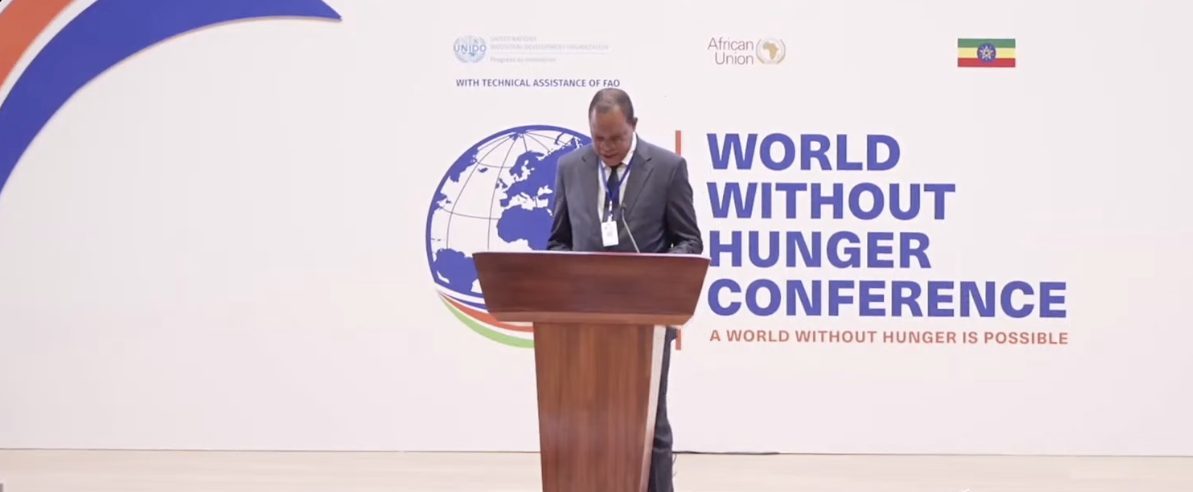
The World Without Hunger Conference, themed: “A World Without Hunger is Possible,” brought together key stakeholders, including heads of state, government officials, United Nations agencies, private sector representatives and civil society leaders to address one of humanity’s most pressing challenges.

