



Story by Providence Maraneli
THE morning bell rings across the dry plains of Matobo, and for the first time, learners at Mahetshe Secondary School walk into classrooms that feel less like a forgotten rural outpost and more like the doorway to possibility.
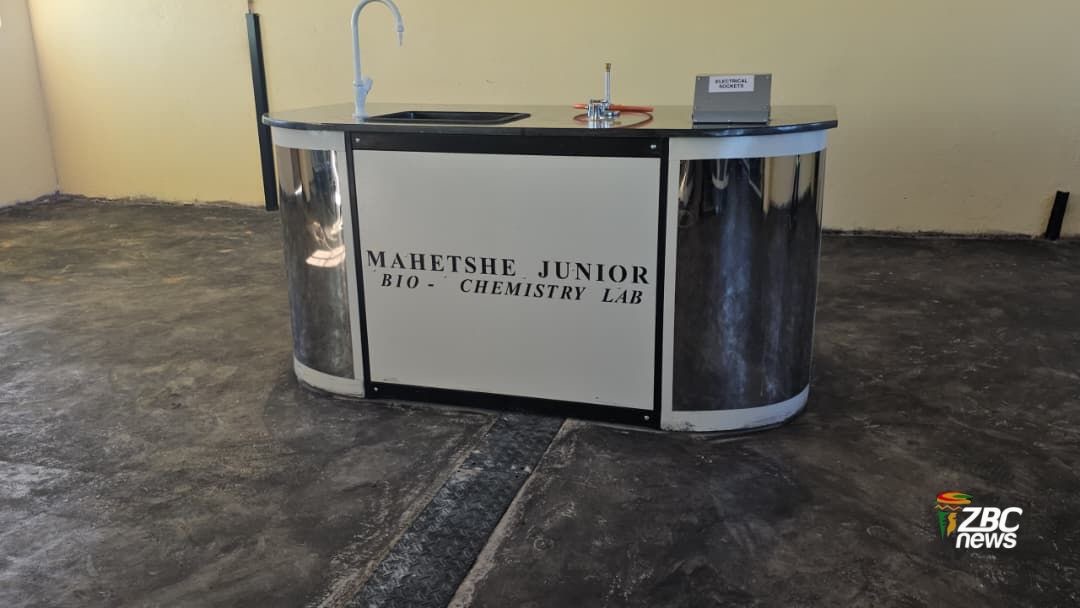
The corridors still smell of fresh paint. Sunlight bounces off polished laboratory tables. New computers hum softly inside a modern technology centre that, until recently, would have seemed unimaginable in this corner of Matabeleland South.
Only a term ago, Mahetshe Secondary School was a modest village school with just two classroom blocks and slightly more than 100 pupils. Today, it stands transformed, reborn through an Independence legacy project that has delivered six additional classroom blocks, science laboratories and computer facilities designed to bring rural learners into Zimbabwe’s growing STEM education drive.
Inside one of the gleaming laboratories, science teacher Ms Annie Chiedza addresses her class with the excitement of someone witnessing history unfold in real time.
“Good morning, students, as you know, we got the new lab. Here are the ground rules: no one is allowed to eat in the lab,” she says, as curious eyes scan shelves lined with scientific equipment.
“Now, we are not going to be seeing pictures, we are going to do live experiments.”
The words land like a revelation.
For years, practical science lessons existed only in textbooks and faded diagrams drawn hurriedly on chalkboards. Experiments were imagined rather than performed. Technology belonged to distant urban schools many learners had only heard about.
Now, learners gather around microscopes and computer screens with a mixture of disbelief and excitement, touching a future that once felt far beyond reach.
Outside, the schoolyard carries a different energy this term. Pupils move briskly between buildings, their chatter filled with wonder at the transformation waiting for them when schools reopened.
“We are stunned by what we saw. We left the school with two classroom blocks,” one pupil said, still struggling to process the scale of the change.
Another learner could barely contain the excitement.
“We are happy that our school has been transformed,” the pupil said.
For many here, the new infrastructure is more than bricks and mortar. It is dignity. It is opportunity. It is the feeling that rural children, too, deserve modern education.
And perhaps nowhere is that hope more visible than in the confidence beginning to emerge among the learners themselves.
“We are going to pass because we now have everything,” another student declared with quiet certainty.
That confidence matters.
In many rural communities, schools battle high dropout rates, limited resources and shrinking enrolment as families often send children elsewhere in search of better opportunities. At Mahetshe, teachers and parents now hope the upgraded facilities will reverse that trend while improving academic performance, particularly in science and technology subjects.
The transformation of Mahetshe forms part of a wider government programme in Matabeleland South Province, where 40 schools received science and computer laboratories under independence legacy projects aimed at strengthening Science, Technology, Engineering and Mathematics education.
But statistics alone cannot fully capture what has changed here.
It is in the widening eyes of pupils stepping into a laboratory for the first time.
It is in the careful way learners handle computers they once only saw in pictures.
It is in the quiet pride of teachers who no longer have to apologise for what their school lacks.
In Mahetshe, a new term has begun.
And with it, perhaps, a new future.

