



Story by ZBC News Reporter
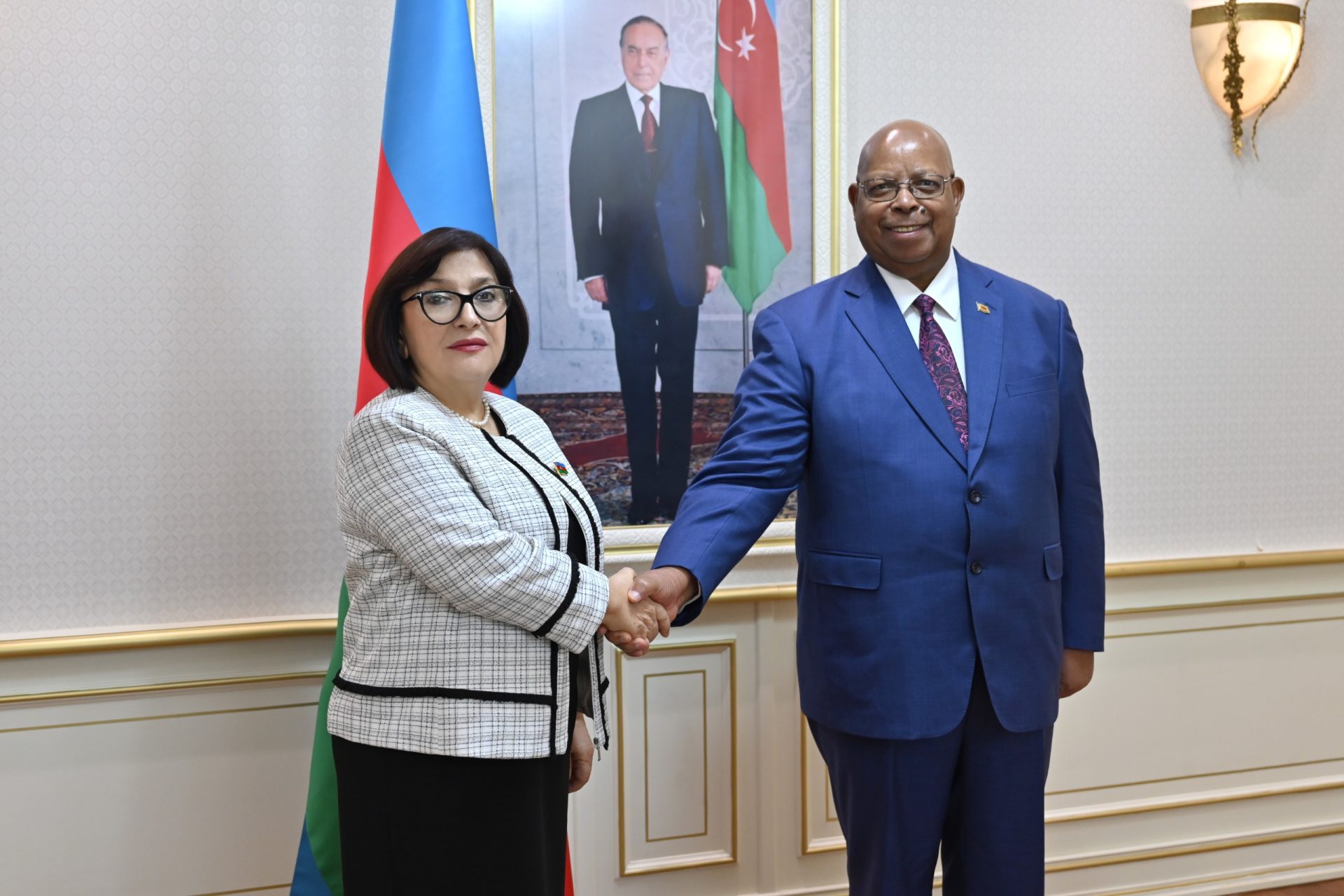
Speaker of Parliament, Advocate Jacob Mudenda interfaced with his counterpart, Her Excellency Speaker Gafarova at the Milli Majlis Parliament Building during his working visit to Azerbaijan, where he was attending IPU Parliamentary Meetings at COP29.
The host Speaker cordially welcomed Speaker Mudenda, expressing fraternal felicitations over his attendance at the just concluded IPU Parliamentary Meeting on the occasion of COP29 where seven thematic sessions on climate change impacts were extensively debated. Speaker Gafarova noted the cordial bilateral relations that exist between Zimbabwe and Azerbaijan which were established in 2008, culminating in the 2019 State visit to Azerbaijan by His Excellency, Cde Dr. E.D Mnangagwa, which further galvanised the excellent bilateral relationship.
Additionally, she stated that the two sister Republics also share similar ideologies as reflected in their affiliation to organisations such as Non- Aligned Movement (NAM) and the Inter-Parliamentary Union (IPU). Further to this, the host Speaker also highlighted that in 2021 Azerbaijan offered a scholarship to a Zimbabwean student to study in Azerbaijan under a government sponsored programme. She indicated that that there is scope to exponentially increase the number of beneficiaries under this initiative. On the whole, Speaker Gafarova was satisfied that her country had done exceptionally well in hosting the IPU Parliamentary meeting on the sidelines of COP29.
In response to the host Speaker, Speaker Mudenda began by expressing approbation to his counterpart and the people of Azerbaijan over the successful hosting of the IPU Parliamentary Meeting on the occasion of COP29 which was graced by Heads of State and Government, including His Excellency, Cde. Dr. E.D. Mnangagwa. Speaker Mudenda applauded the host Speaker and Azerbaijan for outstandingly hosting COP29 wherein His Excellency, Cde Dr. E.D Mnangagwa attended high level meetings of COP29 and delivered exceptional addresses which were well received by the delegates.
The attendance of President Mnangagwa is testimony to the critical importance Zimbabwe places on the topical global imperatives of climate change impacts and also the cordial bilateral relations between the sister Republics. To further consummate the existing excellent relationship, Speaker Mudenda proposed the establishment of a Parliamentary Friendship Association between the two Parliaments, which proposition was immediately agreed to by Speaker Gafarova.
Furthermore, Speaker Mudenda proposed benchmarking visits between the two Parliaments in order to share best Parliamentary practices between the two Parliaments. In this regard, he extended an invitation to Members of the Azerbaijan/Zimbabwe Parliamentary Friendship Association to visit Zimbabwe in the first quarter of 2025. That would be followed by reciprocal exchange visits by both Speakers. Speaker Mudenda expressed his immense admiration of the stature of the unicameral Parliamentary building, which boasts of a state of the art digital communications system for Members of Parliament which include electronic voting in the Chamber. In the spirit of learning best Parliamentary practices, Speaker Mudenda intends to introduce the same digital technologies at the New Parliament Building in Zimbabwe.
Turning to the recently concluded IPU Parliamentary discourse on the occasion of COP29, Speaker Mudenda commended the host Speaker for the exceptional and meticulous planning that resulted in the successful hosting of the two day Parliamentary interface, a significant departure from the previous one day event of such deliberations. This is a welcome departure in response to the need for the Inter – Parliamentary Union Members of Parliament to pay particular attention to seminal subjects such as the climate change phenomenon regarding the need for adaptation and climate action policies and legal regulatory framework be put in place by Parliaments in liaison with the Executive.
As such, Speaker Mudenda was extremely effusive on the comprehensive seven thematic sessions that had been deliberated upon during the two days of unravelling the complexities of climate change impacts and the required regulatory framework thereof to be enacted by Parliaments. Accordingly, Speaker Mudenda underscored the need to catalyse the crafting of such legislation by using Artificial Intelligence (AI) in predictive legislative data analytics, notwithstanding the possible negative AI applications. The two Speakers relatedly exchanged views on how tertiary institutions in both countries could share best research practices which leverage on AI applications as driven by science and technology vis-à-vis the moulding Parliaments of the digital future. Consequently, both Speakers agreed that law making was a key role of Parliaments because the rule of law was a condition precedent for peace, order and good governance in pursuit of national development.
On the issue of Loss and Damage fund, the two Speakers concurred that only strategic dialogue will result in persuading the Global North countries to avail the funding as per COP agreements. Without this key facet, the Global South countries will continue to suffer from funding inadequacies in an attempt to mitigate climate change impacts. In that regard, the host Speaker lamented the non-attendance of the meetings by some European countries in an apparent protest against Azerbaijan for liberating her territory from Armenia. She emphasized that climate change was an issue of global concern and should, therefore, not be politicized.
In that vein, the Global South countries ought to also take decisive measures to cushion themselves against vicissitudes of climate change as exemplified by the Zimbabwean Government which has established a home-grown Climate Disaster Fund which minimises reliance on external funding. To that an extent, Zimbabwe has targeted this kitty to be worth USD10bn by the year 2030, all things being equal. The impact of such an intervention is immeasurable. It will be possible to develop smart civil and architectural engineering designs to combat the debilitating effects of climate shocks especially where infrastructural designs are less robust. Such a move of initial self-funding by Global South countries may persuade the Global North countries to partner the Global South countries in bolstering the Loss and Damage Fund, Speaker Mudenda posited.
Furthermore, both Speakers agreed that cultural ensemble exchange tours by both countries could revamp the cordial relations between the two republics as witnessed by the highly impressive Azerbaijan traditional displays during the dinner hosted by Parliament of Azerbaijan on Saturday night, which typified the rich cultural heritage of Azerbaijan. In this vein, Speaker Mudenda proposed synergies with the trailblazing gastronomy initiative by the First Lady of Zimbabwe, Her Excellency, Dr Amai Mnangagwa, who has taken the Africa cuisine to elevated international levels as demonstrated by the United Nations Gastronomy Fair held in the resort City of Victoria Falls, courtesy of her initiative. Speaker Mudenda suggested that, if invited, the First Lady could visit Azerbaijan to demonstrate her strong belief in cultural gastronomy. Speaker Gafarova accepted graciously the proposed people to people cultural exchanges. The host Speaker concluded the bilateral interface by pledging to invite Speaker Mudenda for a more extensive exchange of Parliamentary tour in order to sample Parliamentary best practices established by Azerbaijan Parliament.
At the conclusion of the highly interactive deliberations, Hon. Soltan Mammadov, Rapporteur and Member of the Milli Majilis (Parliament) of the Republic of Azerbaijan, expressed confidence that the Outcome Document captured the key climate change issues from IPU Member Parliaments. He further explained that the Outcome Document was a result of an extensive consultation process and cooperation among IPU Parliaments as co-ordinated by the IPU Secretariat at the 149th Assembly of the IPU and Related Meetings held in Geneva, Switzerland in October 2024. The Rapporteur further proposed the inclusion of some key aspects emanating from the rich engagements during the sessions as well as bilateral discussions on the sidelines of the IPU Meeting which included harnessing positive emerging technologies such as AI to address the devastating impacts of climate change.
At the closure of the IPU meeting, Mr. Martin Chungong, IPU Secretary General lauded the positive trajectory of the Parliamentary COP Meetings which have evolved from half day meetings to the historic two-day meeting. This is clear testimony of the IPU Member Parliaments’ commitment to contributing towards finding global resolutions in response to the emerging climate change issues. He described the Outcome Document as a roadmap for immediate Parliamentary action to combat the devastating effects of climate change phenomenon which threatens the wellbeing of humanity.
Accordingly, he implored IPU Member Parliaments to take positive action in support of their Governments in the holistic implementation of the Paris Agreement underpinned by the Kotowici Protocol. Additionally, the IPU Secretary General Mr Chungong also urged Parliaments to legislate for positive use of Artificial Intelligence (AI) while at the same time contending with the possible risks that AI may pose from time to time.
At the behest of the IPU President Ms Tulia Ackson and Azerbaijan Speaker, Her Excellency Hon Gafarova, the Parliamentary Meeting on the occasion of COP29 was officially closed by the IPU Secretary General on 17 November 2024, with a pledge to resume deliberations in Brazil at COP30 in 2025 where all IPU Member Parliaments where encouraged to attend.

