



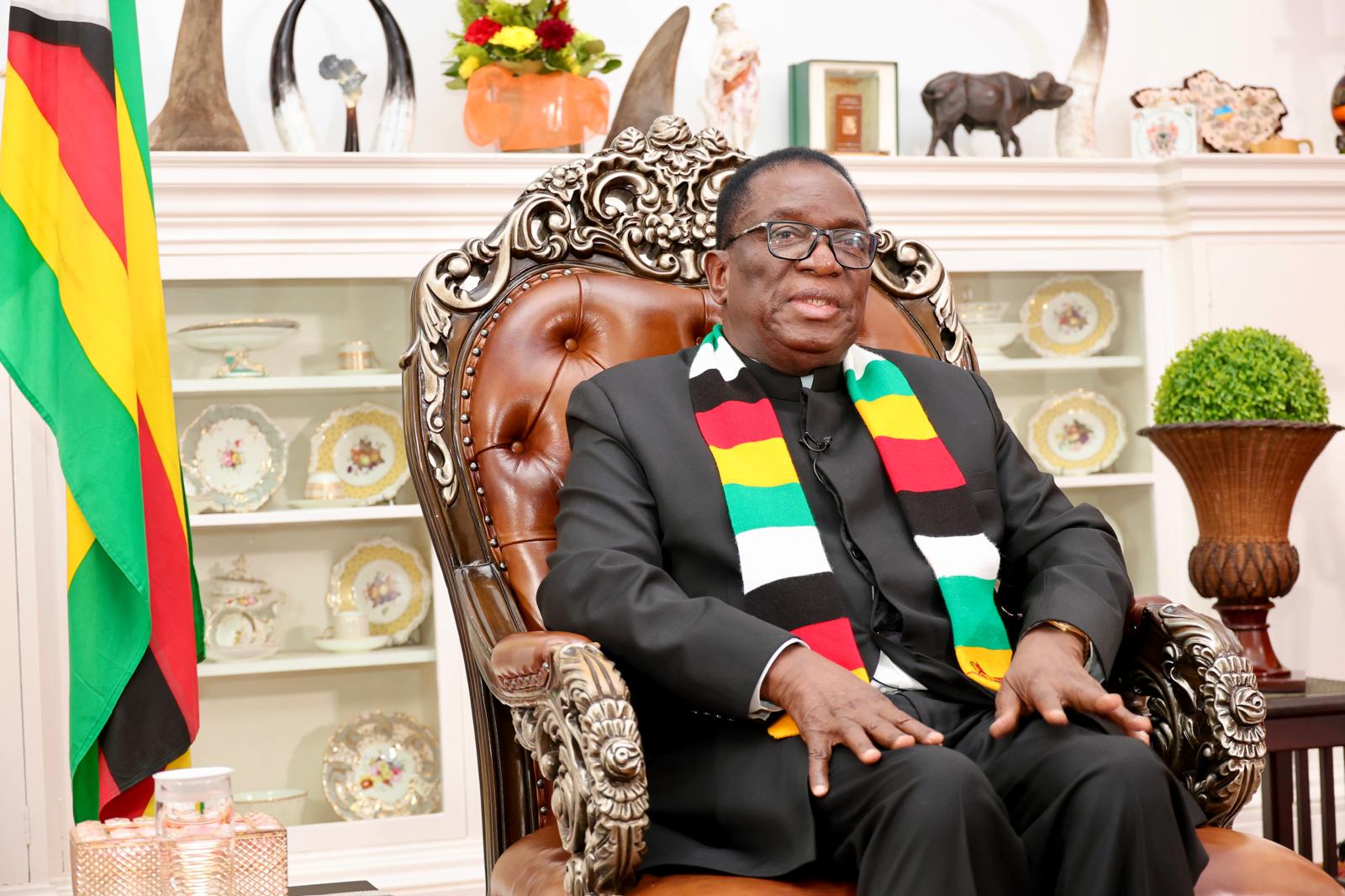
Story by Josephine Mugiyo, Diplomatic Correspondent
PRESIDENT Dr Emmerson Mnangagwa says decisions made at leadership level are in the best interests of the country and its citizenry.
He was responding to journalists in an interview at State House recently, where he sat down with public media journalists at the State House in Harare, where he responded to questions on governance and leadership.
ZBC News Chief Correspondent, Reuben Barwe asked the President: “There are certain issues sometimes that nag you or push you to the wall. Do you have some of the things which you say, “Hey … I could not sleep because of thinking of these particular issues.” Do you sometimes do that?”
“Well, it is not easy to have a country that has no challenges, perhaps in books. In real life, every country has challenges. And no challenges face a country unless the country has the capacity to face the challenges. Are you clear?” President Dr Emmerson Mnangagwa said.
Q: So, you don’t have a time when you say, “Hey…”
A: I sleep very well. Very well.
Q: Your Excellency, in relation to that, are there any difficult decisions that you have had to make as a Head of State?
A: All decisions are difficult, because when you decide, it must be a balanced decision, which considers the effects of that decision.
So, you cannot say every decision can be taken easily or very lightly. No, when you decide, you look at the consequences of whatever decision you take.
And whatever you do, you say what is best for my country and for the people. That guides you as you navigate. But as you do so, you don’t please everybody. And I don’t think even God pleases everybody.”
Zimbabwe’s mining sector has seen a shift in policy to ensure the country maximises on benefits from its resources and President Mnangagwa responded to questions on the ban of exports on raw minerals.
Q: Your Excellency, the mining sector has been key for the Second Republic, and we have witnessed its growth for the past eight years. Recently we saw Government banning the export of unprocessed minerals. Is there a specific timeline for setting up local refineries to ensure local beneficiation and value addition?
A: I think the policy is correct. We have not set up timelines for making sure everything is beneficiated, but that is the goal to achieve because it requires resources. What is important is that we are following a correct path for benefiting the country on the basis that these resources should benefit the country mostly than those to whom we will sell our resources to,”
Q: Still on mining, we have seen that some African countries have tried to enforce those bans with mixed results. What do you think makes Zimbabwe’s industrial base uniquely positioned to succeed?
A: Can I be very, very clear: Each country has its own boundaries. Zimbabwe has its own boundaries. So, we are unique. So, our issues should be dealt with uniquely as a country. We succeed as a country, fail as a country. We don’t need to emulate the failures of other countries or the successes of other countries. What we need to do is to do the best for our country on the basis of the resources and the skills that we have, and the vision as a country which we have, and what we need to achieve. That is the platform from which we develop our country.”
The President also spoke about Zimbabweans who are returning back home from the diaspora.
Q: Your Excellency, we have the issue of our fellow citizens who are coming back home from the diaspora. How do we ensure their integration into the economic and social development process of the country? We know that skills development is important to the country’s transformation agenda. So how do we ensure that they become part of building Zimbabwe?
A: I have no doubt that each one who comes back knows where they came from before they went to South Africa. So, the first thing is to go back to roots and begin from there as they integrate in society. So, there is not a single problem. Government is not facing any problem at all. We do facilitate their transport, their welfare, we do that. But each one gives us an address: “I want to go to Chipinge, I want to go to Bindura.” We facilitate, and they go to their homes. And whatever facilities we give to people already in the country, they will also enjoy those services we are giving. So, there is no problem at all. Every Zimbabwean who is in diaspora is welcome back home.
Q: On services, Your Excellency, people who are coming back have children, and they are coming in the middle of the year. Do we have the capacity to absorb the children who are coming back into our schools?
A: I have not received any complaint from the education system that they are overwhelmed by the children who are coming from across. Until I receive that, then I will see what to do. But for now, no complaint has come.”
The head of state also attributed the country’s milestones in various sectors of the economy to the resilience and focus of ordinary citizens.

