



Story by Mercy Bofu-Matinha
GOVERNMENT is scaling up irrigation development and power generation projects in Masvingo Province, with plans to develop 40 000 hectares under irrigation and construct a 15-megawatt hydropower plant at Tugwi Mukosi Dam.
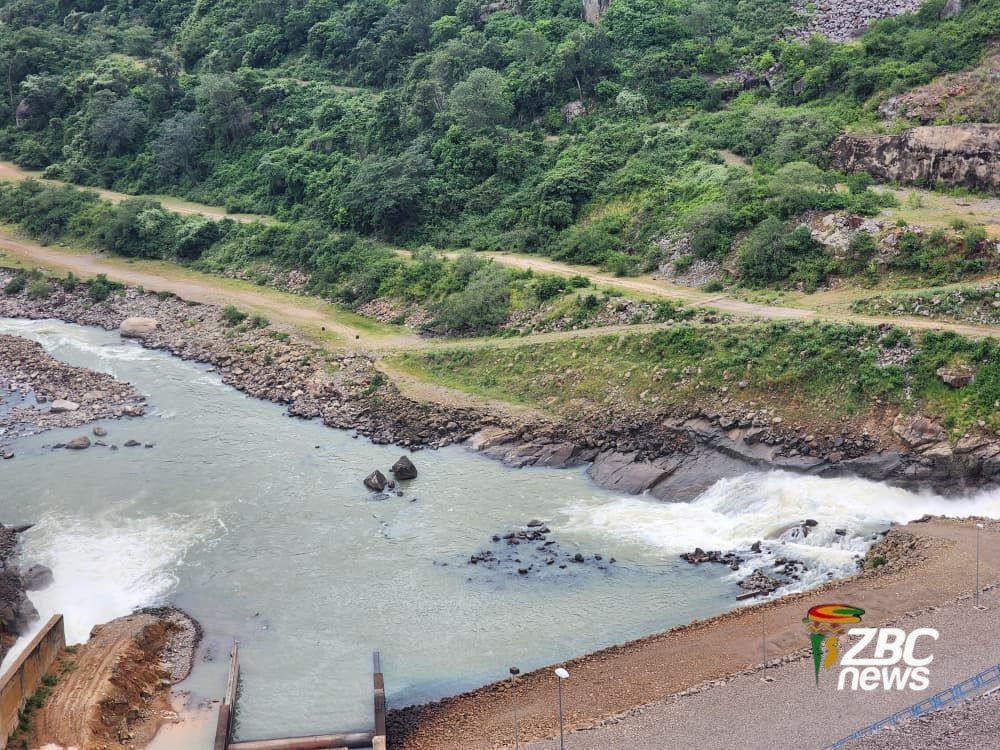
The dam, now filled to capacity following a favourable rainfall season, is spilling for the fourth time since its completion in 2017. With a holding capacity of 1.8 billion cubic metres, Tugwi Mukosi, the country’s largest inland dam is expected to anchor irrigation expansion, fisheries, recreation and power generation projects.
Masvingo provincial leadership toured the dam this Tuesday, where the Minister of State for Provincial Affairs and Devolution, Ezra Chadzamira, said the province is poised for accelerated agricultural transformation.
“As a province, we are happy that all our major dams are now full, including Tugwi Mukosi. Our plan is to intensify agricultural projects under NDS2, especially through irrigation development. From Tugwi Mukosi, we are developing 40 000 hectares for irrigation in the Lowveld, and investors are already on the ground,” he said.
Officials indicated that by the end of the National Development Strategy Two (NDS2) cycle, the province targets a total of 80 000 hectares under irrigation from various water bodies.
Beyond agriculture, a 15-megawatt hydropower plant is under construction at the dam. The project, being spearheaded by the Tugwi Mukosi Hydropower Company, is expected to be completed within two years, with electricity to be fed into the national grid.
Site Engineer Mr Austern Chiboora said preliminary works have commenced, although heavy rains have temporarily slowed construction progress.
Communities downstream of the dam are also set to benefit from small-scale irrigation schemes along the Tugwi River, with residents expressing optimism over improved livelihoods and food security.
Agricultural development remains a central pillar in Zimbabwe’s drive towards attaining Vision 2030 and achieving an upper-middle-income economy, with water infrastructure playing a strategic role in climate-proofing production systems.

