



Story by Abigirl Tembo, Health Editor
ZIMBABWE is making steady progress in strengthening its health system through science, innovation and partnerships, with stakeholders calling for greater collaboration to ensure scientific advances continue to improve the lives of citizens.
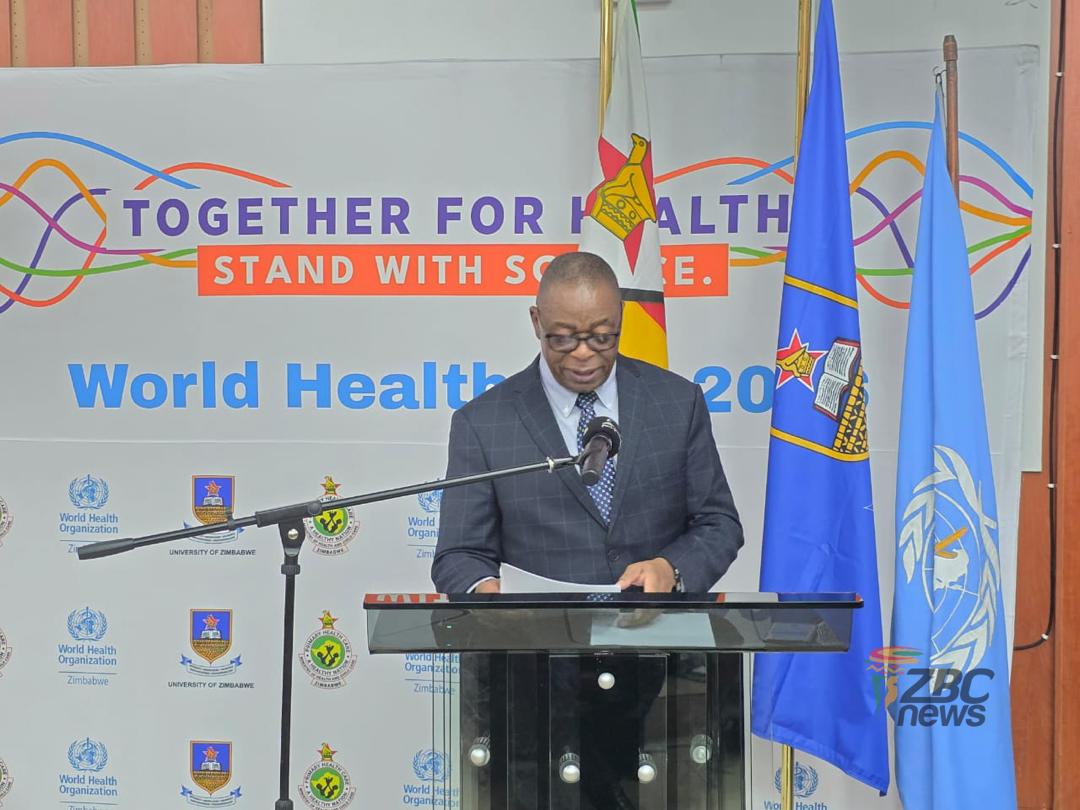
This emerged during the World Health Day commemorations held at the University of Zimbabwe in Harare this Friday.
The commemorations, held under the theme “Together for Health: Stand with Science,” brought together government officials, researchers, development partners, health professionals and civil society organisations to reflect on the role of science in advancing public health.
Health and Child Care Minister, Dr Douglas Mombeshora, said scientific breakthroughs continue to transform healthcare globally through vaccines, diagnostics and innovative treatments that save lives.
He said World Health Day offers an opportunity for reflection on global health challenges and renewed commitment to stronger health systems.
“The day provides an opportunity for the global community to reflect on pressing health challenges and renew collective commitment to improving health and well-being. The theme reminds us that science, evidence and collaboration are the foundation of strong and resilient health systems. It calls upon governments, scientists, health professionals and communities to work together to support science-driven solutions that protect and improve health,” he said.
He added that science has long shaped public health outcomes, citing progress in disease control, maternal health and outbreak response.
“Throughout history, science has transformed public health. Vaccines have eliminated deadly diseases, diagnostics have enabled early detection, and innovative treatments have saved millions of lives. Scientific research has guided responses to outbreaks and strengthened health systems worldwide,” he added.
Stakeholders and partners highlighted ongoing efforts across Africa to strengthen health systems, improve surveillance and enhance preparedness for health emergencies through science-based solutions.
World Health Organisation (WHO) country representative, Dr Desta Tiruneh, said scientific approaches have been central to eliminating diseases such as polio.
He said the health sector has continued to translate scientific evidence into practical interventions that save lives.
“The celebration focuses on science and evidence, which is what the Ministry of Health has been doing. In the health sector, we are translating what was proven by science into action, which is saving lives. In the past we had large numbers of polio cases in communities, which are now non-existent that is a result of science,” he said.
UNFPA country representative, Ms Miranda Tabifor, said maternal health remains a key priority, with ongoing innovations aimed at reducing preventable deaths.
She highlighted collaboration with the Ministry of Health on new technologies targeting maternal complications.
“In terms of innovations, UNFPA is working with the Ministry of Health on e-pantograph and e-motif to address critical issues of postpartum haemorrhage after childbirth. While Zimbabwe has made progress in reducing maternal mortality, there are still cases of maternal deaths, and these innovations are helping to address one of the leading causes,” she said.
Africa CDC representative, Dr Priscilla Kusena, highlighted that the organisation remains committed to supporting member states in building resilient and people-centred health systems.
She stressed the importance of linking evidence to action and strengthening trust in health systems.
“As we stand with science, we also stand with communities, health workers, researchers, policymakers and young people shaping the future of public health. Africa CDC remains committed to building stronger, more resilient and people-centred health systems. Together for health, we stand with science, and we must ensure that evidence leads to action, action builds trust, and trust strengthens health systems,” she said.
As Zimbabwe joined the rest of the world in commemorating World Health Day, stakeholders reaffirmed their commitment to advancing science, promoting innovation and strengthening partnerships as key drivers of improved health outcomes.
The commemorations ended with a shared vision of a healthier and more resilient Zimbabwe, underpinned by scientific knowledge, community participation and collaboration.

