



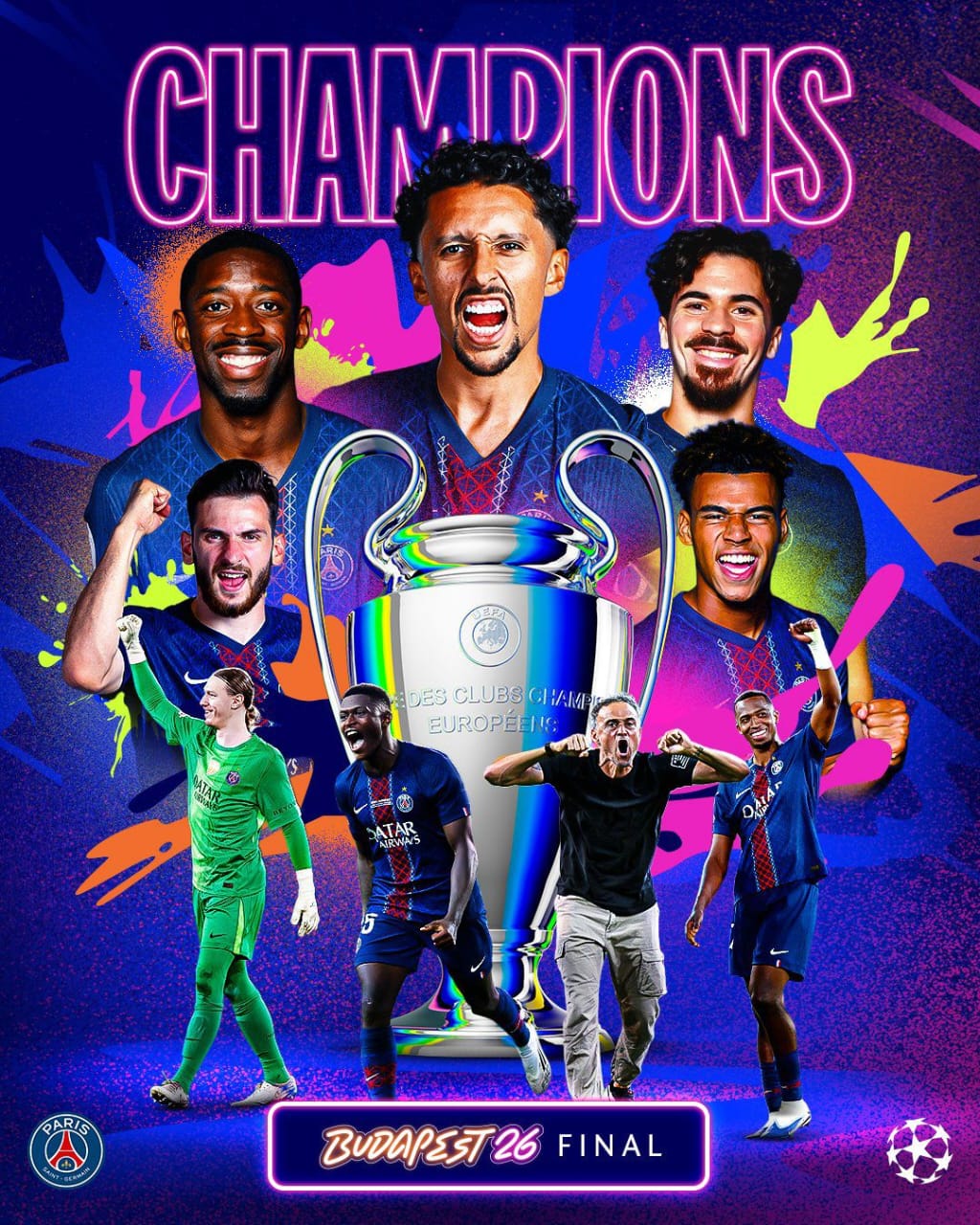
Story by Raynald Ngwarati
As Gabriel Magalhães missed that penalty, the dynasty of Paris Saint-Germain was no longer a promise but a reality, a new European empire forged under the guidance of Spaniard, Luis Enrique, as PSG retained the Champions League crown and etched their name alongside the great dynasties of modern football.
For the book markers, Paris Saint-Germain have etched their names even deeper into football folklore after retaining the UEFA Champions League crown with a nerve-shredding 4-3 penalty shootout victory over Arsenal following a 1-1 draw after extra time in Budapest this Saturday.
While English champions Arsenal’s dreams were dashed, Enrique stole the show winning his third UEFA Champions League trophy to equal the record of Pep Guardiola and Zinedine Zidane as the only kings of European football to have won Europe’s biggest competition thrice.
For Arsenal, the dream began perfectly as Kai Havertz stunned the defending champions with an early sixth-minute strike igniting the Gunners hopes that Europe’s most coveted club trophy was finally within reach, but champions have a habit of writing their own script.
As the pressure mounted and the occasion demanded a hero, the current Ballon d’Or holder, Ousmane Dembélé emerged from the shadows to haul PSG level in the 64th minute slotting home from the penalty spot after Khvicha Kvaratskhelia was fouled in the box, dragging Enrique’s side back from the brink and setting the stage for another unforgettable European night.
Neither side could find the decisive breakthrough during regulation time or extra time, leaving the destiny of the trophy to the unforgiving drama of penalties.
When the dust settled, PSG stood tall once again, prevailing 4-3 from the spot to successfully defend the Champions League title and cement their status as the undisputed kings of European football.
This was not merely a victory.
It was the crowning chapter of a footballing revolution.
When Luis Enrique arrived in Paris in 2023, PSG were still carrying the reputation of Europe’s great underachievers, a club blessed with superstar names but haunted by recurring continental heartbreak.
Enrique dismantled that culture piece by piece, replacing celebrity status with collective responsibility, tactical discipline and relentless intensity.
The result has been a transformation from a glamorous project into a ruthless football machine whose name will be echoed in the chambers of history for decades.
Back-to-back Champions League titles now place this PSG side among the elite dynasties of modern football.
The inevitable comparison is with Zidane’s legendary Real Madrid side that conquered Europe three consecutive times between 2016 and 2018.
Zidane’s Madrid was built around established superstars Cristiano Ronaldo, Sergio Ramos, Luka Modrić, Toni Kroos and Karim Benzema was a team overflowing with individual brilliance.
Yet Enrique’s PSG, by contrast, represents a different football philosophy.
Where Zidane’s Madrid thrived on experience, moments of genius and an unrivalled winning culture, Enrique’s PSG has been forged through collective pressing, tactical flexibility and the belief that no player is bigger than the system.
Even the departure of superstar Kylian Mbappé failed to derail the project rather anslysts say it accelerated PSG’s evolution into a more complete team.
The debate over which side is greater may rage for years, however, Zidane’s Real Madrid remain the benchmark, having achieved an unprecedented three consecutive Champions League triumphs in the modern era.
Remarkably if Enrique’s PSG continue on their current trajectory, a third straight European crown next season could elevate them from champions to legends and perhaps place Luis Enrique alongside Zidane in football’s most exclusive managerial pantheon.
For now, however, France belongs to PSG, Europe belongs to PSG, and Luis Enrique’s relentless pursuit of excellence has delivered another masterpiece on the grandest stage of all.

