



Story by Tapiwa Machemedze
GOVERNMENT has resolved to stop urban mining in Bindura following extensive damage to roads, railway infrastructure, residential land and public facilities caused by illegal mining activities.
Illegal mining has spread across several parts of the town, with miners excavating beneath roads, railway lines, residential stands and other undesignated areas.
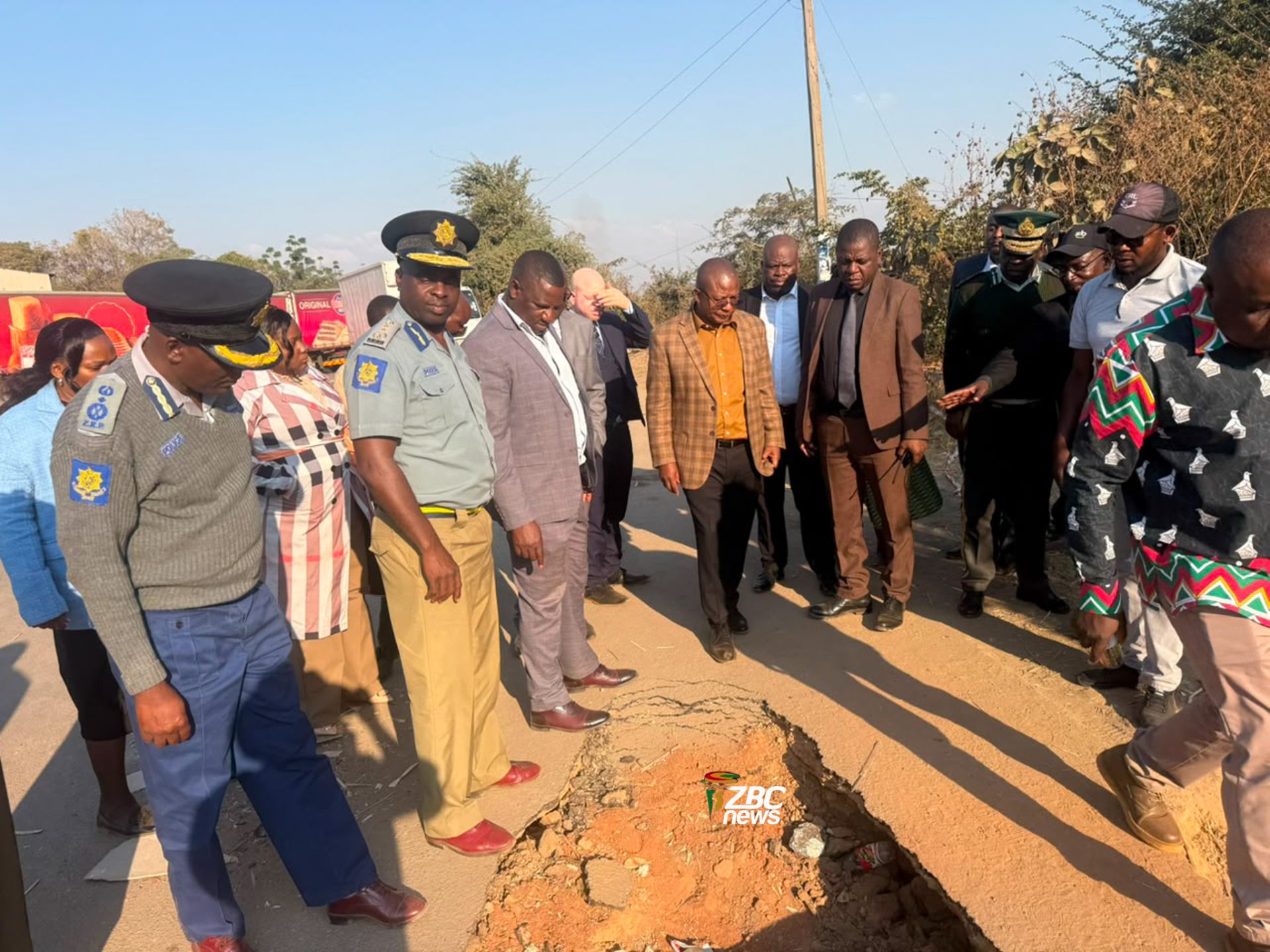
Among the affected infrastructure is Border Gezi Road, which was recently closed to protect motorists and pedestrians.
The destruction prompted a high-level Government delegation comprising the Ministers responsible for Local Government and Public Works, Mines and Mining Development, and Provincial Affairs and Devolution to conduct an assessment tour of the town on Monday.
The ministers reaffirmed Government’s position against urban mining.
“Senior Government officials who are here, we cannot allow urban mining to take place; we must do everything we can to come up with strong recommendations that will support the prayer that urban mining must be banned and must be a criminal offence.”
The delegation was acting on a report showing that land for 2 230 surveyed residential stands had been lost to mining, while 9.2 hectares reserved for a secondary school had been taken over by Makaha Gold Mine.
The delegation warned that unchecked mining was undermining national development.
“This is the beautiful country we need to jealously guard for our children to benefit tomorrow. We cannot talk of 2030 when people are mining this way at Kitsiyatota… when ZEGU is being destroyed… and when railway lines are being destroyed.”
Authorities recommended a whole-of-government approach, stricter environmental compliance and the rehabilitation of degraded land.
“We have toured Chanaka, and we are here at Bharasi. Although inspections are conducted, there is also a need for reclamation. We have the polluter pays principle, where the polluter pays for the rehabilitation of the land that they have destroyed.”
The Ministry of Local Government and Public Works has also resolved to suspend approval of the Bindura Urban Master Plan until mining activities within the town’s boundaries are brought under control.
A joint Government task force found that illegal mining has affected areas including Kitsiyatota, Garati and Ran Mine.
The survey revealed that sections of the Bindura-Shamva railway line are at risk of collapse because of underground excavations, while open-cast mining has spread into residential areas.
It also highlighted serious environmental concerns, with cyanide, mercury and other hazardous chemicals reportedly being discharged into the Mazowe River, increasing water treatment costs and posing a threat to public health.
Mining activities have also encroached on land reserved for public infrastructure, including schools, hospitals and police stations.
According to the report, 2 230 surveyed residential stands in Cleverhill and Greenhill suburbs have been lost to mining, while a 9.2-hectare site earmarked for a secondary school is now occupied by Makaha Gold Mine.
Despite the cancellation of all mining titles around Zimbabwe Ezekiel Guti University (ZEGU) to protect the institution, illegal mining has reportedly continued in the area.
Government says decisive action will now be taken to restore order, protect public infrastructure and safeguard planned urban development.
While mining remains a key pillar of Zimbabwe’s economy, authorities say urban mining cannot be allowed to undermine infrastructure, environmental sustainability and public safety, adding that the Bindura intervention could be replicated in other towns facing similar challenges.

