



Story by Tamuka Charakupa
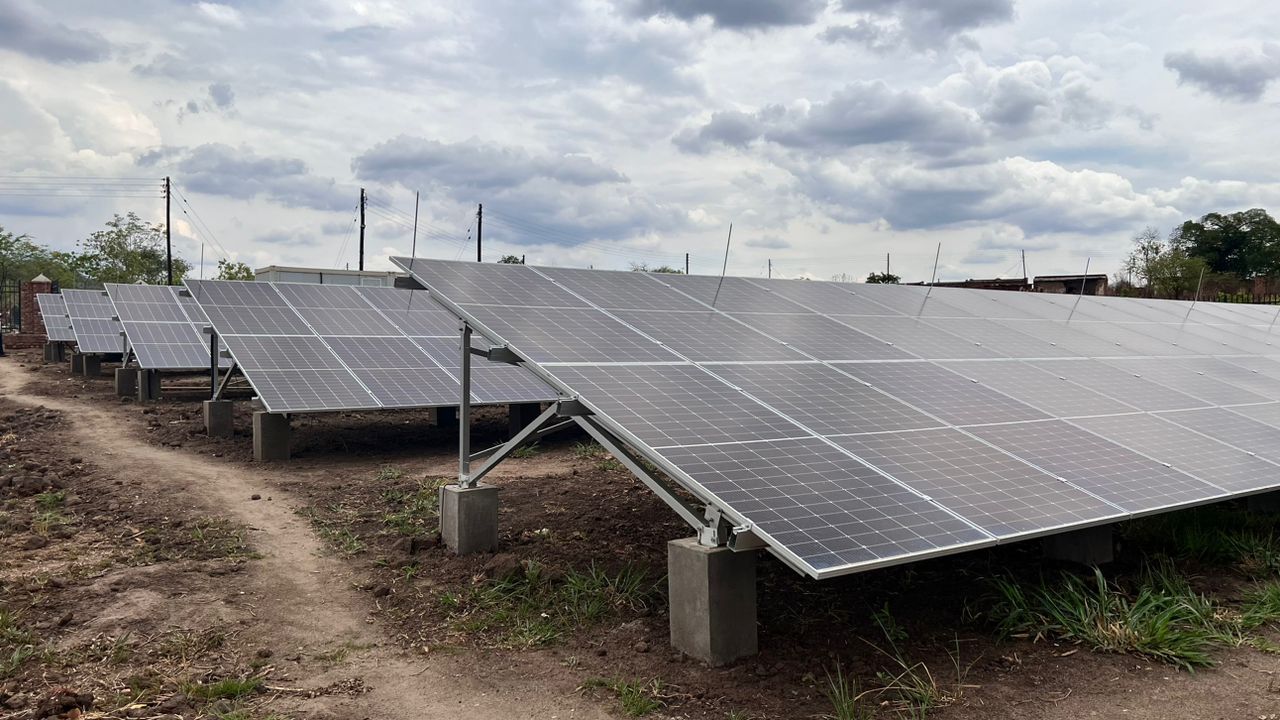
RURAL electrification and industrialisation is in motion, with the government set to commission a 120-kilowatt mini-grid in the Dete area of Hurungwe North as the country gravitates towards an upper middle-income society by 2030.
The completion of the Dete mini-grid has come as a relief for the local community who have never had electricity since settling in the area in the 1980s.
The development has benefited two local schools, a business centre and several homesteads with 101-year-old Sekuru Newton Mahodzwa among the beneficiaries.
“It has always been our wish to have electricity. I can now watch television in the comfort of my home so we are grateful to President Mnangagwa for ensuring that no place and no one is left behind,” Sekuru Mahodzwa said.
“The establishment of this solar grid means supplementary power for this facility. It means we will not have challenges of lighting and the preservation of medication,” the Nurse in Charge at Dete Health Center, Mr Hosiah Handizvidi added.
“This is an exciting development for us because our clinic, school and the business centre are electrified. This means the rural-urban divide has been addressed,” noted Traditional Leader, Mr Zhakata Mayendayenda.
Mashonaland West Minister of State for Provincial Affairs and Devolution, Honourable Marian Chombo says energy is a key enabler for the attainment of Vision 2030.
“As a government, our focus is to ensure we improve rural livelihoods by creating a conducive environment that stimulates economic growth. The plant not only supports social amenities but also enables the start-up of local industries and upscaling of village business units. We now appeal for digital or network connectivity so that learners also benefit through ICTs.”
Rural Electrification Agency Provincial Head, Engineer Last Taguma Sauramba gave an update on similar projects underway across the province.
“This project which is a 120-kilowatt solar grid has progressed as follows: Internal wiring is 99% completed on two schools and, a clinic, while 13 homesteads, 32 shops, 5 churches, 2 Wiring of boreholes, 2 grinding mills and welding machines shops are benefiting. We have set up similar facilities in Makonde, Mhondoro-Ngezi, Kariba and Sanyati as we continue to implement the rural electrification models.”
The government is promoting the use of renewable energy to mitigate climate change while also ensuring the availability of adequate power supply as an anchor towards the attainment of Vision 2030.

