



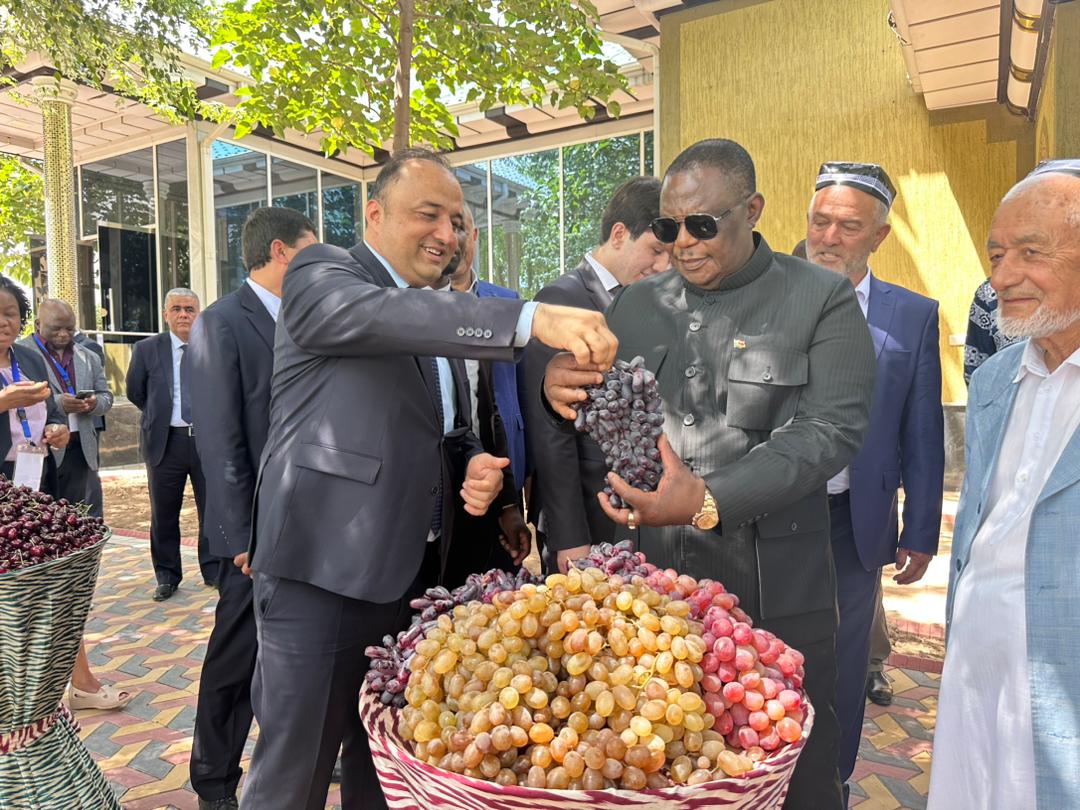
Story by Abigirl Tembo
VICE President General (Retired) Dr Constantino Chiwenga has commended Tajikistan’s rural industrialisation programmes highlighting that this model dovetails with Zimbabwe’s vision to empower rural communities to achieve food security and unlock agricultural value.
Amid the serene, green landscapes of Tursunzoda, about 80 kilometres from Dushanbe, Tajikistan’s capital, small rice fields and well-tended vineyards stretch across the land a striking contrast in a country where 93% of the terrain is mountainous.
With just 7% of land suitable for cultivation, Tajikistan has still managed to make agriculture a cornerstone of its economy, contributing roughly 20% to 25% to the national GDP.
ZBC News crew met up with Usmanov Nematjon, a former rural school teacher who left the classroom behind to embrace farming, a decision he says changed his life for the better.
“I decided to leave teaching because anyone can be a teacher, but not everyone can be a farmer. I chose this life to help produce food, to help the country, and to support others,” he said.
With 200 hectares under cultivation, Usmanov and other farmers in the area grow a variety of fruits but mainly grapes destined for both local and international markets from Russia and Kazakhstan to Pakistan.
Some are dried for snacks, others are frozen for off-season consumption. It’s a diversified model of productivity that combines tradition with innovation.
“I personally own around 500 hectares of land. I also specialise in growing grapes. And how I would say this impacted my life and we have been doing it for generations. My father and grandfather were grape farmers. But only now, with the president’s permit, are we able to grow on this scale. This kind of farming has changed our lives and the community,” a farmer, Kamolov Mahmmadamin said.
These local success stories left a deep impression on Zimbabwe’s Vice President General Rtd Dr Constantino Chiwenga, who toured farms, processing plants, and grape yards as part of a high-level visit. His mission is to draw lessons for Zimbabwe’s own Rural Industrialisation and Development Agenda, a key pillar under National Development Strategy 2 (NDS2).
“You see under our NDS we are just now coming out of the NDS1 and getting into the NDS2 our emphasis is to industrialise our rural areas this is where we see our economy growing because for any economy to grow you need food security. Not only food security alone but which is also nutritious what we have seen here is the intensification of smallholder farming you have seen the rice fields very small hectarage but they yield at the maximum rate and then they combine all their produce to have economies of scale. It was quite interesting that those small fields in this particular town produce 30 000 tonnes just from those small fields.”
“The maximum of one single acre per farmer is one hectare but they managed to produce 30 000 tonnes when they say they have got 5 000 hectares and then which means those small plots on the average are producing six tonnes per hectare so that’s exactly what we would want to see our rural community in Zimbabwe doing under the rural accelerated industrialisation program.
“That is what we want to see when we have different types of fruits and different types of vegetables being produced that’s exactly what we would want to see. Back home, the government is rolling out the Rural Industrialisation and Development Agenda, a major pillar of NDS2. The aim is to turn rural areas into hubs of agro-based productivity and processing where local crops are not just grown but also transformed into market-ready goods,” he said.
Whether it’s grapes in Tajikistan or groundnuts in Gokwe, the message is the same: with smart policy, investment, and community coordination, rural farming can feed nations and fuel economies.

