



Story by Stanley James, Business editor
ZIMBABWE has stepped up its diplomatic engagement with other African countries and key global partners at the Russia-Africa Partnership Forum underway in Cairo, Egypt.
On the sidelines of the meeting, Zimbabwe’s Foreign Affairs Minister, Professor Amon Murwira, held high-level bilateral engagements with his counterparts from Algeria, Egypt and the Russian Federation.
In talks with Algeria’s Foreign Minister, Mr Ahmed Attaf, the two sides reviewed progress on agreements signed under the Algeria-Zimbabwe Joint Permanent Commission on Cooperation.
“We had a bilateral meeting with Algeria. In our bilateral meeting, we were assessing the level of our cooperation, firstly and secondly, we were assessing the agreements that we made during the state visit of His Excellency the President, Dr Emmerson Mnangagwa, to Algeria, in order to assess where we are and where we want to go. We also assessed the state of our cooperation in the international arena, including the United Nations and Zimbabwe’s bid for a non-permanent seat in the United Nations Security Council. The vote is taking place in 2026, but for the 2027-2028 term and Algeria assured us of their support for our seat. So it was a very productive meeting,” Professor Murwira said.
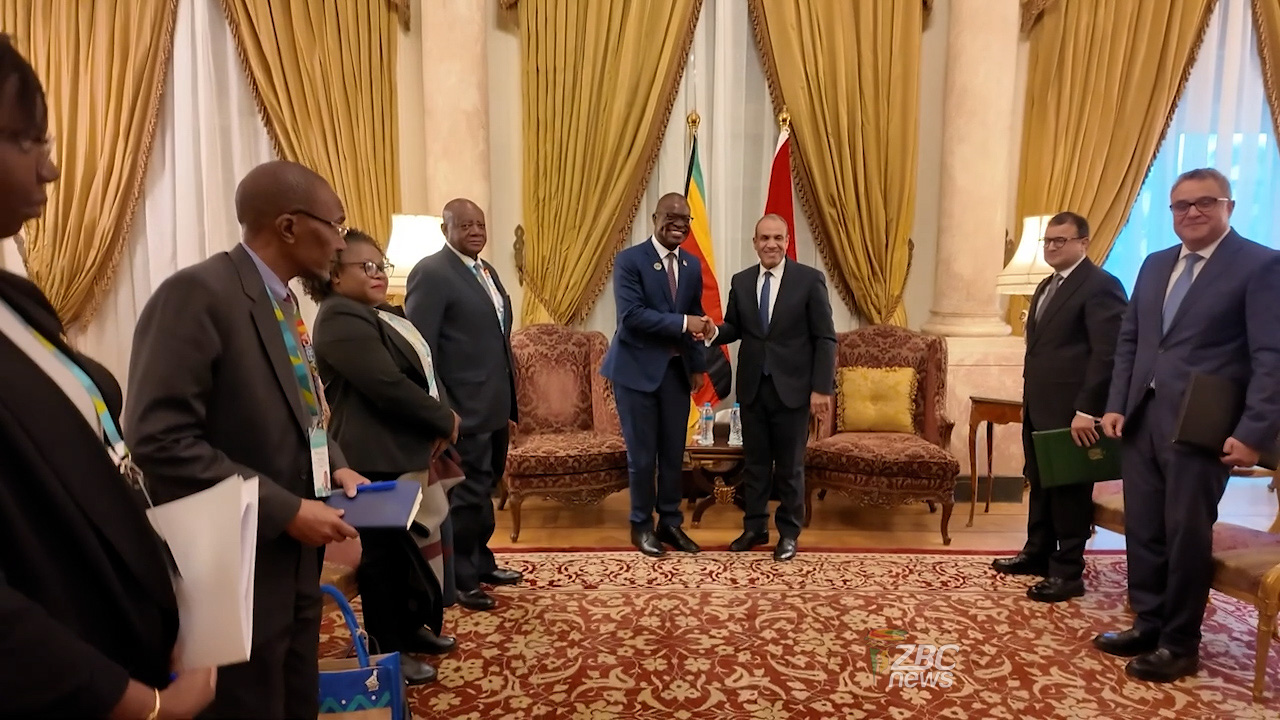
Professor Murwira also held talks with Egypt’s Foreign Minister, Dr Badr Abdelatty.
“We then had a meeting with my colleague, the foreign minister of Egypt, where we were also assessing the state of our cooperation, especially economic cooperation. Our political relations are excellent, but we need to match the political relations with economic partnerships. We talked about the possibility of the Foreign Minister of Egypt coming to Zimbabwe with a business delegation and us in Zimbabwe organizing a Zimbabwe-Egypt business forum. In this forum, we are expecting business to business collaboration as well as business to government collaboration so that we encourage the volume of trade between Zimbabwe and Egypt. So we had a productive meeting. We also talked about our Security Council bid and Egypt promised to support, as usual, Zimbabwe in its bid for the non-permanent seat on the Security Council. So we really had a very good discussion yesterday,” he added.
In a separate high-level meeting, Professor Murwira met Russian Foreign Minister, Sergey Lavrov.
“Zimbabwe is a country that has a lot of subsoil resources, mineral resources and with Russian technology working with Zimbabwe, we are able to do work that benefits both Russia and Zimbabwe. We are cooperating a lot in the area of education, science, technology and innovation, in the area of space, in the area of energy and many other scientific areas. There is huge cooperation between Zimbabwe and the Russian Federation, because the Russian Federation is a country that is more than 1 000 years old
“It is a country that has systems of education that agree with the requirements of Zimbabwe and we are working together in this area to make sure that it benefits Zimbabwe and the Russian Federation through mutual benefit. We work very well together with mutual respect and that makes the relationship very solid. Our relationship with the Russian Federation is our relationship with the Russian Federation.
” It is not influenced by any other people. We touched on our areas of cooperation, areas of trade, and areas of our governmental commission. We last met in 2024 in Moscow. We are now going to meet in 2026 in Harare. So we have been talking about preparing the agenda for our meetings. Discussions also covered Zimbabwe’s bid for a non-permanent seat on the United Nations Security Council, with Algeria’s support described as critical to African solidarity,” he noted.
The discussions focused on cooperation in mining, energy, education, science, technology and space science, as well as preparations for the next Zimbabwe-Russia Intergovernmental Commission, scheduled for Harare in 2026.
The Russia–Africa Partnership Forum is viewed as a critical platform for strengthening Africa’s global influence, supporting industrialisation, value addition and sustainable growth.

