



Story by Tamuka Charakupa
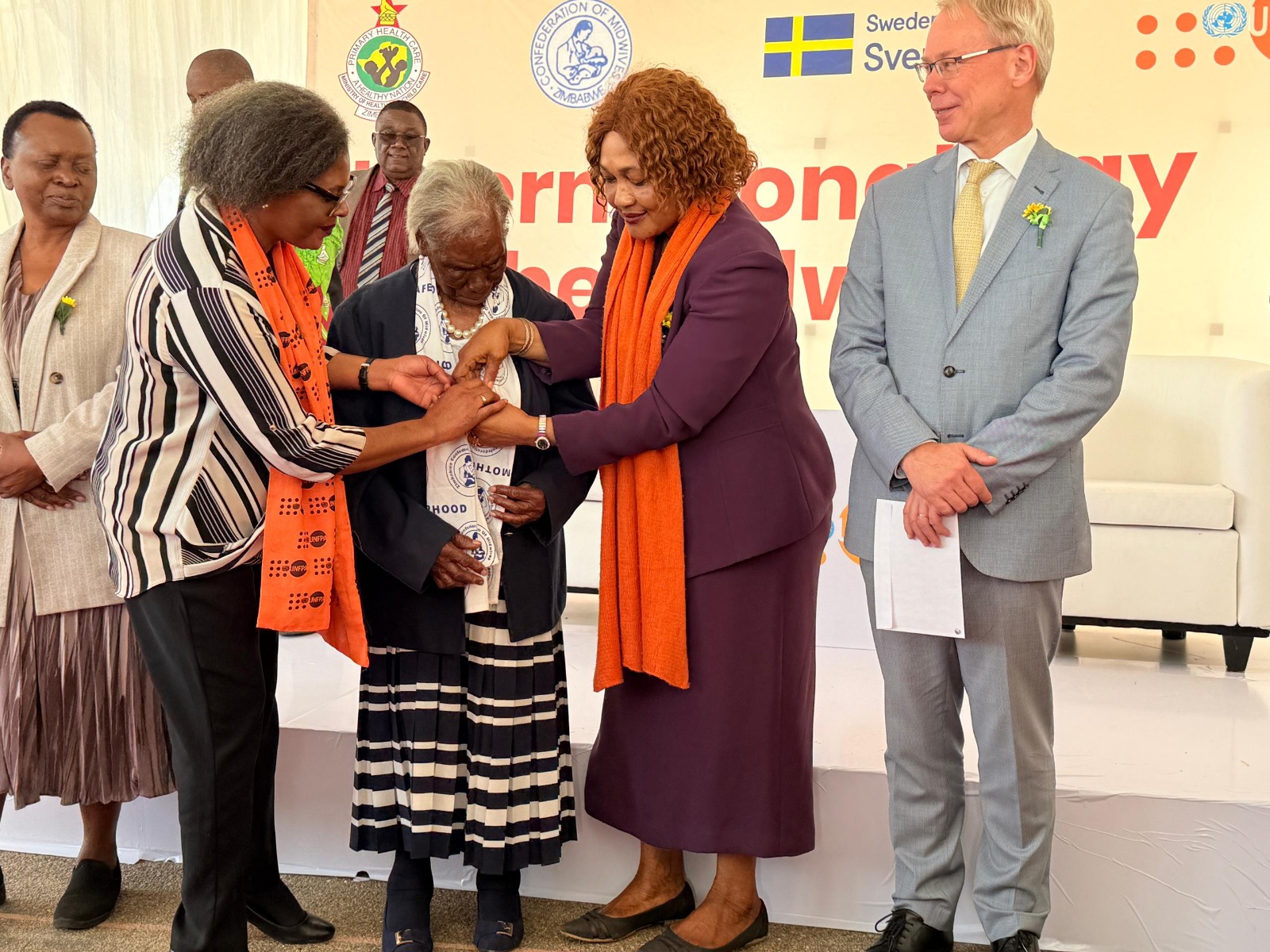
VETERAN midwife Gogo Hagar Mapondera has been recognised with a Lifetime Achievement Award for her outstanding contribution to Zimbabwe’s health sector, spanning over six decades.
The accolade was presented during belated commemorations of the International Day of the Midwife, held on Thursday at Chinhoyi Provincial Hospital.
At 95, Gogo Mapondera’s legacy remains deeply etched in the history of Zimbabwean midwifery. Her name echoes with quiet authority and lasting impact in the country’s health sector as she is celebrated as a pioneer, a mentor, and a symbol of excellence in midwifery.
Having trained in England during the 1950s and 1960s, she returned to Zimbabwe with a Midwifery Tutor’s Diploma and a prestigious silver medal. In 1972, she went on to establish the Harare Midwifery School.
“It all started in 1963 at the then Harare Central Hospital, I was working in maternity, I loved midwifery, so I opted to go into maternity to work there. I had an option of working in theatre, but I said, no, I love midwifery,” she narrated.
“I worked as a community midwife, training student midwives from Harare Hospital. For two years, 64 to 65. Then I left for England to go and do the midwife tutor’s diploma in England. I came back in 1967 and joined my partner in the School of Midwifery, but I was based more in the clinical area. Which I enjoyed very much, and it gave me a very wide spectrum of midwifery in Africa.
“Because I trained in England, the patients are the same, but there are a few differences. So I appreciated that period when I was actually working with the students in the clinical area. Then my colleague resigned and left for South Africa. I took over the training school from 1972 up to 1993, when I left the Ministry of Health to join the World Health Organization country office,” she said.
Beyond the classroom, Gogo Mapondera played a key role in global maternal health. She contributed to the groundbreaking 1972 study on the Partograph, a tool that transformed the management of obstructed labour and saved lives worldwide.
“Some of the challenges we faced were that we had mothers who came to deliver when they had not been attending antenatal care and most of the problems that we had were really preventable if they had attended antenatal care. As a midwife, you have to learn to be patient because not all mothers are going to deliver within 24 hours. You need to have love for your work and especially for the patient.
“I enjoyed midwifery because I enjoyed seeing these women delivering and having their babies and the midwife is the first person to see the baby before the mother and to congratulate the mother. In some few circumstances there were stillbirths, you’ve got to show empathy to the mother who is going through that traumatic situation,” she added.
Deputy Minister of Health and Child Care, Honourable Sleiman Kwidini, who officiated at the event, underscored the importance of midwifery in reducing maternal mortality. He announced a significant policy shift allowing nurses to enter midwifery training directly after nursing school, eliminating the previous two-year waiting period.
“Let me be clear midwives save lives. A substantial body of evidence consistently demonstrates that the involvement of skilled midwives in childbirth significantly improves maternal and neonatal outcomes. In Zimbabwe where we continue to face unacceptably high maternal mortality rates empowering midwives is not a luxury it is a necessity,” he said.
“This is why my Ministry is prioritising investment in midwifery education and training. On June 20, 2024, we proudly launched the e-learning platform for midwifery training. This innovative initiative directly addresses the shortage of qualified teaching staff and ensures that student midwives across the country have equitable access to high-quality instruction, regardless of geographical location. With the click of a button, aspiring midwives can now participate in live online lectures, gaining the knowledge and skills they need to provide excellent care.
“This transformative project is the result of a partnership between the government of Zimbabwe and UNFPA, and I extend my sincere appreciation to all who contributed to its success,” he said.
The Second Republic is on a drive to improve healthcare provision through improving the welfare of health workers, and construction of clinics and hospitals countrywide.

