



Story by Abigirl Tembo, Health Editor
SADC member states have called for increased domestic investment in healthcare and stronger regional cooperation as declining donor funding places growing pressure on essential health programmes across Southern Africa.
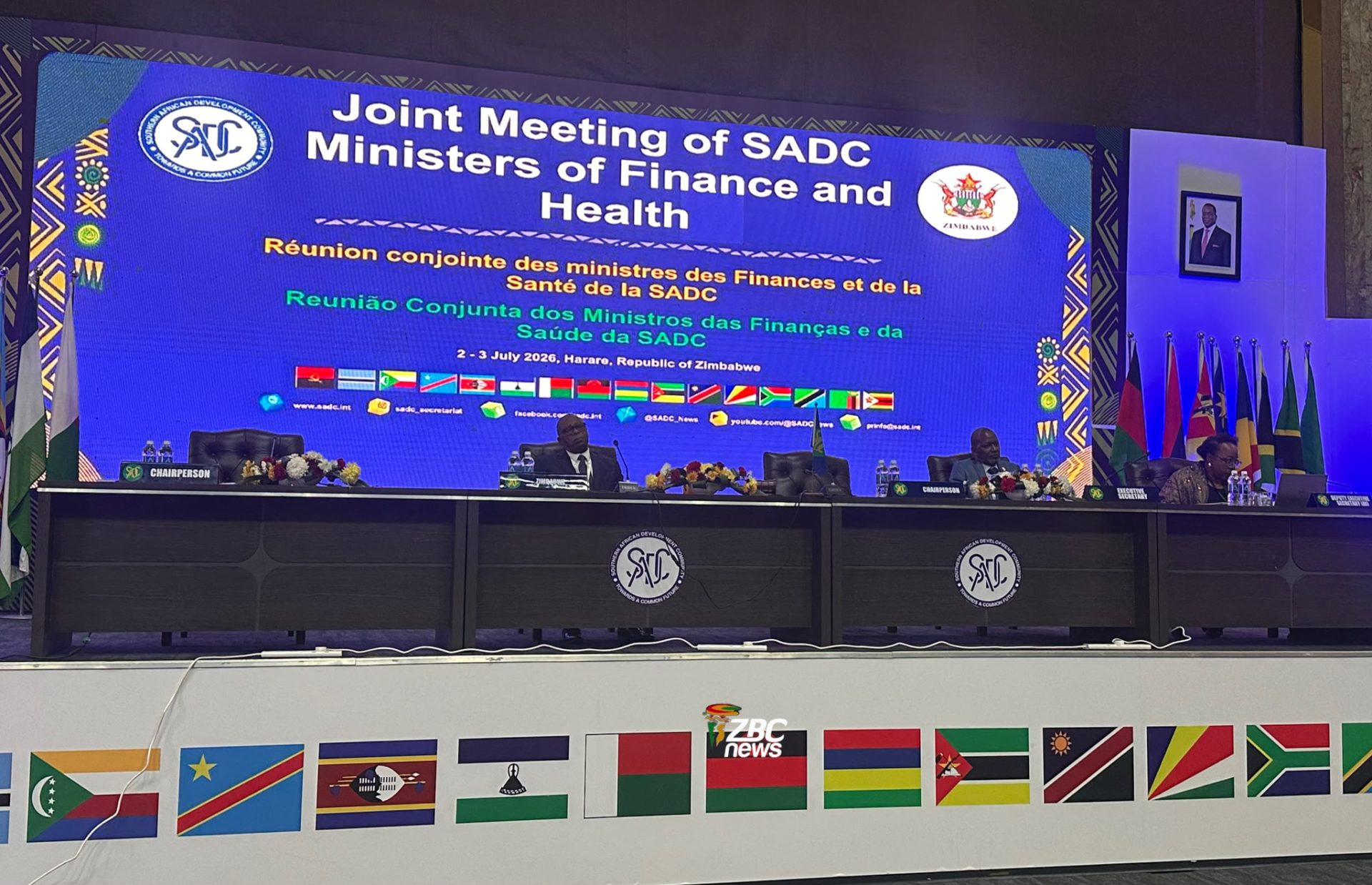
The appeal was made during the inaugural Joint Meeting of SADC Ministers of Health and Finance in Harare, where delegates agreed that sustainable health financing is critical to economic growth, regional stability and public health security.
Chairperson of the Committee of SADC Ministers of Health and HIV and AIDS, Dr Aaron Motsoaledi who is also South Africa’s Minister of Health, said the joint meeting reflected the urgency of addressing the region’s health financing challenges.
“For the first time, ministers responsible for health and finance are meeting together in the same forum, not because protocol requires it, but because the realities confronting our region demand it,” he said.
Dr Motsoaledi urged governments to treat healthcare as a strategic investment rather than a cost, warning that official development assistance for health in Africa had fallen by 70 percent between 2021 and 2025.
He said the decline in external funding has widened financing gaps for HIV and AIDS, tuberculosis, malaria, and maternal and child health programmes, while increasing out-of-pocket healthcare costs for many households.
Among the measures proposed were predictable domestic financing for epidemic preparedness, stronger support for the Africa Centres for Disease Control and Prevention (Africa CDC), expanded pooled procurement of medicines and vaccines, and increased investment in local pharmaceutical manufacturing and regulatory systems.
SADC Executive Secretary Mr Elias Magosi said many member states remain heavily dependent on donor funding for HIV, tuberculosis and malaria programmes, making domestic resource mobilisation increasingly important.
He encouraged governments to explore innovative financing options, including community-based health insurance schemes, health taxes on tobacco, alcohol and sugary drinks, and stronger public financial management systems.
World Health Organisation Africa Regional Director Dr Mohammed Yakub Janabi said the continent already has the technical expertise needed to strengthen health systems, but implementation remains the biggest challenge.
“Success is not determined by knowledge alone; it is determined by implementation. Across Africa we already know what works. We have the evidence, the data and the commitment. Our challenge is implementation,” he said.
The ministers later entered closed-door deliberations to formulate resolutions on sustainable health financing and regional cooperation, with the outcomes expected to shape SADC’s future health financing agenda.

