



Story by Bruce Chahwanda, Political Editor
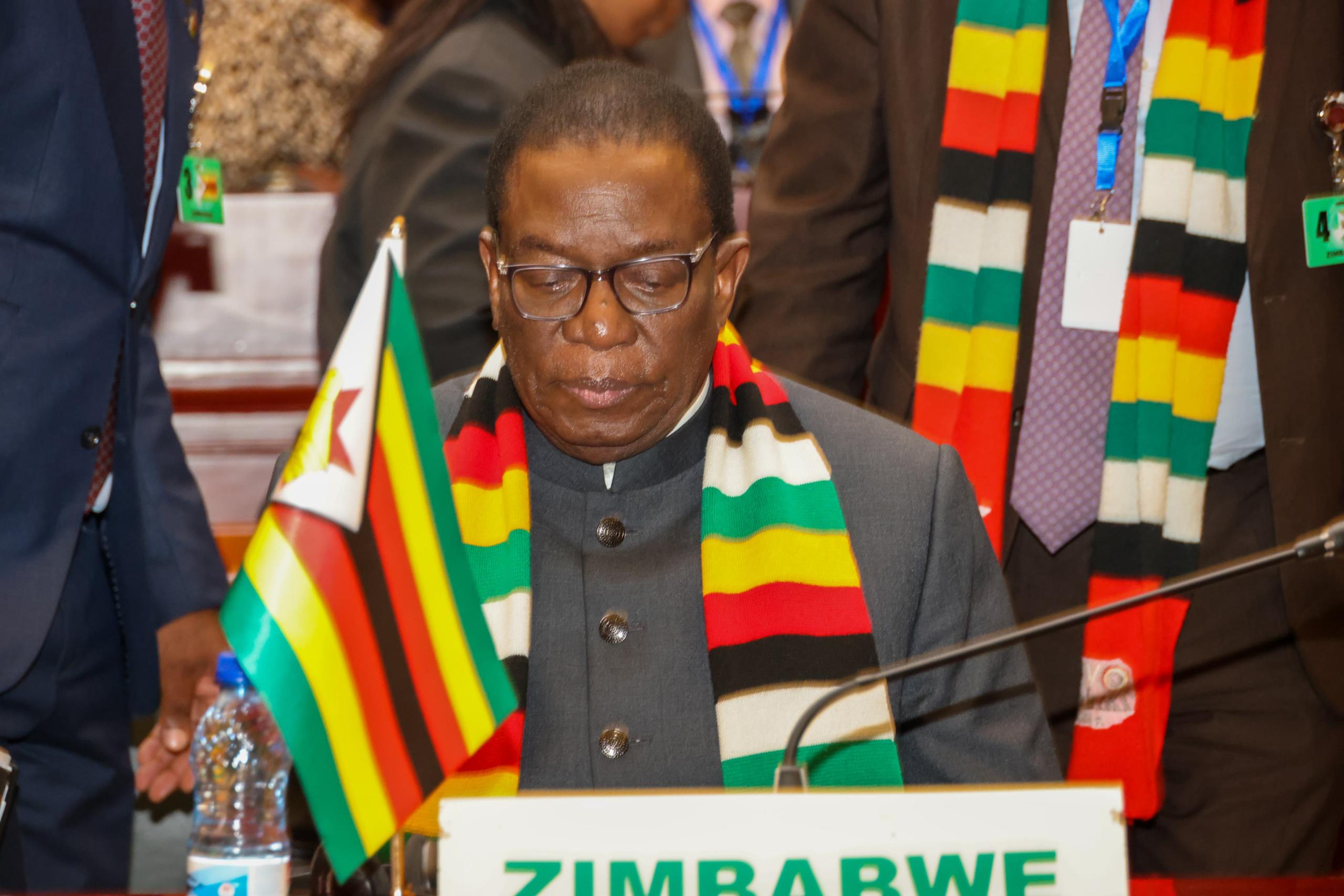
SADC Chairperson, President Emmerson Mnangagwa, has urged African leaders to enact robust solutions to challenges facing the continent.
President Mnangagwa said this while addressing the 7th Mid-Year Coordination Meeting between the African Union, the Regional Economic Communities, and the Regional Mechanisms in Malabo, Equatorial Guinea, this Sunday.
Heads of State and Government and Chairpersons of Regional Economic communities convened at the Sipopo International Conference Centre for the seventh African Union’s Mid-year Coordination Meeting held in Equatorial Guinea this Sunday.
President Emmerson Mnangagwa represented fifteen other heads of state and government of the SADC region at the summit and highlighted a critical position pivotal in aiding the direction of the continent.
Addressing the summit, SADC Chairperson President Mnangagwa said coming up with solutions for the continent’s challenges, there is a need for a unity of purpose.
”The challenges of coordination between the AU, RECs, RMs, and Member States are another critical area, which has contributed towards the slow pace of integration in the African continent. It is recommended that the AU and RECs increase, strengthen, and quicken their coordination efforts. Likewise, a clear division of labour is necessary to avoid duplication.
“As I conclude my remarks, I wish to emphasise that Africa cannot afford to stand still. We must act with urgency, unity, and foresight. Timely responses to these and many other issues must give impetus to our quest to deepen integration, invest in resilience, and build African solutions to African challenges. Africa’s dream of unity, prosperity, and global relevance is not only within reach but imperative for our survival and dignity,” he said.
SADC has made tremendous strides toward promoting the modernisation and industrialisation agenda through the strengthening of value-addition strategies.
”The envisioned establishment of a SADC Parliament, attests to our commitment to deepen inclusive and participatory governance that leaves no one and no place behind. On industrialisation, SADC is intensifying support for the development of value chains across all sectors. Included in this quest is local manufacturing; beneficiation of minerals, pharmaceuticals, agro-processing, and the broadening of regional mining value-chains.
“These are being driven by an education sector anchored on innovation, science, and technology. Our strategy is to produce more within Africa, for Africa, and for the world. The implementation of the SADC Free Trade Area is ongoing. Growth in the intra-SADC trade showed an upward trend to 19.8 percent in 2024 from 18 percent in 2022. With 85 percent of tariffs already eliminated, momentum exists that should see the SADC region surpass our 30 percent intra-regional trade target,” President Mnangagwa noted.
The trading bloc continues to implement innovative strategies as a way of guaranteeing food security.
”SADC is advancing climate-smart agriculture, building water harvesting infrastructure, and implementing regional drought risk strategies. We urge partners to support our call for equitable climate financing, especially for adaptation. SADC also reaffirms the continent’s position on Loss and Damage and calls for operationalisation of related funding commitments made at COP summits.
“Our Southern Region continues to work towards guaranteeing food security and sovereignty through regional seed banks, veterinary services, and pooled procurement of essential medicines. A regional pandemic preparedness plan is also underway to fortify our health systems,” he added.
President Mnangagwa said the SADC region is doubling its efforts towards domestic resource mobilisation to fund its programmes.
”The Southern African bloc remains committed to gender-responsive budgeting, promoting women’s leadership and supporting youth entrepreneurship to combat unemployment and marginalisation. We are doubling efforts to mobilise domestic resources, including through_ better tax administration, curbing illicit financial flows, strengthening public financial management, and leveraging innovative financing mechanisms such as green bonds and diaspora investments,” he said.
In line with the AU 2025 theme, delegates were reminded that Justice for Africans and people of African descent is a historical obligation considering centuries of enslavement, racial discrimination, and systematic inequalities, which requires a holistic approach.

