



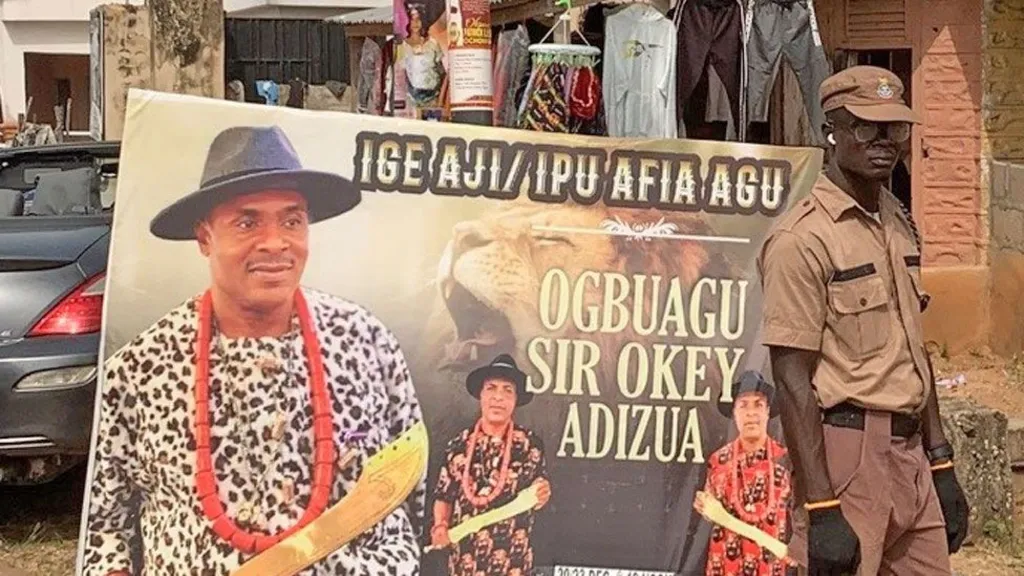
At the age of 60, Nigerian businessman and healthcare professional Ken Okoroafor achieved his childhood dream of obtaining the revered title of “Leopard Slayer”.
Jubilant crowds thronged as he was inducted into the prestigious and male-only Igbuu Society in his hometown of Oguta, in south-eastern Nigeria.
In ancient times, slaying a leopard was not just an act of bravery but a ritualistic feat that conferred societal prestige.
To become a “Leopard Slayer”, known as an “Ogbuagu” in the Igbo language, a man had to present a leopard – hunted and killed by himself – to the local king. Its meat was then shared amongst 25 villages around Oguta.
Over time, the practice evolved, and people no longer needed to hunt the leopard themselves.
Conservation concerns then ended the use of leopards as they became scarce in the region. The last known leopard sacrifice occurred in 1987.
Once widespread across Nigeria, leopards now tend to be only found in a few national parks, where they are protected.
Today, the financial equivalent – a substantial but undisclosed sum – is distributed among the family heads in the 25 villages, maintaining the communal spirit of the tradition.
“In Oguta when you join this society, you get respect and you join them in most of the decision making in the town,” said Mr Okoroafor, who has lived in the US for decades but returned to his roots to become an Ogbuagu.
“That attracted me. It’s something I’ve been hoping to join since I was a little boy.”
The first recorded use of money as a substitute goes back to 1942 when a man named Mberekpe Ojirika caught a leopard for the ceremony, but then his mother passed away.
Tradition stipulated that Ojirika had to mourn for six months and could not continue with the ritual. When he later tried to find another leopard, he failed.
Understanding the difficulty, his relative, the Eze Igwe – the traditional king of Oguta – allowed him to pay four shillings instead of providing a leopard.
“From that time, you now had a choice to use money or a leopard,” said 52-year-old Victor Aniche, the current secretary of the Igbuu Society, and a grandson of Ojirika.
“When I did my own in 2012, someone offered to bring me a live leopard from northern Nigeria. They had one to sell to me. But I couldn’t imagine having an endangered animal killed,” said Mr Aniche, a mechanical engineer and Cambridge University alumnus.
But today, the path to becoming an Ogbuagu is still rigorous, involving three elaborate stages.
Many of those wanting to become an Ogbuagu choose to go through their ceremonies during the festive Christmas season, allowing families and diaspora communities to come together, often drawing large crowds.
(BBC)

