



Story by Justin Mahlahla
AFRICAN governments have been urged to prioritise investment in digital education platforms to equip citizens with modern skills and adapt to rapid technological advancements, a senior Zimbabwean official has said.
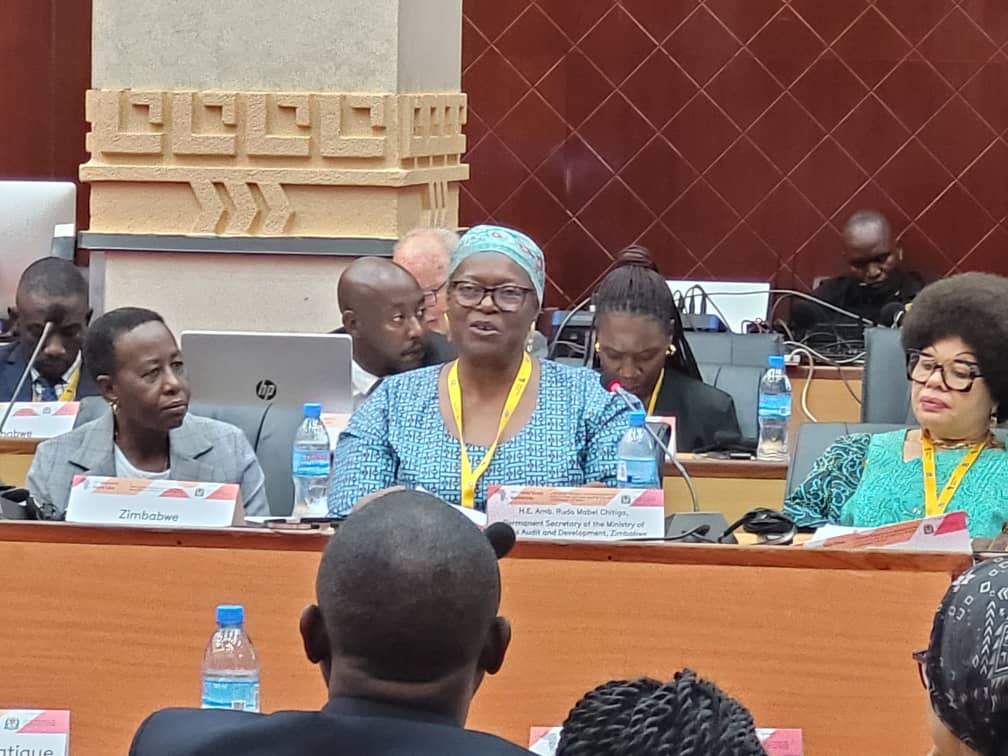
Speaking at the Ministerial Round Table of the 18th eLearning Africa Conference, Permanent Secretary in the Ministry of Skills Audit and Development, Ambassador Rudo Chitiga challenged African leaders to move beyond traditional education models and embrace skills and competency-based, technology-driven learning.
Ambassador Chitiga said the continent should shift its focus from physical infrastructure to digital learning solutions.
“In Africa, there is a pre-occupation, with building schools. Schools featured in all Public Sector Investment Projects (PSIP). There is not enough talk about building learning platforms and digital learning pathways,” she said.
“So, until we move from the buildings to platforms for learning, as long as our mindset and imagination of education is the old education system, Africa will not catch up with digital technology. The old mindset plans a 4-year cycle for curriculum review or the development of a new course. Technological changes are very fast, often occurring within a year. There is, therefore, need for institutions to be agile and to quickly adapt to changes.”
She noted that some governments were facilitating systems to promote institutional flexibility, agility, and adaptability. This allows them to always be one step behind technological changes.
The Permanent Secretary recommended that digital literacy be introduced at an early age in preschool.
“Schools should also have skilled personnel, who can assess as well as test aptitudes and spot talent from that early age. Talented children should be supported with mentoring and scholarships to global centres of excellence in the area of their talent.”
Ambassador Chitiga emphasised that education must extend beyond youth to lifelong learning, particularly for Africa’s vast informal sector, which accounts for 70% of Zimbabwe’s workforce.
“Last week, we had a meeting on jobs of the future and looking at the impact of AI, and one of the people criticised us along with universities and industry, they asked where is the informal sector and we are in a country where 70% of the population is in the informal sector and we have people in the informal sector who do e-commerce, the M-Pesa type, so they are ahead, and until we discover and create platforms and products that cater to the different constituencies in countries in terms of digitalisation, we will continue to remain behind and then we will revert to our comfort level of primary school, higher education and all that.”
She also warned of brain drain, citing Europe’s new “tech visas” luring African talent.
“I think one of the areas that we also need to look at and I am glad there was a proposal is regional cooperation. Just recently, Europe said it is now going to attract tech experts with free visas and free tickets.
“So the capabilities and competencies needed abound, that is why the Europeans have said they are giving tech visas. The Africans are going to leave! Which country is attracting Africans with tech visas and professorships and all that?”
Ambassador Chitiga urged regional cooperation, suggesting that African economic blocs such as SADC and EAC establish centres of excellence in AI, renewable energy and fintech to compete globally.
“We need a hub in Africa for this innovation and to strengthen our tech abilities, maybe not for the whole continent, but using our regional economic communities. We need really to develop strategies of where we can have a hub and we should be able to attract others from all continents.”
To achieve all this, educators must adapt or risk irrelevance, said Ambassador Chitiga.
The biggest challenge, she said, lies with educators and policymakers who resist change.
“We have talked about the issues of data, content, electricity, but now we have renewable energy and some of these excuses are falling off. In my country, for example, we now have new internet service providers. This has widened access to the internet and led to a drop in data charges. It is important to now provide usefull learning and skills development content. Access to data should not be used for entertainment purposes only, but also for functional digital literacy. Education and skills development is the business of government, the private sector, local authorities and citizens.
“This technology is disruptive. Are our institutions open to be disrupted, or they are protecting their perceived spaces, past history and jobs? Agility of institutions will determine the pace at which Africa moves to be a creator of technology rather than a mere consumer. Policymakers should not live in the past.
“When one looked at education in the past the focus was on youth. The 4th industrial revolution requires that we all become learners. Life-long learning will ensure that we adapt, reskill and upskill.”
Ambassador Chitiga stated that policymakers need to provide spaces and opportunities because learning is no longer just for education, but is meant for people to adapt.
She concluded with a stark warning: “This is a challenge for us all, but we need to work together as a region, to benchmark, sit down with each other because if we are going to wait, we are going to continue to be consumers of technology and a consumer of technology has no place at the table.”
The summit, attended by more than 1 500 delegates including education ministers and tech experts from more than 80 countries, highlighted key steps for Africa, such as shifting from brick-and-mortar schools to digital learning ecosystems; integrating informal sector workers into skills development programmes; teaching AI, coding and machine learning from primary education and creating regional tech hubs to retain talent and attract investment.
With global competition intensifying, Africa’s ability to leapfrog outdated systems will determine its place in the Fourth and Fifth Industrial Revolutions.

