



Story by Yolanda Moyo
CAPTAINS of industry have emphasised the need for bankable projects to attract private and international partners, as the country accelerates efforts to implement Vision 2030 and National Development Strategy 2 (NDS2).
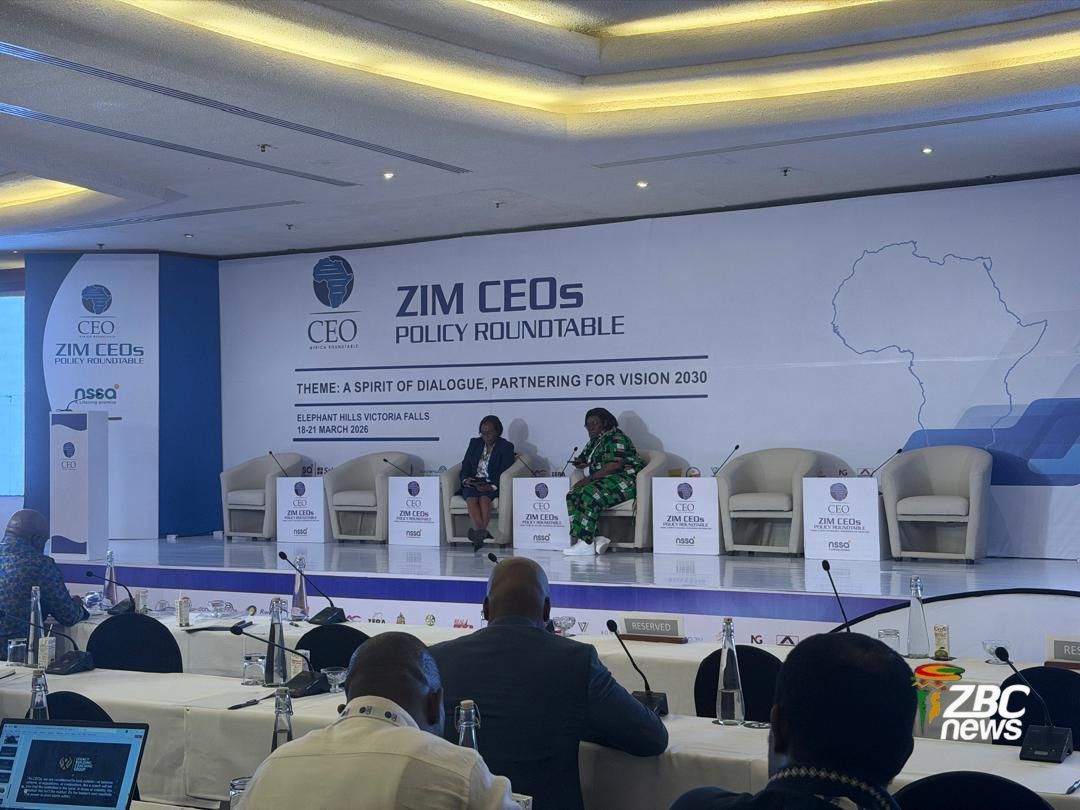
The call emerged during the ongoing Zimbabwe CEO Africa Roundtable, held under the theme “A Spirit of Dialogue: Partnering for Vision 2030”, which has convened government officials, industry leaders, and investors to explore strategies for industrial growth, financing innovation, and economic transformation.
Speaking at the forum, CEO Africa Roundtable Board Chairman, Mr Oswell Binha, highlighted the importance of collaboration between public and private sectors.
“Over the course of this Roundtable, we will engage deeply on several critical pillars of national development. Agriculture and Energy remain the twin engines of national resilience. Infrastructure and Public Health are foundations of economic productivity. Artificial Intelligence and Human Capital will shape the competitiveness of Zimbabwe’s future workforce. As we reflect on the macroeconomic outlook, we must also acknowledge that financing the transformation envisioned under Vision 2030 and NDS2 will require innovative financial structuring.
“Government alone cannot fund this journey. We therefore need bankable projects, mobilisation of pension and institutional capital, and risk-sharing mechanisms that ensure investors and entrepreneurs operate within a predictable policy environment. Vision 2030 will not be achieved by government alone, nor by the private sector operating in isolation. It will be realised in the middle space where a CEO and a Permanent Secretary sit down and ask: “How do we make this project work?” From this Roundtable, we should not merely produce resolutions. We should produce results. Let this gathering give birth to energy investment consortia, industrial partnerships, and policy innovations that unlock development financing,” Mr Binha said.
The consensus at the round table is that the “three evils”, that is, limited capital access, high interest rates, and low savings, should be systematically addressed through stable macroeconomic statistics and a move toward single-digit interest rates.
“The reason why we need to address these three evils is that the informal sector covers about 70 percent from the reports. 70 percent are informal. And then when we’re saying they are informal, we’re saying they are not recorded as those who are contributing to tax. They are not in the books. So once we have them, they have access to capital, lowest interest rates, they are able to grow and then be able to um be recognised, be able to be registered under the tax, and then included in the financial system, where we can then say they are now um contributing to the formal market.
“At the moment, because we cannot track them, we cannot tell that they are accessing funding at a very high cost. They cannot grow bigger. Even though the microfinances have testimonies of whatever they can, but the environment itself is not allowing them to go far. I think there is a need to de-risk the informal sector so that the microfinance can also push in there with the lowest interest rate, which then helps them to grow,” Wisrod Investments Group CEO MrJoseph Tore said.
Economists at the forum commended macroeconomic stabilisation gains while urging policy focus on unlocking affordable long-term financing.
“Coming from a hyperinflationary era to then get to single-digit interest rates is something that anyone and every Zimbabwean should actually be proud of. I think to consolidate now the wins that we have had is to make sure that we can manoeuvre around the global induced imported inflation that we will see as a consequence of the war that’s taking place in the Middle East. So perhaps with hindsight, reducing interest rates, which I personally desired for the productive sector, will probably stave off inflation away and will also stem credit creation. So that’s good. But I am an advocate of a reduction in the margins, that is, the interest rate margins. I am an advocate of credit creation for the productive sector. I am an advocate for competitiveness of our economy,” Dr Nigel Chanakira said.
“We need to get out of that space where Zimbabweans as a nation cannot currently access infrastructure finance for medium to long-term loans so that we can get our basic infrastructure right. That is now for me an imperative. This is what the CEO Roundtable should be discussing and has been the focus heretofore in terms of the discussions.
“We, more than ever, need multilateral funding so that our infrastructure program, as good as it has been, can be accelerated for growth of the economy. We have anything between US$40 billion and US$80 billion needed. Our equity markets and our savings are inadequate; therefore, we need the complement of multilateral and bilateral funding. If we get that, this economy will be pumping. This economy will be exciting. Interest rates will come down, productive sector lending will be expanded, and more jobs will be created.”
Government continues to implement reforms aimed at improving the ease of doing business, including policy consistency, investment protection frameworks, and streamlined regulatory processes.
These measures, coupled with strengthened public-private partnerships and ongoing re-engagement efforts, are expected to unlock critical financing, attract both domestic and international investment, and accelerate Zimbabwe’s trajectory towards sustained economic growth under Vision 2030.

