



Story by Bruce Chahwanda, Political Editor
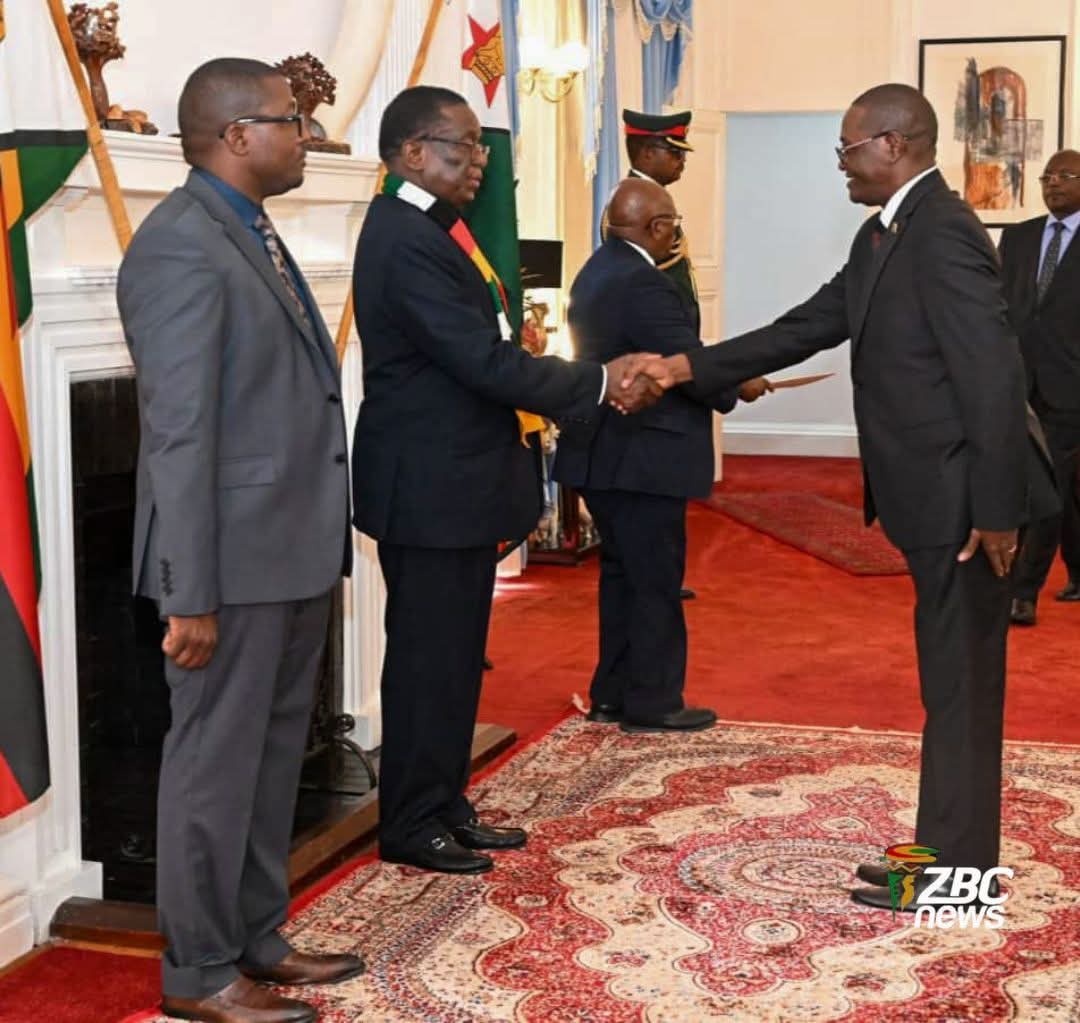
PRESIDENT Emmerson Mnangagwa on Thursday received letters of credence from newly appointed ambassadors of Japan, Italy and Namibia, who pledged to expand investment and deepen bilateral cooperation with Zimbabwe across key sectors of the economy.
Presenting his credentials first was Japan’s Ambassador to Zimbabwe, Ambassador Nobutaka Maekawa, who previously served in Zambia. His appointment marks his second diplomatic posting in Southern Africa.
Speaking after the ceremony, Ambassador Maekawa said his meeting with President Mnangagwa focused on strengthening sectoral cooperation.
“We had a very fruitful exchange on cooperation between Zimbabwe and Japan in various fields. We placed emphasis on sectors such as agriculture, mining and human resource development,” he said.
Italy’s new envoy, Ambassador Giuseppe Giacalone, also presented his letters of credence, outlining plans to consolidate trade and cultural relations between Harare and Rome.
“It is an honour to represent the Italian Government in Zimbabwe, a friendly country with which we share long-standing relations. I assured His Excellency President Mnangagwa that during my mandate, my primary objective will be to consolidate and foster bilateral relations, including within the framework of the European Union.
“I will also endeavour to strengthen economic and commercial ties between Italy and Zimbabwe. The Embassy remains open to companies interested in initiating or expanding relations with Italian enterprises.
“The President assured me of the full support and assistance of the Government of Zimbabwe to the Embassy of Italy. Today’s meeting with President Mnangagwa was both important and productive,” he said.
Namibia’s Ambassador to Zimbabwe, David Asheelo Thomas, was the third diplomat to present credentials, pledging to deepen long-standing ties rooted in shared liberation history.
Ambassador Thomas said relations between the two countries were forged during the armed liberation struggles, with Zimbabwe supporting Namibia’s independence campaign.
“When Zimbabwe attained independence in 1980, the government and people of Zimbabwe continued to support Namibia’s liberation struggle. Zimbabwe also played an instrumental role in laying the foundation of the Namibian nation-state when Namibia gained independence in March 1990. Namibia remains grateful for this selfless and brotherly solidarity,” he said.
He added that his tenure would prioritise cooperation in political, economic, trade and diplomatic spheres, alongside defence, agriculture, higher and tertiary education, vocational training, health, mining and energy, road infrastructure development, tourism, sport, culture and people-to-people exchanges.
“In prioritising economic ties, I will focus on trade and investment promotion so that the full potential between our two countries can be realised,” he said.
Zimbabwe maintains bilateral relations with Japan, Italy and Namibia, with cooperation spanning economic development and social sectors, in line with its “friend to all and enemy to none” foreign policy framework.

