



Story by Tichaona Kurewa
ZIMBABWE is optimistic of passing the third mutual assessment in compliance with international standards on combating money laundering, terrorism financing and related financial crimes due in 2026.
The assessment will be conducted by the Eastern and Southern Africa Anti-Money Laundering Group (ESAAMLG).
Countries throughout the world are periodically assessed on compliance with Anti-Money Laundering and Counter-Financing of Terrorism (AML/CFT) standards, and Zimbabwe’s turn comes in June next year.
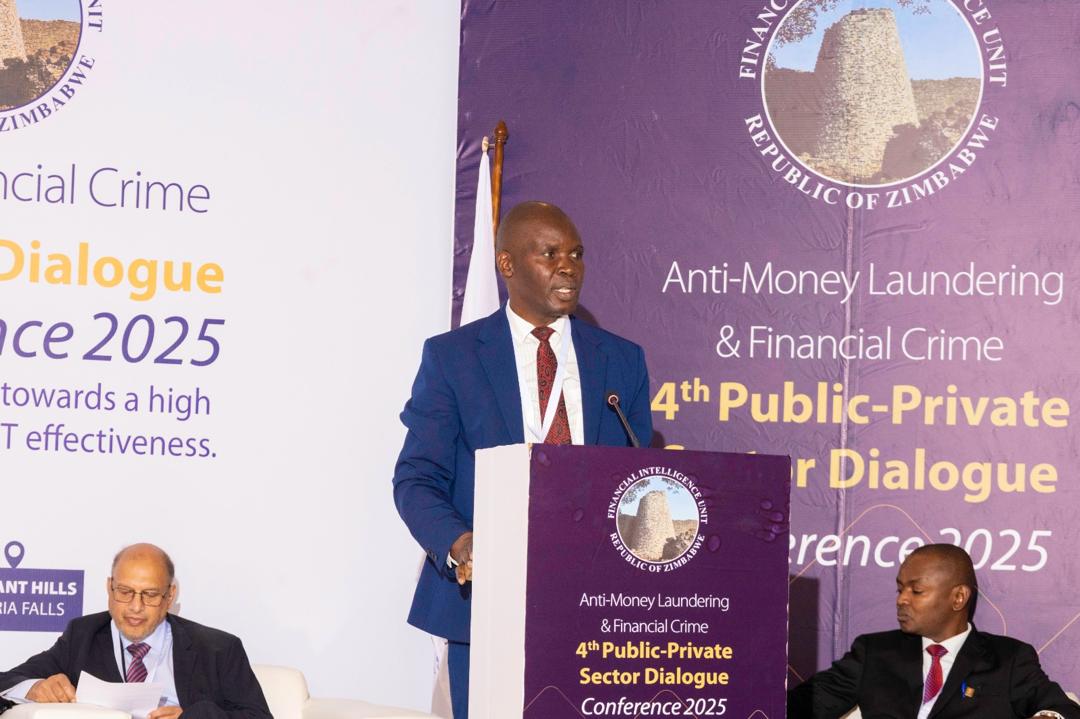
As the clock ticks down, authorities say preparations are well underway, indicating that the Anti Money Laundering and Financial Crime 4th Public-Private Sector Dialogue (PPSD) 2025 currently underway in Victoria Falls, is part of the platforms to raise awareness on the matter among stakeholders.
“Come 2026, the next round of assessments is going to focus less on the institutional and legal framework. It is now going to be a results-based assessment, focusing on a collection of statistics that demonstrate how well we have implemented our laws and frameworks to combat money laundering. We can make quite good scores when we are assessed the next time. We are on the right trajectory; our chances are good if we maintain the momentum,” Director General of Zimbabwe’s Financial Intelligence Unit, Mr Oliver Chiperesa said.
Zimbabwe was removed from the Financial Action Task Force (FATF) ‘Grey List’ in 2022, owing to strong public-private sector collaboration.
If the country fails the 2026 assessment, it will be ‘grey listed’ again and that status can deter international banks from doing business, restrict trade, and isolate the country financially.
Previous assessments were held in 2006 and 2015, focusing heavily on laws and institutional frameworks.
Director General for Zambia’s Financial Intelligence Unit, Mr Clement Kapalu, has expressed confidence in Zimbabwe’s readiness.
“Part of what Zimbabwe should do is already happening. I am seeing a lot of good domestic coordination. This work is not just for the FIU, it is for all the competent authorities in the country.”
The PPSD brings together senior leaders from government agencies, law enforcement, regulatory bodies and the private sector as peers, enabling frank discussions about the evolving landscape of financial crime.

