



Story by Abigirl Tembo, Health Editor
THE Emergency School Feeding Programme has been boosted by a US$15 million cash injection which has been disbursed to the Ministry of Primary and Secondary Education.
Government’s Emergency School Feeding Programme has made significant strides in addressing hunger in the wake of the El Nino-induced drought.
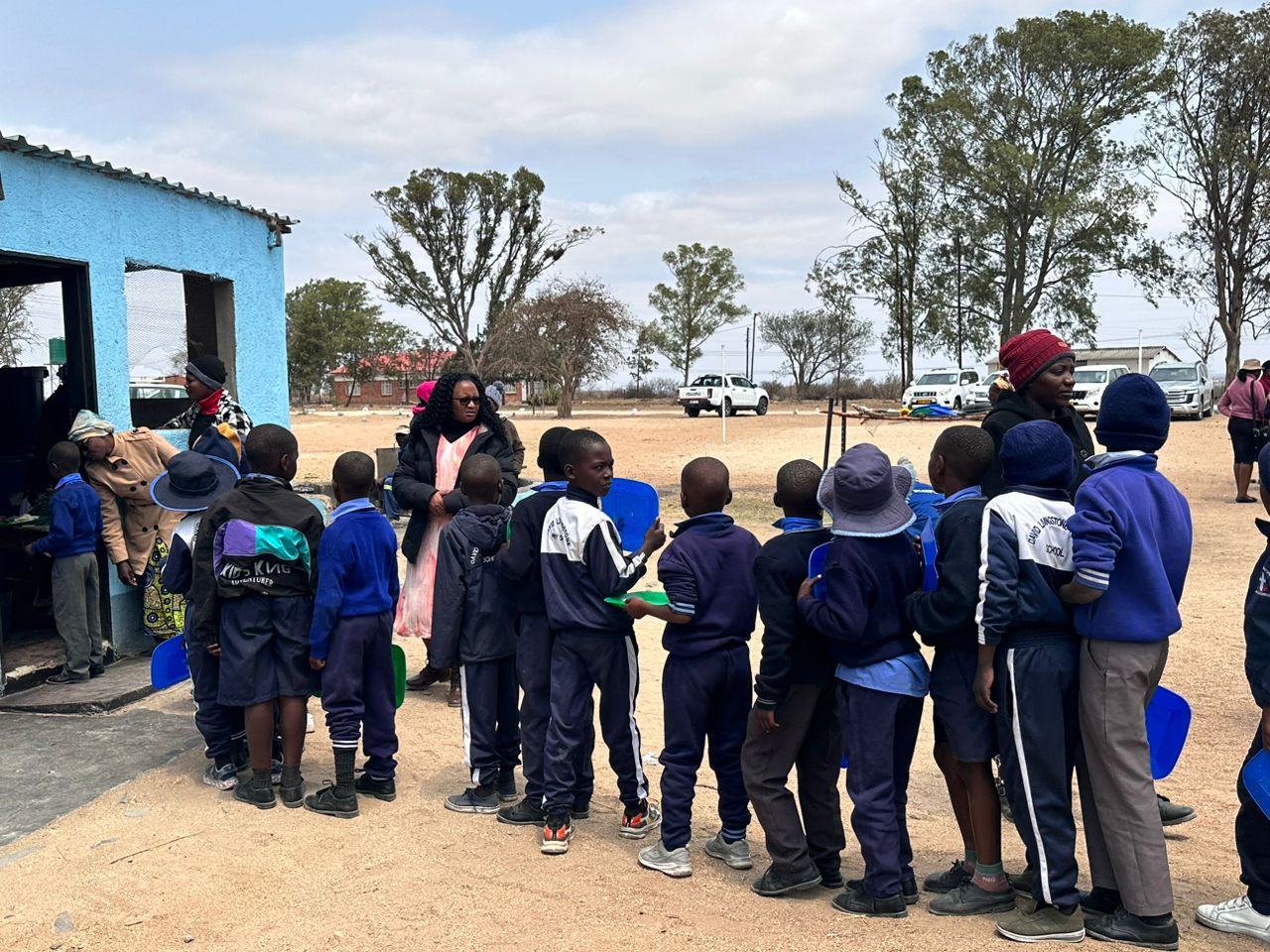
According to the head of David Livingstone Primary School in Umguza district, Mr Nkosinathi Maphosa, the programme has improved enrolment and attendance.
“We have an enrolment of 762 we received 119 bags of grain, relish which is being organised by the school development committees and comprises of vegetables, beans and chunks. We feed them every day, in the morning, we give them porridge then sadza in the afternoon. We started the school feeding programme this year and it has had a positive impact. Those who were absenting themselves because of hunger are coming to school daily. We anticipate that we are going to increase our pass rate. Last year, we had 74%, but because the children are not absenting themselves from school, we hope we are going to hit 80 or plus,” he said.
Matabeleland North provincial nutritionist, Mrs Alleta Moyo acknowledged the impact of the programme at a time when the province is facing a high prevalence of stunting.
She said, “We had an urban assessment and we also had a rural assessment. For the urban assessment, our standing was at 29 percent and for the rural assessment, it was around 27 percent. As the Provincial Food and Nutrition Security Committee, working with all the other nutrition sector members, we are working on programs to try and reduce stunting. We have the school nutrition program that we are currently implementing, and we are focusing on school meals.
“We are focusing on iron-folic acid supplementation within the guidance of our school nutrition guidelines. In terms of ensuring a balanced diet, we are currently receiving maize meal, and maize grain through DSD. We are working with the caregivers to ensure that our children receive a full and balanced diet where we are coming in with the relish, beans, legumes, the animal sauce food so that we ensure that they have a four-star meal on their plate when they have the hot meals at school.”
The Minister of Primary and Secondary Education, Honourable Torerai Moyo highlighted the government’s efforts to provide grain and supplementary nutrition to schools across the country.
“So far, we have observed that in towns all our schools have received mealie-meal. In addition to mealie-meal, the government has also allocated USD$15 million to procure things like matemba, beans, cabbages and so on. But our thrust as a ministry is for the provision of school development units and also for entrepreneurial skills through fundraising. We want our schools to embark on projects. In the rural areas, the majority of our schools have received mealie- meal, but we still have some schools that have not yet received because of logistic challenges but these challenges are being addressed.
“I’m sure that the Ministry of Finance has secured funding to pay transporters to transport mealie meal from the GMBs to rural schools. I’m happy with the amount of food that we are giving to our learners because Zimbabwe is a signatory of the School Meals Coalition, where we committed to providing at least one hot meal a day for every learner. That improves the pass rate and the quality of education because learners will be motivated through school feeding.
“We received $US50 million from the government and we have decentralised that to provinces. So these GSIs are all aware of the existence of those funds which they have used to procure relish to supply to all our schools so that students don’t have difficulties in the emergency school feeding programme,” he said.
As a signatory to the School Meals Coalition, Zimbabwe is committed to ensuring every child has access to nutritious meals in school.
The Emergency School Feeding Programme, a key component of the government’s efforts to combat malnutrition, aligns with this global initiative to fight hunger and stunted growth.

