



Story by Abigirl Tembo, Health Editor
As Zimbabwe recorded its first Mpox cases, one in Mberengwa and another in Harare, concerns about the virus have grown.
But what exactly is Mpox, and how can we protect ourselves?
Endemic in the Democratic Republic of Congo since 1974, the Mpox virus formerly known as monkeypox has been around for almost 54 years.
Over the years, it has mutated and spread to over 120 countries, with more than 100,000 confirmed cases globally including two in Zimbabwe.
Dr Johannes Marisa, a medical doctor and public health analyst, shares valuable insights into the virus.
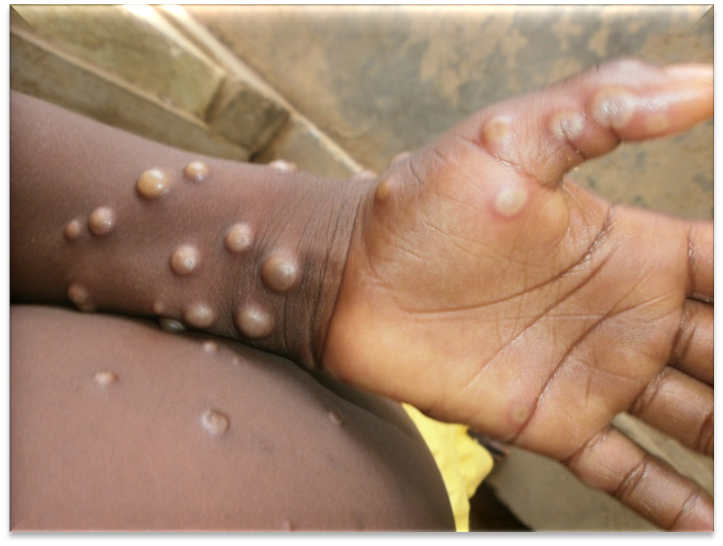
“So as an orthopoxvirus, and as a virus which has been in existence for the past 54 years in humans. There are common symptoms, that it presents and chief among them is the rash, the typical rash, which is deeply seated in the skin and is very painful. It has flu-like symptoms again, almost like what COVID-19 used to do.
“Sore throat can come, can have fever, headache, general body weakness, muscle aches, and lymphadenopathy. When we say lymphadenopathy, we mean lymph nodes that get swollen around the neck and around the axilla. Mpox is transmitted via contact, maybe person-to-person contact. It may be zoonotic, meaning from animal to people.
“The physical contact can come from kissing, touching, and intimacy. It may be through just touching. Skin-to-skin contact is probably when you are travelling in a bus or on a plane, so we have to make sure we observe a patient’s wave especially nodules that are catalysts of pox so if somebody has lesions on the skin and then you come into contact with those lesions be there through scales falling from the lesions through bed linen through direct contact,” he explained.
Just like many viruses, Mpox virus can be prevented.
“The first preventive measure is to make sure that you fight misinformation and disinformation, number one. The second one is that you need to fight ignorance. You have to know, you have to appreciate what Mpox is all about and understand the symptoms. The third measure that I want you to know is that, like other viruses, mpox can also be prevented by hygiene. Hygiene, hygiene, hygiene is very important.
“And fourthly, I want people to know that they have to report suspected cases. Report to medical centres, report to health authorities, report even to police. If you suspect that somebody is hiding this disease, you are allowed, as a public health emergency, to report such cases so that action is taken. We don’t want to contaminate many people under the disguise of ignorance, where they assume that they don’t even know what is happening to their bodies.
“The mpox rash, you know, it is abrupt, very painful. It can be different from the herpes. The herpes is also different from chicken pox. Chickenpox is usually gradual. The mpox is usually abrupt and painful. It can crust and is very painful. So once we have that rash, sudden onset rash coming, unexplained rash coming to your body, accompanied by symptoms, common symptoms like fever, general body weakness, lymphadenopathy, then you should make sure that you isolate yourself so that you don’t transmit to the next person and lastly you have to report to medical units as soon as you feel that you may be having mpox,” he added.
The government has instituted several measures to combat the spread which include the activation of the National and Subnational Incident Management Systems, training of healthcare workers on Integrated Disease Surveillance and Response which is ongoing, and conducting awareness campaigns in the provinces to ensure that the community is well informed on M-pox, enhanced surveillance at all the ports of entry including monitoring of travellers coming into the country, enhanced community-based surveillance systems as well as Identification and establishment of isolation centres throughout the country which is underway.

