



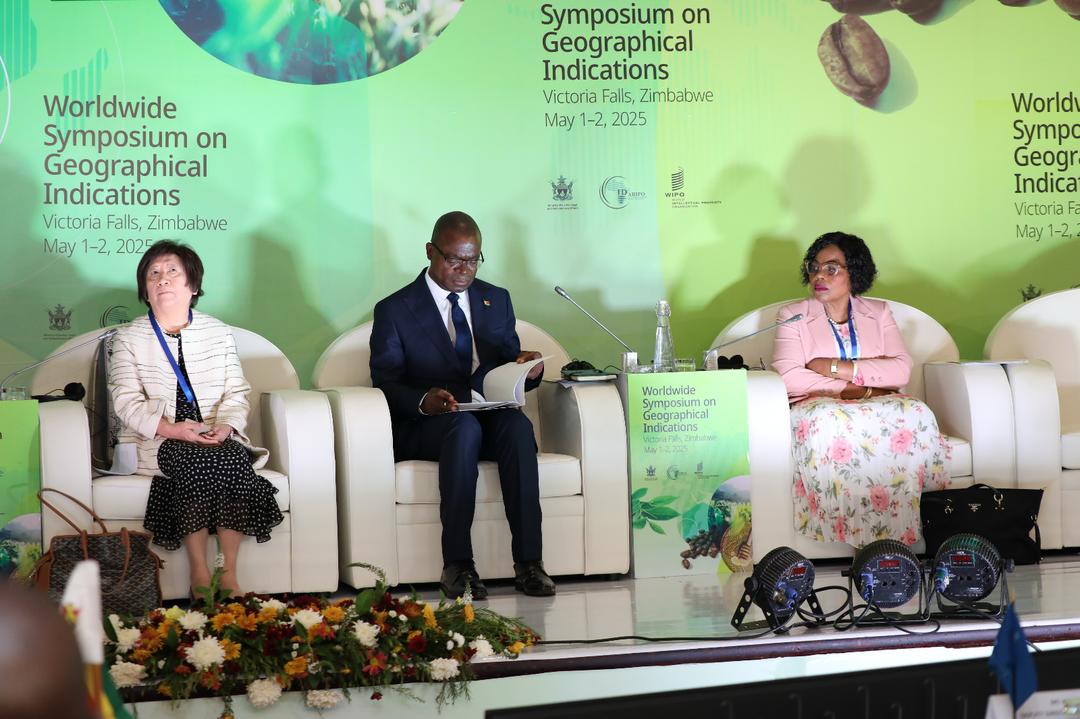
Story by Oleen Ndori
PRESIDENT Emmerson Mnangagwa says geographical indications play a pivotal role in intellectual property protection which is essential in global trade and commerce.
Zimbabwe is hosting the Worldwide Symposium on geographical indications with a view to bringing to the table ideas on how the world can come together in the drive towards sustainable development.
In a speech read on his behalf by the Minister of Foreign Affairs and International Trade, Professor Amon Murwira, President Mnangagwa said the symposium comes at a time when the world must re-think development models in the face of mounting challenges.
“This symposium takes place at a critical juncture in the evolution of the global economy. Indeed, this is a time when nations must rethink and recalibrate their development models in the face of mounting challenges, such as climate change, economic inequality, food insecurity, pandemics, and rapid technological advancements. Within this context, the potential of Geographical Indications as powerful instruments for sustainable development, cultural preservation, and trade competitiveness cannot be overemphasised.
“The concept of Geographical Indications is not merely a legal or commercial matter; it is also profoundly human. It is rooted in the intricate relationships between people, land, tradition, and knowledge systems, embodying the story of a product, its authenticity, and its cultural soul. In this regard, Geographical Indications provide a system of intellectual property protection that links quality and reputation to geographical origin.
“Whether it be cheese from Roquefort, coffee from Colombia, or wine from Napa Valley, Geographical Indications distinguish products by their unique local characteristics, including soil composition, climate, and traditional expertise, passed on from one generation to another. In doing so, Geographical Indications enhance value, promote local development, and safeguard cultural identity.
“In many ways, Geographical Indications are the interface between heritage and modern commerce. They empower rural communities by granting them agency over their resources, while allowing nations to unlock the commercial potential of their cultural assets. Further, they create conditions for inclusive and sustainable economic growth,” he said.
He added that for Zimbabwe, SADC and Africa, Geographical Indications are strategic tools for economic integration and transformation.
“For Zimbabwe, SADC and Africa as a whole, our rich tapestry of agro-ecological zones, indigenous knowledge systems, and distinctive traditional food and craft products, provides the requisite impetus for us to leverage Geographical Indications (GIs) as strategic tools for economic transformation and integration.
“Zimbabwe’s journey in the Geographical Indications space is still in its early stages, but it is gaining significant momentum. This symposium marks a historic milestone, providing us not only the opportunity to host the first-ever Worldwide Geographical Indications Symposium but also to register our first Geographical Indication.
“This is being accomplished through the partnership between the Zimbabwe Intellectual Property Office, the Centre for International Agricultural Research and Development and Bio-Hub Trust, under what we have termed the Zimbabwe-Geographical Indications Project.
“The Zimbabwe-Geographical Indications project is emblematic of what we seek to achieve: a bold, forward-looking, yet heritage-anchored approach to sustainable socio-economic development that leaves no one and no place behind. This project is supporting the identification, promotion, and protection of origin-linked products, beginning with Honey from Nyanga, in Manicaland Province.
“It is pleasing that our local producers, in collaboration with French counterparts, are engaged in robust capacity-building, skills exchange, and knowledge transfer initiatives. This ensures that our local products meet international standards, while maintaining local identity and quality,” he said.
The Head of State further said as the world grapple’s changing macro-economic and environmental catastrophes, the role of the World Intellectual Property Organisation cannot be over-emphasised.
“The success of any Geographical Indications regime depends not only on domestic effort but also on regional and international cooperation. The cross-cutting nature of Geographical Indications, encompassing trade, environment, heritage, agriculture, and law, demands multi-stakeholder engagement. In this regard, I applaud the continued leadership of WIPO and ARIPO in providing technical assistance, capacity development, and policy guidance to Member States.
“I also recognise the growing role of South-South cooperation and partnerships, which demonstrate the value of mutual learning, solidarity, and co-creation. At the continental level, I call upon the African Union and its organs to fast-track the implementation of the African Continental Free Trade Area Protocol on Intellectual Property Rights. We must harmonise our legal instruments, promote intra-African trade in origin-linked products, and establish a continental brand that embodies quality, heritage, and sustainability.
“As the world grapples with the effects of climate change, Geographical Indications offer a sustainable model of production that is rooted in local ecosystems, heritage and traditional knowledge. The concept incentivises the conservation of natural resources and the preservation of agro-biodiversity, as well as helps communities to build climate resilience and adaptation,” he said.
President Mnangagwa also revealed that Zimbabwe is undertaking a review of the National Intellectual Property Legislative Framework, with a view to aligning the country’s Geographical Indications laws to the requirements of the World Trade Organisation’s Agreement on Trade-Related Aspects of Intellectual Property Rights, the Geneva Act of the Lisbon Agreement, and the African Continental Free Trade Area Protocol on Intellectual Property Rights.

