



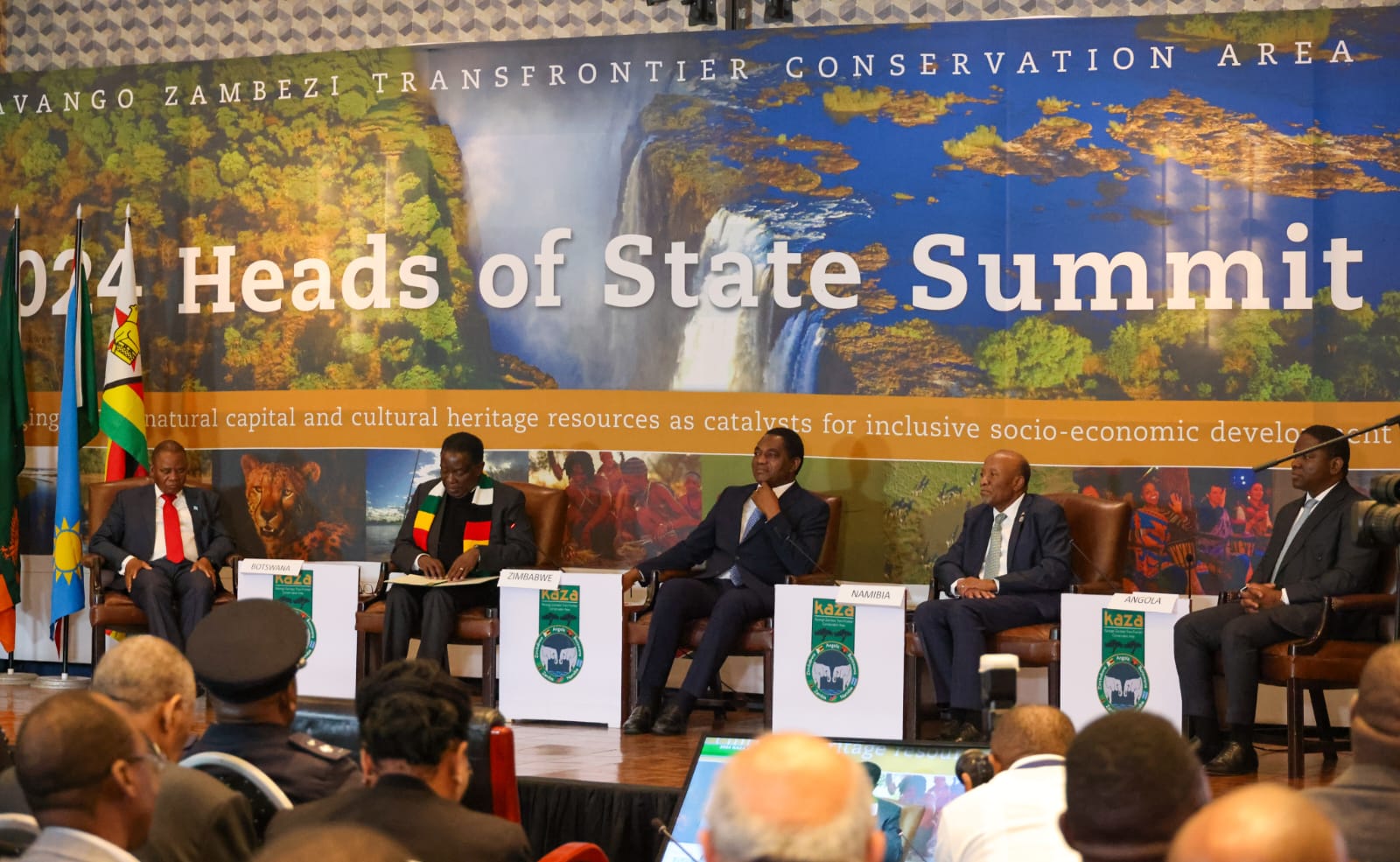
Story by Josephine Mugiyo
PRESIDENT Emmerson Mnangagwa says the region should take a holistic approach in its wildlife conservation policy.
He was speaking at the Kavango Zambezi Transfrontier Conservation Area (KAZA TFCA) Heads of State Summit in Livingstone, Zambia this Friday.
Brought together by a common cause, the five countries which make up the Kavango and Zambezi basin formed the KAZA Transfrontier Conservation Area to manage their common natural resources.
Leaders from Angola, Botswana, Namibia, Zambia and Zimbabwe met stakeholders in conservation and the elephant in the room was the ballooning elephant herd which has resulted in increased human wildlife conflict.
Botswana has the largest herd among the five countries, with Zimbabwe second having close to 100 000 elephants.
The ballooning elephant population is a direct result of CITES, a multilateral treaty to protect endangered plants and animals which has banned ivory trade.
This has become a restrictive measure on KAZA member states who cannot sell their ivory which continues to accumulate at a time when they are also prohibited from culling the elephants.
President Mnangagwa said despite the region’s proud history of conservation, it is regrettable and disheartening to note that those opposing the region’s conservation philosophy have failed to manage their own resources.
“We must be holistic in the strategies we proffer to address challenges on the conservation of our elephants, given the bulging populations and ever-increasing incidences of human wildlife conflict. The principle of sustainable utilisation has been effectively used in our region through the issuance of hunting and management offtakes to reduce our elephant herd, it is disheartening , most unfortunate and unacceptable that those who are opposing our conservation philosophy have themselves failed to manage their own. I heard they said we must not cull our elephants at some conference, I am sure we can donate to them 40 000 herds of the elephants,” he said.
The Head of State noted the need for the region to speak with one voice at the CITES 20th Conference of Parties (COP 20) in 2025 to defend its wildlife conservation policies.
He added, “We should never allow those with dubious agendas to dictate the way we manage and utilise our own God-given resources, in this context we need to speak with one voice in defending our conservation policies, our people and our sovereignty,”
President Mnangagwa also highlighted the importance of addressing other challenges surrounding conservation in the region, including climate change.
“Our response to the resulting disruptions to the eco systems coupled with negative impact of wildlife, agriculture and water resources must be met with robust and pro-active interventions to build greater resilience,” said the President.
Host President, Dr Hakainde Hichilema echoed President Mnangagwa’s sentiments on the need to work as a unit in conservation issues and improving livelihoods in conservation areas.
“We must focus on complementing each other’s efforts. We are one,” said President Hichilema.
In the same vein, Namibian President, Dr Nangolo Mbumba noted the need for community-based conservation.
The region has made a clarion call for the lifting of the CITES ban on ivory trade amid growing consensus to speak with one voice against the restrictive measure.

