



Story by Yolanda Moyo
THE 2025/2026 summer cropping season in Matabeleland North Province is progressing positively, with farmers on course to meet key production targets following widespread adoption of the Pfumvudza/Intwasa conservation farming programme.
Provincial agricultural officials say improved farmer participation, timely land preparation and continued government support have strengthened prospects for household and provincial food security, particularly among smallholder farmers.
In Hwange District, farmers say lessons from previous seasons and the use of climate-smart techniques are already yielding visible results.
Mr Sibangilizwe Nyathi, a farmer from the Mawuse area, said conservation farming methods had helped preserve soil moisture and improve crop performance despite erratic rainfall patterns.
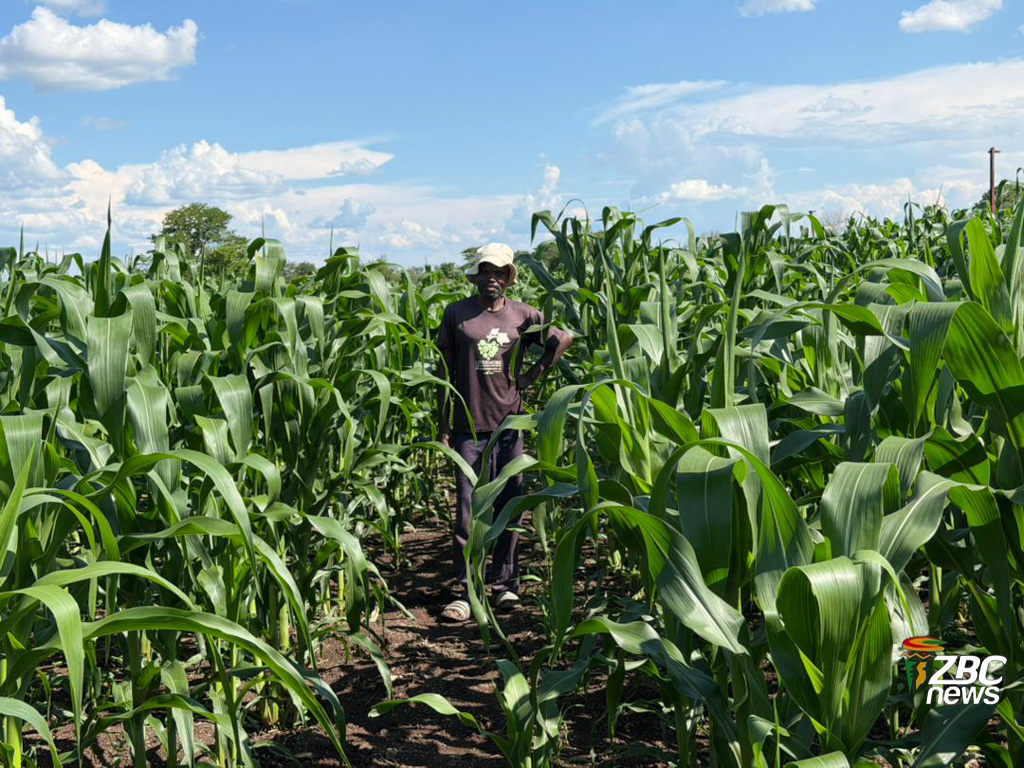
“With Intwasa, we prepare planting basins early, apply manure, and mulch to retain moisture. We plant on time and space our crops properly. Even when the rain delays, the moisture is preserved. We are also rotating crops like maize, sorghum and groundnuts, which improves soil fertility and ensures food throughout the year. As you can see, we are expecting a bumper harvest from this, this conservation technique is helping us increase household food security,” Mr Nyathi said.
Farmers across the province said timely access to inputs, including seed and fertiliser, had enabled early planting and adherence to recommended agronomic practices.
“We received our inputs on time from the government, including seed and fertiliser. That made it possible for us to plant early and follow the correct agronomic practices,” one farmer said.
“The continued support from the government has encouraged us to expand our fields and take farming seriously as a business. “With this support, we are confident that our families will have enough food, and even surplus to sell,” another added.
However, farmers in parts of Hwange raised concern over emerging insect infestations, saying prompt distribution of insecticides would be critical to protect crops.
Matabeleland North ARDA’s Acting Provincial Director, Mr Mkhunjulelwa Ndlovu, said provincial planting figures showed encouraging progress across both conventional and conservation farming systems.
”Provincial figures reflect this activity on the ground. Under conventional farming, Matabeleland North set a maize target of 110 000 hectares and has already planted 109 490 hectares. Sorghum has surpassed expectations, with a target of 31 340 hectares but an impressive 56 838 hectares planted, a clear indicator of farmers embracing small-grain production suited to the province’s climatic conditions.”
He said the surge in small-grain production reflected growing farmer confidence in crops suited to the province’s semi-arid climatic conditions.
“These plots are planted to maize, sorghum, groundnuts, millets, cowpeas and sunflowers. This crop diversity ensures nutrition at the household level while also strengthening resilience against climate shocks,” he said.
Authorities say the continued expansion of Pfumvudza/Intwasa and irrigation development remains central to the province’s strategy to boost food security and climate resilience.

