



Story by Abigirl Tembo
THE coughs echo through the wards long before dawn breaks over Kwekwe General Hospital.
Dry. Relentless. Exhausting.
For many lying in the hospital’s respiratory ward, each breath has become labour, drawn slowly, painfully, as though the lungs themselves are resisting life.
These are men who once descended deep underground in search of gold. Men who blasted rock faces in suffocating shafts where dust hung thick in the air like smoke. Today, long after the dynamite fell silent, the mines are still claiming them.
Only now, the enemy is invisible.
Silicosis, an incurable lung disease caused by inhaling fine silica dust is tightening its grip on Kwekwe’s mining communities, leaving former miners and artisanal workers trapped in a slow and devastating battle for breath.
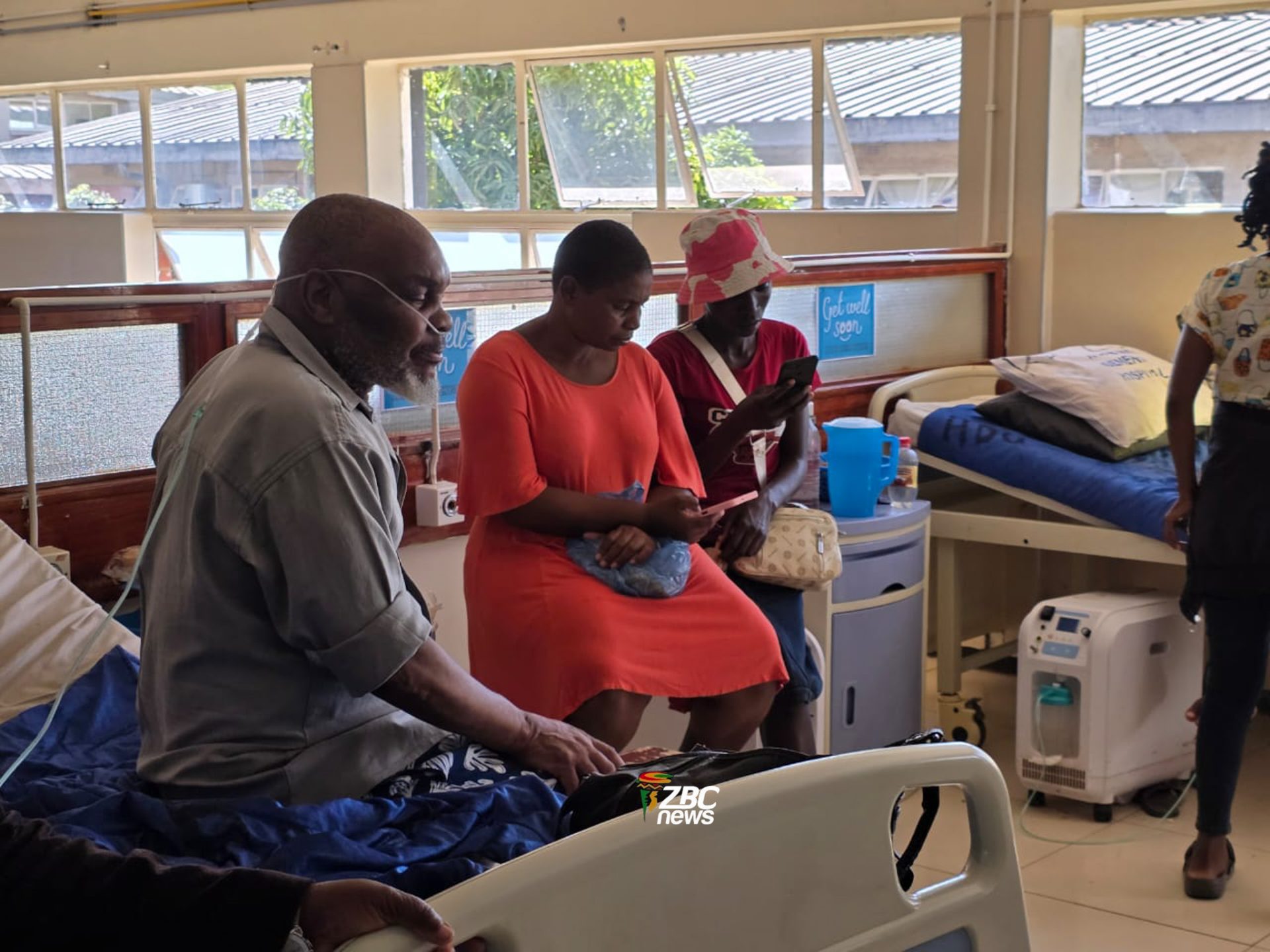
Inside the wards at Kwekwe General Hospital, oxygen concentrators hum beside steel-framed beds while patients struggle through coughing fits, chest pains and crushing exhaustion. Some stare blankly at the ceiling. Others sit upright through the night because lying down makes breathing impossible.
For 67-year-old former miner Mr Raphael Kambalami, the disease arrived decades after he left the mines.
His voice is faint, interrupted by pauses for breath.
“I came to the hospital because I had been experiencing breathing difficulties for a long time. One day, I fell as I was trying to stand up after experiencing shortness of breath,” he said.
Mr Kambalami spent years working as a blaster at Peacock Mine and Shangani Mine before retiring in 2002. At the time, he thought he had left the dangers underground behind him.
Instead, the dust remained lodged deep inside his lungs.
“When I went for an X-ray, they discovered that I had an accumulation of fine dust in my lungs from the time I worked in the mines. They said it was silicone,” he said.
The diagnosis came last September.
For others, the disease is striking while they are still trying to earn a living underground.
Tafara Takawira, a small-scale miner who once worked at Globe and Phoenix Mine, says what began as a persistent cough was first mistaken for tuberculosis.
“In 2022, I was diagnosed with TB, but the cough did not go away. Later on, I was diagnosed with silicosis. I was told I have a lot of dust in my lungs, so I struggle to breathe every time,” he said.
The confusion is common. Silicosis often mimics tuberculosis, pneumonia and other respiratory illnesses, delaying treatment while lungs continue to scar irreversibly.
By the time many patients arrive at hospital, the disease has already tightened its hold.
Mr Shelton Nyanhewe remembers watching his body waste away without understanding why.
“I just started experiencing a persistent cough and losing weight. I went from 95 kilogrammes to 50 kilogrammes,” he said.
“At some point, I could no longer walk even a short distance before getting out of breath and feeling weak.”
Now reliant on an oxygen concentrator to breathe, he speaks softly about the reality of living with a disease that has no cure.
Doctors at Kwekwe General Hospital say the scale of the crisis is alarming.
“This is a very serious condition that we should at all times try to prevent,” said the hospital’s Medical Superintendent, Dr Tinashe Gunda.
“As you know, this is a mining town. We have a significant portion of our population working in the mines, primarily as small-scale miners, and these are prone to silicosis.”
The numbers paint a grim picture.
“In 2025, we had 88 patients with silicosis. Of the 88, we had 42 deaths in just one year,” Dr Gunda said.
“So far this year, we have admitted about 40 new patients. Depending on the time of the year, we are having an average of 10 patients with silicosis in the hospital at any given time. We are also recording about one death a week.”
The burden stretches beyond the patients themselves.
Silicosis patients often require continuous oxygen support, specialised monitoring and repeated admissions, placing immense pressure on hospital resources.
“It is a burden for us as an institution as well,” Dr Gunda said. “These are patients who rely solely on oxygen, and oxygen is very expensive.”
Yet amid the grim statistics and fading breaths, there are signs of resilience.
The hospital recently received a 140-kVA solar power system through a partnership involving the Government, the Global Fund and the United Nations Development Programme (UNDP). The installation is helping maintain uninterrupted electricity supplies for critical departments and life-saving equipment, including oxygen support systems and diagnostic services.
For patients whose survival depends on machines that must never fall silent, reliable power has become as essential as medicine itself.
Health experts say the tragedy unfolding in Kwekwe also exposes the dangers facing thousands of miners across Zimbabwe, particularly in small-scale and artisanal operations where protective equipment and dust-control systems are often inadequate or entirely absent.
Silicosis is progressive, irreversible and potentially fatal. Once silica dust settles inside the lungs, it triggers inflammation and permanent scarring that slowly suffocates the body from within.
The disease is preventable.
Proper ventilation systems, protective respiratory equipment, dust suppression technologies and stronger occupational safety enforcement can dramatically reduce exposure.
But for many miners, survival today often outweighs fears about tomorrow.
And so they continue descending underground.
Into tunnels thick with dust.
Into darkness.
Into the slow, invisible storm settling inside their lungs.

