



Story by Mercy Bofu-Matinha
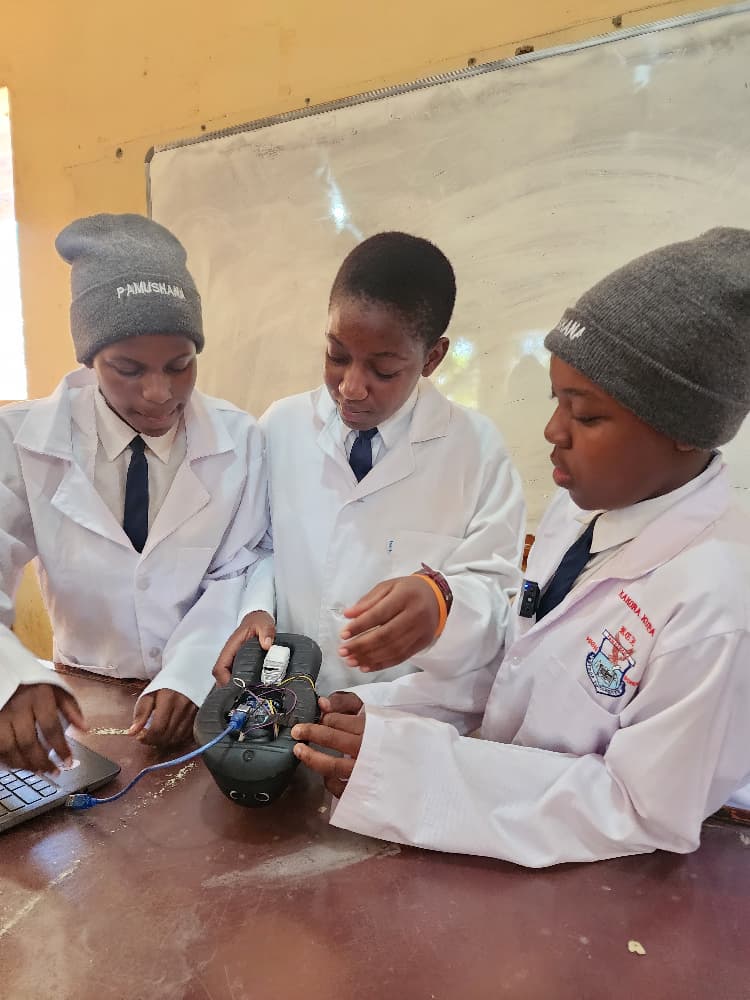
THE Heritage-Based Curriculum continues to inspire practical solutions to everyday challenges, with Form Two students at Pamushana High School in Masvingo developing a smart navigation shoe designed to improve mobility for visually impaired people.
The innovation is among several student-led projects being developed at the school’s laboratory, which has become a hub of creativity and problem-solving. Other projects include the MediTrans Sentinel, Rain Detector and Clothes Collector System, and the Smart Road Safety Checkpoint System.
The smart navigation shoe was conceived by three Form Two students who identified the challenges faced by visually impaired people when moving through unfamiliar environments.
Designed to promote safe and independent movement, the device uses obstacle-detection technology linked to an alert system that warns users of objects in their path.
“The shoe is designed to help visually impaired people move around more safely and independently. Many visually impaired individuals face challenges when navigating unfamiliar environments and may require assistance from others. Our innovation helps them detect obstacles before coming into contact with them, reducing the risk of accidents and giving them greater confidence while walking,” said one of the students, Rumbidzaiishe Dhuwu.
The device combines an Arduino Uno microcontroller, an ultrasonic sensor, a buzzer and a battery-powered system to enhance safety and mobility.
Explaining how the technology works, student Pretty Chuma said the system detects obstacles and immediately alerts the wearer.
“This smart navigation shoe is made up of several key components which work together to assist visually impaired people. We used an ultrasonic sensor to detect obstacles that may be in front of the user, an Arduino Uno, which acts as the brain of the system by processing information from the sensor, a buzzer that produces an alert sound whenever an obstacle is detected, and a battery that powers the entire device. When the sensor detects an object within a certain distance, it sends a signal to the Arduino Uno, which then activates the buzzer to warn the user.”
The young innovators believe the prototype has the potential to evolve into a more sophisticated assistive device with additional support and partnerships.
“This is just a model, but we believe the project can be improved further through collaboration with experts and industry partners. We would like to incorporate more advanced features such as vibration alerts, GPS tracking, and longer-lasting power sources. With adequate support, this innovation can be developed into a product that can benefit many visually impaired people across the country and beyond,” said Tanaka Mutiti.
The students have received guidance from their teacher, Mrs Shupikai Chitsa, who said the project demonstrates the practical value of Zimbabwe’s Heritage-Based Education 5.0 model.
“This project demonstrates the practical impact of the Heritage-Based Education 5.0 model, which encourages learners to identify challenges within their communities and develop solutions through innovation. We are seeking partnerships with industry, research institutions, and other stakeholders to refine this product and facilitate its commercialisation,” she said.
The project highlights how Heritage-Based Education 5.0 is nurturing innovation, practical learning and problem-solving among young Zimbabweans, enabling learners to develop solutions that address real community needs.

