



Story by Stanley James, Business Editor
Economic cooperation continues to anchor the longstanding relationship between Zimbabwe and China, with bilateral trade volumes recording sustained growth amid deepening engagement between Harare and Beijing.
Zimbabwean delegates drawn from various Government institutions have been briefed on the expanding economic partnership between the two countries, which has gathered momentum under the Second Republic led by President Emmerson Mnangagwa.
Addressing delegates in Beijing, retired diplomat Professor Han Bing, who previously served in Zimbabwe, said trade between the two nations has grown steadily over the past three years.
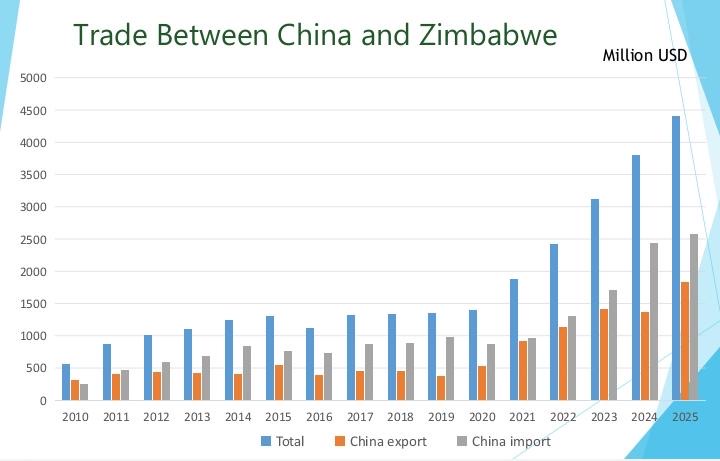
“Between 2022 and 2024, trade between China and Zimbabwe increased from US$2.4 billion to US$3.8 billion.
“Last year, bilateral trade volumes between the two countries rose to US$4.41 billion, representing a year-on-year increase of 15.2 percent.
“China’s imports from Zimbabwe reached US$2.57 billion, while exports to Zimbabwe stood at US$1.83 billion,” said Professor Han.
Zimbabwe is also expected to benefit from China’s Zero Tariff Policy, introduced in May this year, which applies to 53 African countries maintaining diplomatic relations with the Asian nation.
The growing economic partnership has been reflected in a number of major infrastructure and development projects supported by China as Zimbabwe advances towards its Vision 2030 targets.
These include the construction of Mahusekwa Hospital, the expansion of Victoria Falls International Airport and Robert Gabriel Mugabe International Airport, the construction of the New Parliament Building, the National Pharmaceutical Warehouse in Harare, and the expansion of Hwange Thermal Power Station Units 7 and 8.
Among the most significant Chinese investments is the Dinson Iron and Steel Company project in Manhize, which has emerged as a key driver of Zimbabwe’s steel industry.
Professor Han said the company is preparing for a major expansion phase.
“The company’s announcement of an additional US$800 million investment to establish critical facilities, including the construction of a blast furnace, will increase annual carbon steel production from 600 000 tonnes to 1.2 million tonnes under Phase Two of the project,” he said.
Zimbabwe’s steel exports surpassed 140 000 tonnes in 2025, with DISCO becoming the country’s largest steel producer.
Beyond infrastructure and industry, China has continued to provide technical support in strategic sectors such as agriculture and health.
In agriculture, modern technology demonstration centres established across Zimbabwe, including one at Gwebi Agricultural College, have contributed to increased crop productivity, with yields rising from about one tonne to at least five tonnes per hectare in some areas.
The health sector has also benefited from the partnership, with China having dispatched 23 medical teams to Zimbabwe since 1985, further strengthening cooperation between the two countries.

