



Story By Bruce Chahwanda, Political Editor
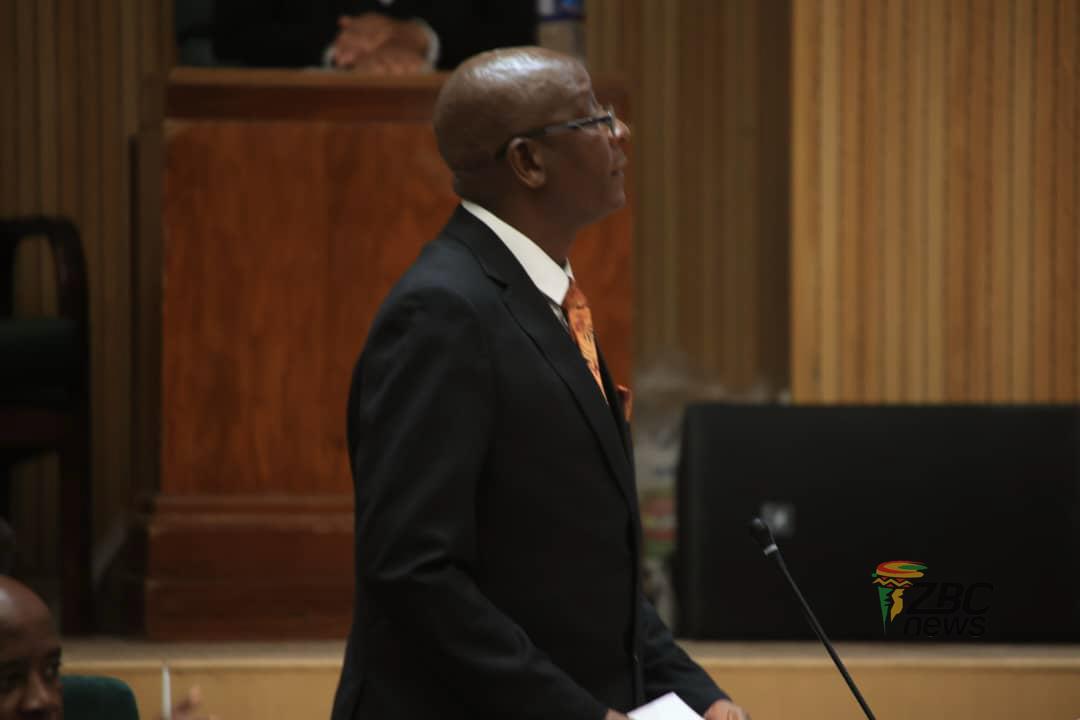
THE proposal to return voter registration and maintenance of the voters’ roll to the Registrar-General did not originate from the Government but was first advanced by opposition legislators in Parliament, Justice, Legal and Parliamentary Affairs Minister Honourable Ziyambi Ziyambi told the National Assembly as he presented the Second Reading of the Constitution of Zimbabwe Amendment (No. 3) Bill.
Presenting the Bill this week, Honourable Ziyambi said the measure seeks to streamline electoral administration, strengthen governance institutions and align constitutional provisions with what he described as practical governance realities after more than a decade of implementing the 2013 Constitution.
The Minister said Clause 2 of the Bill would transfer voter registration responsibilities from the Zimbabwe Electoral Commission (ZEC) to the Registrar-General, arguing that the proposal had previously received support across the political divide.
“The proposal to return voter registration to the Registrar-General did not originate with this Government. It first came from the opposition benches of this House,” he said.
Honourable Ziyambi cited proceedings from May 18 2023 during debate on the Electoral Amendment Bill, where legislators Charlton Hwende, Tendai Biti and Allan Markham supported the transfer.
“It is recorded in the Hansard of that day. We are completing, through the proper door, what this House had already, across its divisions, found common ground to do,” he said.
He argued that the Registrar-General, as custodian of citizens’ records from birth to death, is better positioned to maintain an accurate and continuously updated voters’ roll.
“There is no need for the Zimbabwe Electoral Commission to register voters. The Registrar-General, as the keeper of the nation’s civil records, is the natural registrar of voters,” he said.
The Minister said the Bill would leave ZEC focused on its core mandate of conducting and supervising elections and referendums.
Under Clauses 11, 12 and 13, the Bill proposes the establishment of a dedicated Zimbabwe Electoral Delimitation Commission responsible for drawing electoral boundaries.
The new body would be chaired by a judge qualified to serve on the Supreme Court and include experts in law, governance, administration, demography and cartography.
Honourable Ziyambi said the reform would separate boundary delimitation from election administration while extending the period between delimitation exercises and elections from six months to 18 months.
“The Commission’s proper task is to conduct elections, and the drawing of boundaries, a distinct and technical discipline, belongs with a body built for it,” he said.
The Bill also introduces a series of judicial reforms aimed at strengthening key legal institutions.
Clause 7 raises the qualifications for appointment as Attorney-General to the same standard required for a Supreme Court judge.
“The Attorney-General is the State’s principal legal adviser. It is right that the qualification for such an office should match the company it keeps and the responsibility it discharges,” Honourable Ziyambi said.
Clause 14 broadens access to the Constitutional Court by allowing it to hear matters involving arguable points of law of general public importance, subject to leave being granted.
The Minister said the change would enable the apex court to resolve significant legal questions affecting citizens and commerce.
On judicial appointments, Clause 15 removes public interviews and binding shortlists for judges while retaining consultation with the Judicial Service Commission.
Honourable Ziyambi said judicial independence derives from security of tenure and constitutional protections rather than the appointment procedure itself.
“Judicial independence does not reside in the manner of a judge’s appointment; it resides in the protections that surround that judge for every day of service thereafter,” he said.
The Bill also seeks to amend the appointment process for the Prosecutor-General by removing the Judicial Service Commission’s role in recommending candidates.
The Minister argued that the current arrangement creates a conflict of interest because judges who appoint the Prosecutor-General later preside over matters handled by that office.
“Clause 20 removes that conflict. The guarantee of independence stands in full. It is only the conflicted appointment procedure that goes,” he said.
Traditional leaders are also affected by the proposed changes.
Clause 21 repeals constitutional restrictions on chiefs participating in political activities, with Honourable Ziyambi arguing that the current framework is contradictory because traditional leaders already serve in the Senate and perform constitutional functions.
“A Constitution that seats traditional leaders in its amending chamber while stripping them of the civic standing of ordinary citizens is internally contradictory,” he said.
The Bill further proposes expanding the Senate from 80 to 90 members through the appointment of 10 senators selected for professional expertise.
According to the Minister, the appointments would bring specialised knowledge in areas such as science, finance, technology, law and public health into the legislative process.
“Ten expert voices in a Parliament of 370 do not dilute the people’s representation. They enrich the quality of the legislation that representation produces,” he said.
Another significant amendment is on the the Zimbabwe Defence Forces.
Clause 16 replaces the phrase “to uphold this Constitution” with “in accordance with the Constitution” when describing the role of the military.
Honourable Ziyambi said the amendment strengthens civilian oversight by clarifying that the Defence Forces operate within the constitutional framework rather than acting as parallel guardians of the Constitution.
“The civilian and constitutional control of the military is not weakened by Clause 16. It is made textually consistent, and thereby strengthened,” he said.
The Bill also proposes merging the Zimbabwe Gender Commission into the Zimbabwe Human Rights Commission while retaining constitutional guarantees on gender equality and women’s rights.
The National Peace and Reconciliation Commission would cease to exist as a standalone constitutional body, with its functions incorporated into broader state-led peace-building and reconciliation mechanisms.
Concluding his presentation, Honourable Ziyambi described the Bill as a constitutional recalibration designed to strengthen institutions, improve governance efficiency and create conditions for long-term national development.
“What this Bill seeks to do is to recalibrate the architecture of our democracy, so that it serves the work of governing and the task of development rather than the endless fighting of elections,” he said.
He added: “This Bill is sound in its law, principled in its purpose and overdue in its time.”
The Constitution of Zimbabwe Amendment (No. 3) Bill now proceeds to further parliamentary debate.

