



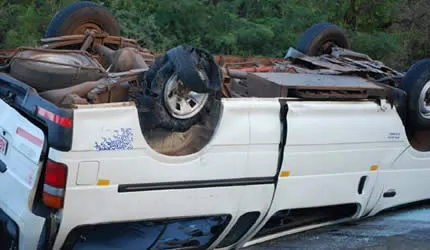
Story by Theophilus Chuma, Investigative Editor
COMMUTERS in Harare are being exposed to serious risks amid revelations that the majority of commuter omnibuses operating in the capital lack proper passenger insurance cover.
Official figures from the Zimbabwe Republic Police show that about 16 000 commuter omnibuses operate in the city, but only 3 000 are registered, raising serious concerns about passenger safety and compensation in the event of accidents.
The situation means thousands of commuters board kombis daily without knowing whether the vehicles have the legally required passenger liability insurance.
Transport and road safety authorities warn that the challenge is not necessarily the number of vehicles on the roads, but how many are properly registered and insured.
Without passenger cover, accident victims may struggle to receive compensation, leaving them to shoulder medical costs and long-term financial burdens on their own.
Ms Florence Mashuwa knows this reality all too well after surviving a serious crash involving a commuter omnibus.
“I was travelling on a commuter omnibus from work when the accident occurred. I was badly injured on the chest and on the left leg. Since then I have not been able to do anything else. The commuter omnibus operator refused to assist with any compensation and so the medical bills have been heavy for me. I am really drained financially there is nothing left for me to live for.”
Her experience mirrors that of another crash survivor, Ms Pedzisai Mashaire who says she is still waiting for assistance two years after the accident.
“Up until now I have not heard from the kombi owner. Since the accident happened there has not been anyone from that company to assist. I have actually been plunged into huge debt as a result of this accident,” Ms Mashaire said.
Zimbabwe continues to record high road accident statistics, with official figures indicating at least 2 000 deaths were recorded in 2025.
A survey of Harare’s major routes shows both registered yellow-plate commuter omnibuses and unregistered vehicles dominating the public transport system, exposing passengers to potential legal and financial risks.
Managing Director of the Traffic Safety Council of Zimbabwe, Mr Munesushe Munodawafa said the widespread use of unregistered and uninsured commuter vehicles poses serious safety concerns.
“Thank you very much for raising that pertinent issue. The challenges that are faced by use of those unregistered combis are many and varied, ranging from safety of passengers, possible abuse, but also to exposure in the unlikely event of an accident.
The issue that arises there is that the vehicle may be insured, let’s say it is third-party insurance, but it is now being used for ferrying passengers on a commercial basis.
Already there are issues to do with the validity of that insurance cover. The second issue is that if it is not properly registered, it automatically means that there is no passenger liability cover. So again, the passengers are left exposed.”
Mr Munodawafa said the implications of boarding uninsured vehicles can be severe for passengers and their families.
“And in the event that you have injuries or worse, it means the people at best have to fend for themselves, because there is no insurance cover over that vehicle, over the people, the passengers that are in that vehicle. So the consequences are extremely high.
But perhaps at times we take life for granted. Perhaps at times we think that the fact that the combi is moving all is well, when in fact we are totally exposed as passengers.”
He added that even if the number of unregistered vehicles were smaller, the risk would still be unacceptable.
“The bottom line remains. We have a large fleet that is operating which is not registered, which is not insured, which does not have adequate papers, where the passengers are exposed. And that is worrisome.”
In written responses, the Insurance and Pensions Commission said public service vehicles in Zimbabwe are required to carry statutory insurance cover.
This includes Road Traffic Act insurance, commonly known as Third-Party Motor Insurance, which is mandatory for all vehicles, as well as Public Passenger Liability Insurance required specifically for public service vehicles transporting passengers.
However, the commission says compliance with Road Traffic Act insurance currently stands at around 40 percent, highlighting widespread non-compliance in the sector.
Authorities say the planned Road Accident Fund is expected to provide relief to accident victims by addressing compensation gaps currently faced by survivors of road crashes.

