



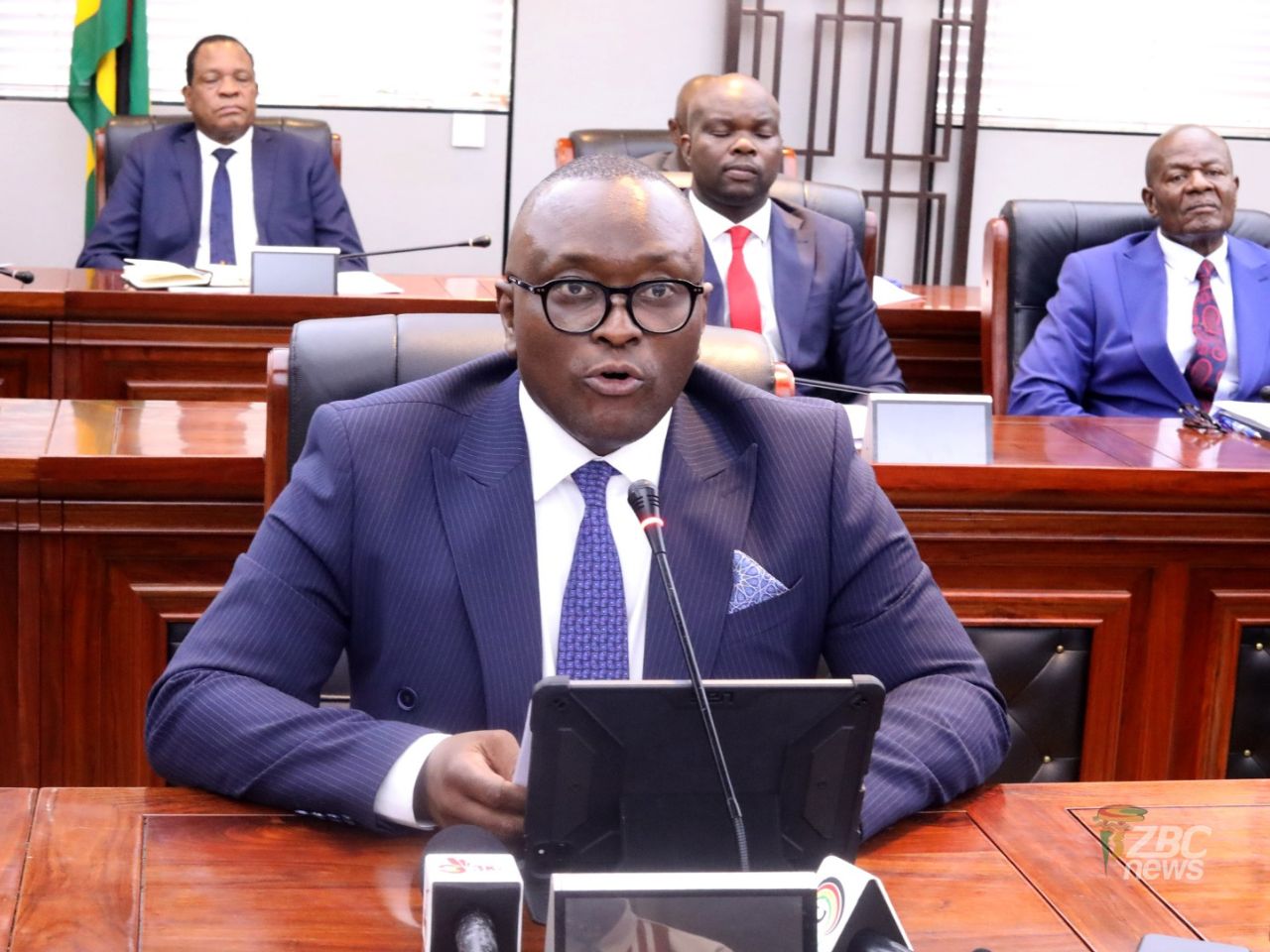
1.0 CONSTITUTIONAL AMENDMENT NO.3 BILL, 2026
INTRODUCTION
The Constitutional Amendment No. 3 Bill, 2026 proposes a series of legal
reforms to strengthen constitutional governance, clarify institutional roles,
promote political stability, and enhance the efficiency of the State
architecture.
The Bill forms part of Zimbabwe’s continuing legal evolution and seeks to
adhere to the spirit of the Constitution, refine and mordenise certain
provisions in response to governance experience, developmental
imperatives, and comparative constitutional practice.
RATIONALE
The primary objectives of the Bill are to-
i.enhance political stability and policy continuity to allow development
programmes to be implemented to completion;
clarify institutional mandates and eliminate functional overlaps that
undermine efficiency and accountability;
strengthen democratic structures through rationalization of electoral
and oversight institutions;
align Zimbabwe’s constitutional framework with contemporary African
constitutional models that have demonstrated resilience, legitimacy
and effectiveness; and
promote long-term national stability, inclusivity and public confidence
in constitutional institutions.
In detail, the Bill provides as follows:-
Clause 1 provides for the Tittle of the bill.
Clause 2 repeals section 92 of the Constitution and substitutes it with a
parliamentary process for electing the President. It specifies that a candidate
must secure a majority of votes, and if no one achieves an absolute majority,
a run-off election will be held. The process is overseen by the chief Justice
or a designated judge to ensure it is conducted properly. These measures
strengthen constitutional accountability by promoting fairness, openness,
and judicial oversight in the election. The procedure for the election shall be
in accordance with Standing Rules and Orders of Parliament.
Clause 3.7. and 8 amend sections 95, 143 and 158 of the Constitution to
substitute the current five-year term of office for the President and
Parliament with seven-year term. The objective of this reform is to reduce
election-related disruptions, enhance policy continuity, allow sufficient time
for the implementation of long-term national projects, and promote political
and economic stability.
Clause 5 amends section 114(3) of the Constitution by substituting “High
Court” with “Supreme Court”, thereby requiring that a person appointed as
Attorney-General possess the qualifications necessary for appointment as a
judge of the Supreme Court. The justification for this amendment is that, in
accordance with the Attorney-General’s Office Act [Chapter 7:19], Deputy
Attorney’s-General are now placed at a level equivalent to that of High Court
Judges, making it institutionally coherent and legally appropriate for the
Attorney-General to be subject to the higher threshold applicable to the
Supreme Court.
Clause 6 amends section 120 of the Constitution to allow the President to
appoint ten senators, increasing the total number of senators from eighty to
ninety, The amendment is intended to broaden technical expertise within
Parliament, enhance oversight, expand the pool of potential Minister’s and
promote national cohesion.
In addition, clause 9, 10,11 establish the Zimbabwe Electoral Delimitation
Commission and transfer the function of delimitation of electoral boundaries
from the Zimbabwe Electoral Commission (ZEC) to the new Commission. The
reform addresses concerns relating to institutional overlap and perceived
conflicts arising from ZEC’s dual role, and promotes good governance,
institutional integrity and functional specialization.
Clause 12 and 16 repeal sections 239(c) to (e) that relate to the registration
of voters, compilation of voter’s roll and registers, and ensure proper custody
and maintenance of the voters’ roll is transferred to the Registrar-General.
This amendment is intended to improve efficiency, as the Registrar-General
is the custodian of vital registration information.
Furthermore, clause 14 repeals section 180(4), (4a) and (5) by removing the
interview process.
Clause 15 amends section 212 (Functions of Defence Forces) of the
Constitution by deleting the words “to uphold the Constitution” and
substituting them with “in accordance with the Constitution”. The
amendment is intended to reinforce the provision of section 213 and 214 of
the Constitution.
Additionally, clause 17 repeals Part 4 of Chapter 12 of the Constitution, which
establishes the Zimbabwe Gender Commission, and transfers its functions
and responsibilities to the Zimbabwe Human Rights Commission. The
amendment aims to consolidate oversight of human rights, including gender
equality, under a single institution, promoting greater efficiency, coherence,
and effectiveness in the protection of fundamental rights.
2.0 UPDATE ON THE IMPLEMENTATION OF THE 2025/2026
SUMMER PRODUCTION PLAN
Cabinet received and noted an update on the 2025/26 Summer Crops
Production Plan.
Cabinet advises that the current Strategic Grain Stock at the Grain Marketing
Board (GMB) stands at 187 245 metric tonnes, with 113 751 metric tonnes
being wheat while the balance comprises maize and traditional grains.
Notably, ARDA as the food security agent for the nation has contributed
84.8% of the marketed grain. In terms of funding, the summer cropping
season currently stands at ZiG73 million and US$313.933 million. The Grain
Marketing Board has already paid farmers for grain deliveries valued at
US$22 384 053.16 and weekly payments are being made to clear
outstanding payments.
Cabinet highlights that the First Round of Crop, Livestock and Fisheries
Assessment led by the Zimbabwe National Statistical Agency (ZIMSTAT) is
currently underway and conclusive area indications for various crops are
expected in due course. Preliminary assessments indicate that the crop
condition is good across all provinces. The Meteorological Service
Department predicts normal to above normal rainfall.
A total of 1 900 709 hectares across the ten provinces was set aside for
maize during the 2025/2026 season, compared to 1 463 465 hectares during
the 2024/2025 season, representing a 30% increase. To date, ARDA has
planted 101 230 hectares, comprising 34 752 hectares under maize and 66
478 hectares under sorghum.
Concerning the adoption of climate-proofed, sustainable intensive
conservation agriculture, provinces registered a combined 15 967 155
Pfumvudza/Intwasa plots under the 2025/2026 season, compared to the 10
817 408 plots achieved in 2024/2025, indicating a 48% increase. A total of
164 536 hectares has been planted under tobacco, reflecting a 15% increase
in area compared to the 143 025 hectares planted at the same time in 2025.
The crop condition is reportedly good, and the country is poised for another
record harvest. Meanwhile, tobacco exports increased to 42 139 million
kilogrammes, compared to the 19 891 107 million kilogrammes exported at
the same time in 2025.
3.0 PREPARATIONS FOR THE NATIONAL YOUTH DAY
CELEBRATIONS
Cabinet received an Update Report on Preparations for the National Youth
Day Celebrations.
The 2026 National Youth Day Celebrations will be held at Igava Training
Centre in Marondera District, Mashonaland East Province on 21st February
2026, under the theme “Youth Agenda for Transformation” The event
will continue the rotation of hosting national events among provinces,
promoting regional development and youth empowerment. A new, state-of
the-art Vocational and Youth Centre to be established at Igava will be named
in honour of His Excellency the President, Cde. Dr. E.D. Mnangagwa, to
support skills training and entrepreneurial growth for young people. The
Youth Centre will be equipped with modern, state-of-the-art facilities
including smart workshops, metal fabrication and digital learning
laboratories, innovation and incubation hubs, demonstration farms, mining
technical workshops, sports and recreation amenities, residential
accommodation, and health facilities, among others. It will provide a diverse
curriculum and training programmes, which will be supported through
Public-Private Partnerships to enhance market relevance and ensure
sustainability. A total of 30 000 youths from all provinces will be mobilised
to participate in the Celebrations at Igava.
Outcome expected from the 2026 National Youth Day Celebrations include
enhancing employment opportunities; empowering young people;
developing skills for youths who are Not in Education, Employment or
Training; supporting youth-owned enterprises; and establishing a model for
Youth Service and Vocational Training Centres across the country.
4.0 PREPARATIONS FOR THE 46TH INDEPENDENCE DAY
ANNIVERSARY CELEBRATIONS AND THE 2026 CHILDREN’S
PARTY
Cabinet received and noted a progress update on preparations for the 46th
Independence Day Anniversary Celebrations and the 2026 Children’ s Party.
Cabinet advises that the 46th Independence Celebrations and the 2026
Children’s Party will be held at Maphisa Growth Point in Matobo District of
Matabeleland South Province under the theme “Zim@46-Unity and
Development Towards Vision 2030”. The Children’ s Party will be held
at Mahetshe Primary School, while the Independence Gala will be held at
Minda Primary School in Matobo District.
The decision to hold the 2026 Independence Day Anniversary Celebrations
at Maphisa Growth Point resonates with the rotational principle of “Leaving
No one and No Place Behind”. The event will not only honour the legacy
of the late Vice President Joshua Nkomo who hailed from Matobo District,
Matabeleland South Province, but will also bring about a surge in
infrastructural projects, including rehabilitation of roads, schools and health
facilities. The event will therefore serve as a catalyst for long-term
development, social inclusion and national unity.
Preparations for the upcoming events commenced in earnest in October
2025 with Government teams mobilized to spearhead development initiatives
which include rehabilitation and surfacing of three major access roads at
Maphisa Growth Point and the gravelling of three more, to provide access to
the Independence Celebrations Venue. Other legacy roads which are to be
rehabilitated include the Bulawayo Airport Road; Bulawayo to Kezi; Bulawayo
to Maphisa; Gwanda to Maphisa; Maphisa to Mphoengs; Maphisa to Sun Yat
Sen; Sun Yat Sen to Manama; St Joseph to Sun Yat Sen; Filabusi to Avoca;
Plumtree to Tsholotsho; Plumtree to Maitengwe and Ndolwane roads.
Government has already worked out the Programme and logistical
arrangements for the Children’s Party and the main Celebrations where a
total of 3 050 learners are expected to participate. Other significant
milestones include the following: the memorialisation of already identified Liberation War Sites at Ratanyana, Zezani Mission, Ratanyana Battle Sites, King Mzilikazi’s
grave site and the District Heroes Acre;
establishment of the Joshua Mqabuko Nkomo Vocational Training
Centre in honour of the late Vice President Dr. Joshua Nkomo;
installation of Information Communication Technologies devices and
gadgets at Mahetshe Secondary School and fifty schools in the district;
5.0
establishment of a Cultural Centre and a Drug and Substance Abuse
Rehabilitation legacy facility;
selection of entertainment groups such as Ufasimba the Home of Arts,
Idonsakusa the Morning Star, Ndolwane Super Sounds, Mavusani and
the Chimurenga vocalists, Macrey Super Sounds; and many others;
selection of Herentals Queens Football Club to play against Mpopoma
Sports Academy for the Children’s Party, while the Premier League will
feature Scottland FC versus Highlanders Football Club during the main
Independence Celebrations; and selection of 18 torch bearers for the lighting of the Independence Flame.
PROPOSED GENERAL AMNESTY 2026
Cabinet considered and approved the 2026 General Amnesty as proposed by
the Minister of Justice, Legal and Parliamentary Affairs.
Cabinet advises that His Excellency the President, Dr. E. D. Mnangagwa will,
in terms of the Constitution of Zimbabwe, exercise his power of mercy to
grant pardon to any person concerned in or convicted of an offence against
the law. The Presidential Clemency aligns with the mandate of the Zimbabwe
Prisons and Correctional Service (ZPCS) on the rehabilitation and
reintegration of offenders back into society. Inmates who have
9
demonstrated good behaviour and readiness to be reintegrated into society
will benefit through the 2026 General Amnesty before the Parole system
comes into effect. The Presidential Clemency will decongest the prison
population for a healthy and secure environment for the remaining prisoners.
The following categories of prisoners will benefit under the 2026 General
Amnesty:
a) all convicted female prisoners;
b) juveniles;
c) prisoners serving an effective period of 48 months and below;
d) inmates certified terminally ill;
e) prisoners at Open Prison;
f) all prisoners aged 60;
g) prisoners sentenced to life imprisonment, provided they have
served 20 years;
h) prisoners with disabilities; and
i)an additional one quarter remission of the effective term of
imprisonment to those prisoners who were sentenced to more
than 48 months.
The General Amnesty will exclude any prisoner who was previously released
on amnesty; any person serving a sentence imposed by a Court Martial; any
person with a record of escaping from lawful custody; and any inmate
convicted of any specified offence. The specified offences include murder,
treason, rape or sexual offence, carjacking, robbery, armed robbery, public
violence, human trafficking, unlawful possession of a firearm, contravention
of the Electricity Act, the Postal and Telecommunications Act, the Public
Order and Security Act/ the Maintenance of Peace and Order Act, the Railway
Act; and the Copper Act.

