



Story by Oleen Ndori, Foreign Editor
ZIMBABWE is intensifying its drive towards clean and sustainable energy as part of broader efforts to address climate change and improve access to reliable power.
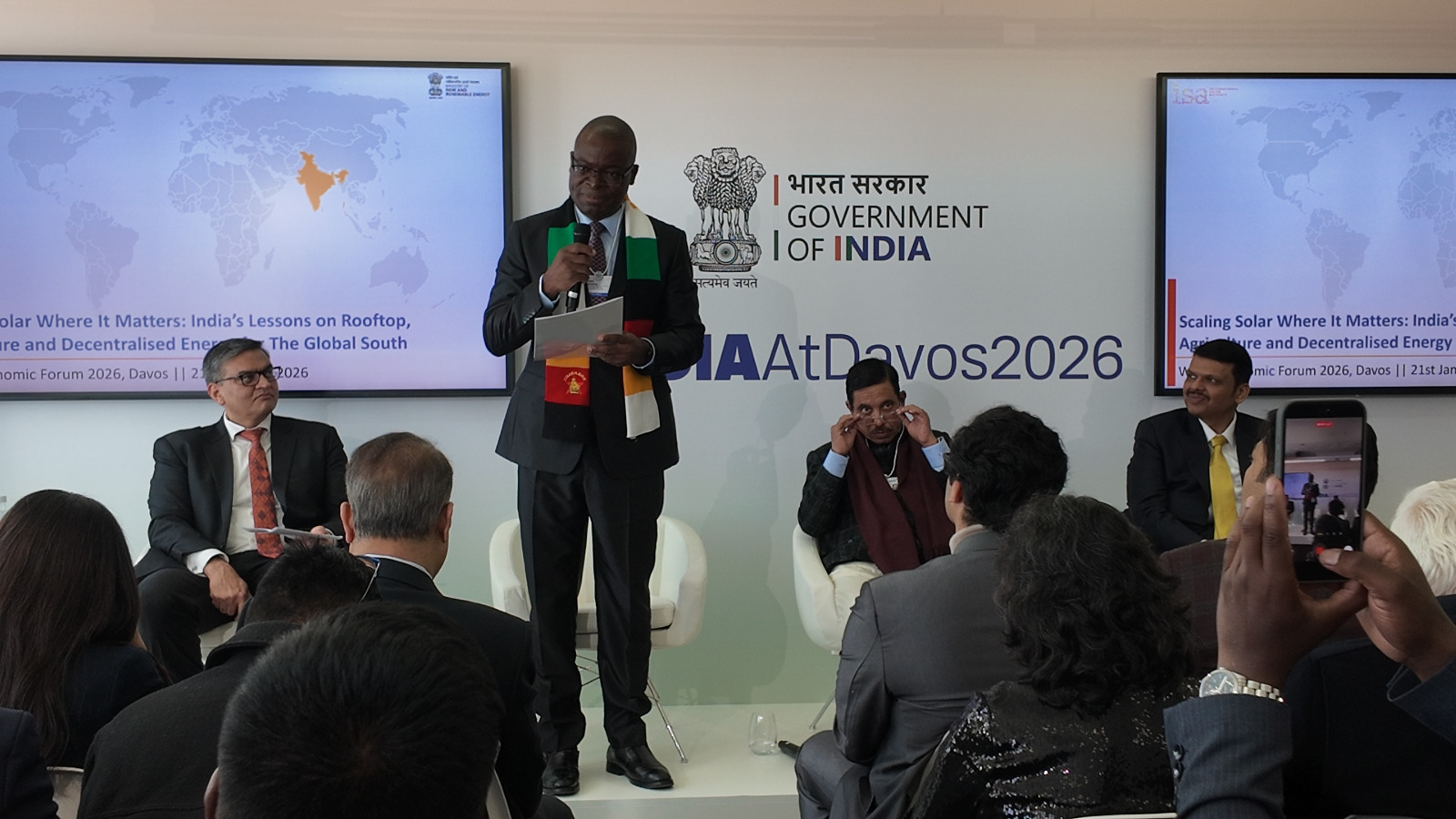
This was highlighted during the country’s participation in a high-level solar energy session held on the sidelines of the ongoing World Economic Forum.
With climate change increasingly affecting food security, water availability and economic growth, countries in the Global South are accelerating the transition towards clean and renewable energy sources.
On the sidelines of the ongoing World Economic Forum, Zimbabwe joined policymakers, regulators, development partners and private sector leaders to explore scalable models for expanding solar energy access and strengthening rural livelihoods, hosted by India.
Over the past decade, India has rapidly expanded its renewable energy capacity while maintaining strong economic growth.
“India has shown that energy transition is not a burden on development. We have decoupled economic growth from emissions. Today, what is being organised by ISA is how we can scale up, especially in developing countries, the Global South, and how we can fulfil aspirations. How solar and renewable energy have changed the energy history and energy story of India, these are all things which, under the leadership of Prime Minister Shri Modi, have been done in the last 10-11 years and need to be showcased. In 2014, we had 81 gigawatts of renewable energy. Today, it is about 261-267 gigawatts, meaning over 50% of installed capacity is from renewable sources. What we promised at COP26 to achieve by 2030 has been achieved five years in advance,” India Minister of New and Renewable Energy Honourable Shri Pralhad Joshi said.
Zimbabwe plans to scale up solar-powered irrigation and village business units across its 35 thousand villages, supporting agriculture, agro-processing and rural industrialisation.
“In Africa, we have 1.5 billion people. We have large families, which means we have 300 million households. I come down to the SADC region, where Zimbabwe is located. Four hundred million people, using the rough statistic of five, means we have 80 million households. In Zimbabwe, we are a population of about 16.5 million people, which means about three million households. Zimbabwe, being located centrally within the heart of Southern Africa and belonging to the African Continental Free Trade Area, means Zimbabwe is an axis. Anybody who works with Zimbabwe or any other country within Africa is working with 1.5 billion people,” Minister of Foreign Affairs and International Trade Professor Amon Murwira said.
As climate change accelerates, clean energy is emerging as a critical solution for sustainable development.
For Zimbabwe and the SADC region, solar energy presents an opportunity to power economic growth while safeguarding the environment.

