



Online Reporter
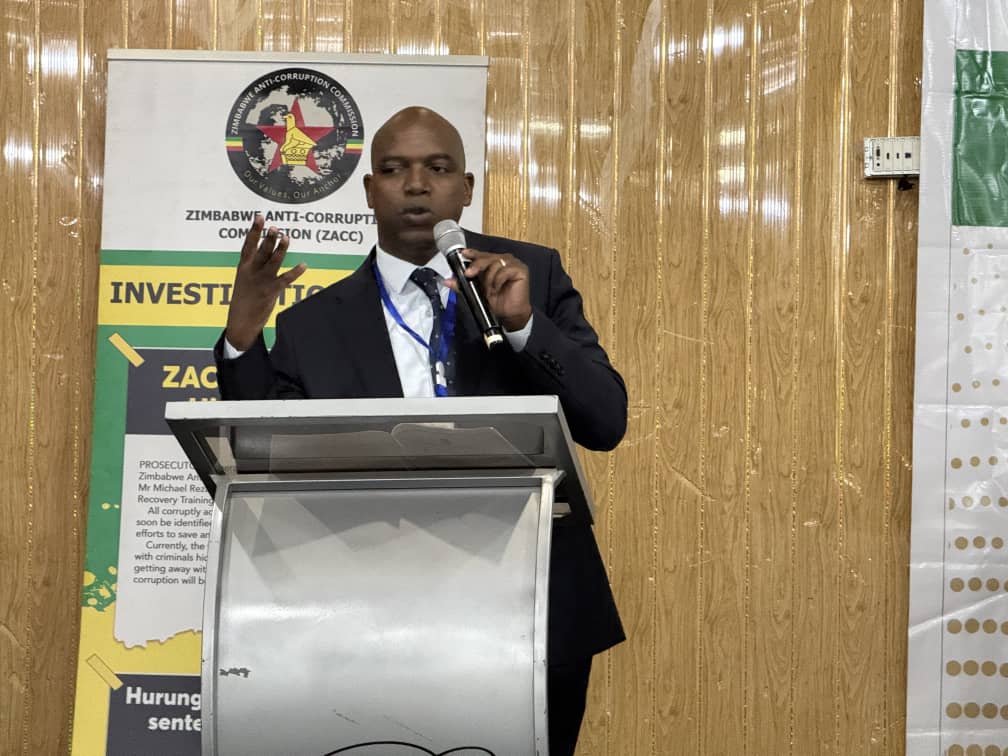
ILLICIT financial flows (IFFS) are draining billions of dollars from Africa each year, stripping the continent of resources needed to build hospitals, repair infrastructure, improve education and expand economic opportunities, the Zimbabwe Anti-Corruption Commission (ZACC) Executive Secretary Advocate Shepherd Manhivi has said.
In his opening remarks at a capacity-building training workshop for journalists and investigators in Harare on Monday, Advocate Manhivi said IFFS were silently eroding Africa’s wealth and undermining development, emphasising that tackling them was central to the continent’s anti-corruption agenda.
“Africa loses billions of dollars every year through IFFS, resources that should be building hospitals, fixing roads, equipping schools, supporting farmers, improving water systems, and creating opportunities for our young people. Instead, these resources disappear quietly and illegally, aided by sophisticated networks that exploit weak systems, limited skills, and cross-border loopholes,” he said.
Avocate Manhivi said the scale of the losses meant African countries, including Zimbabwe could not hope to achieve long-term development goals including Vision 2030 unless illicit flows were curbed. He stressed that no country could attain upper-middle-income status while its resources continued to leak out through sophisticated criminal networks exploiting weak systems, limited skills and cross-border loopholes.
“Let us be reminded that curbing IFFs is, in every sense, fighting corruption. And fighting corruption is not just a slogan in this country; it remains a central pillar of our government’s agenda. It is at the heart of His Excellency the President’s commitment as we work towards Vision 2030, where Zimbabwe becomes an upper-middle-income society. We cannot attain that vision if our resources continue to leak out of the system. This training, therefore, is more than a formal event; it is a key part of our national effort to secure a better future for our people,” he said.
Advocate Manhivi said the training programme was part of Zimbabwe’s wider national effort to equip officers and journalists with the skills needed to detect, investigate and expose illicit financial flows.
“The African Union’s CAPAR framework provides a clear and united strategy for stopping illicit flows and recovering stolen assets. However, even the strongest framework is ineffective unless those tasked with implementing it are equipped with the right skills. This is why capacity building is not optional for us; it is essential. The networks involved in IFFs are becoming more sophisticated by the day. These networks move money across borders, conceal it in complex structures, and take advantage of weaknesses in systems. To match and ultimately defeat them, we need officers and journalists armed with modern investigative techniques, financial intelligence and strong ethical foundations. To our trainers and experts, thank you for being here. You bring knowledge grounded in real cases, real challenges, and real solutions. Your presence reminds us that IFFs are a continental challenge and that our response must also be continental,” he said.
In a speech read on his behalf by Commissioner Kindness Paradza, ZACC Chairperson Michael Reza warned that Illicit Financial Flows (IFFs) pose a growing threat to Zimbabwe and the continent saying rapidly evolving cross-border criminal networks continue to siphon resources that should support national development.
He said IFFs were not statistical abstractions but represented real losses to our people undermining economic security and national integrity. He said technological advances had made it easier for criminal syndicates to move funds undetected, conceal ownership and exploit financial loopholes, calling for an equally rapid evolution of investigative and regulatory responses.
“Illicit Financial Flows are not abstract numbers. They represent real losses to our people. We cannot afford to continue losing resources to sophisticated criminal networks that operate across borders with speed, precision, and secrecy. The environment in which these actors operate is evolving rapidly. Technology has made it easier to move funds undetected, conceal ownership and manipulate financial loopholes. This means our response must evolve just as rapidly,” he said.
He said ZACC was on a path of institutional strengthening, including professionalising investigators, modernising systems and enhancing cooperation across national and regional borders.
“We are committed to professionalising our investigators, modernising our systems and enhancing cooperation, locally, regionally, and internationally.”

