



Story by Gay Matambo
CHIREDZI – A community of smallholder farmers in Rupangwana which is in Chiredzi district, has transformed their livelihoods by embracing commercial agriculture.
After the government revitalised the Rupangwana Irrigation Scheme, farmers in the area have fully transitioned from subsistence farming to running profitable agribusiness ventures.
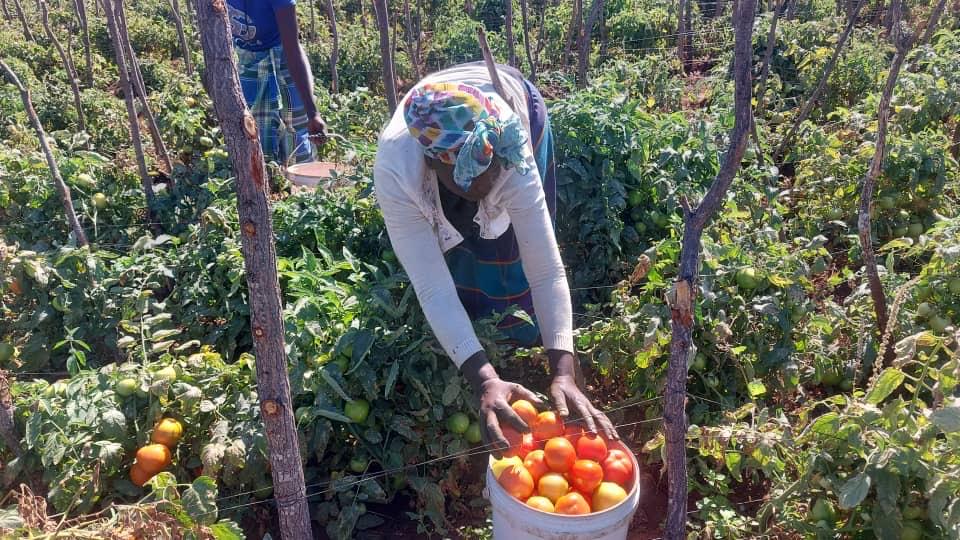
One such farmer, Ms Esther Chitiki, who cultivates a two-hectare plot, expects to earn close to US$500 from just one batch of freshly harvested tomatoes.
“I planted this tomato crop in December on a two-hectare piece of land. When I started selling my produce, from the first batch I managed to get 85 boxes of tomatoes which I sold at US$17 per box. Now I have started picking the second batch, I got 18 boxes. Today, I am expecting to get 20 boxes of tomatoes. We are grateful to the government for revitalising our irrigation scheme, we have been empowered.”
At the end of each season, each farmer at the scheme takes home close to US$3 000 after selling their produce, which they use to improve their livelihoods and plan for the next farming season as they grow cash crops all year round, thanks to the government for revitalising the Rupangwana Irrigation Scheme.
My husband’s salary alone could not cover our children’s school fees, but now that we have thriving agricultural businesses here, we can send our children to school. We have even solarised our homestead and bought electrical appliances, which I never thought was possible,” a farmer said.
When I started I never thought that farming would make my life better but I have noticed that land is money. I used to grow beans, but when I grew tomatoes, that’s when I noticed that farming is a highly profitable business because every week, I would get almost 500 United States Dollars. I’m managing to pay for my child’s fees, and my life has transformed through farming.”
Farmers are not only improving their own lives but also contributing to the national economy by embracing agribusiness models.
Rupangwana Agriculture Extension Officer, Ms Shumirai Muva noted that the scheme currently supports 150 farmers, the majority of whom are women.
“We grow crops all year round, and our area is generally hot, hence, our crops are not affected by frost in winter. We encourage our farmers to grow cash crops. Before we plant for a certain season, our farmers do market surveys as far as Harare and the Midlands. We mostly grow sugar beans, tomatoes, green mealies, and watermelons. At the beginning of the summer season, we are the first to supply tomatoes and green mealies,” she said.
The Rupangwana Agriculture Extension Supervisor, Mr Jairos Vuriri noted that farmers are now embracing agriculture as a business.
“They have taken farming as a business and their lives have been transformed. This is in line with President Emmerson Mnangagwa’s Vision 2030 mantra. Most of them have bought houses and cars, and they are now able to send their children to school from the proceeds they get from the sale of their produce.”
After the revitalisation of the Rupangwana irrigation scheme under the government’s Smallholder Irrigation Revitalisation Programme (SIRP), the water still flows, and now it carries more than just life.
It carries the future of the smallholder farmers, a future where small hands cultivate big dreams.

