



Story by Fungai Jachi
HARARE – JUNIOR parliamentarians have commended the government for strides made in safeguarding children’s rights but have called for increased attention to the specific needs of children with disabilities and those in rural areas.
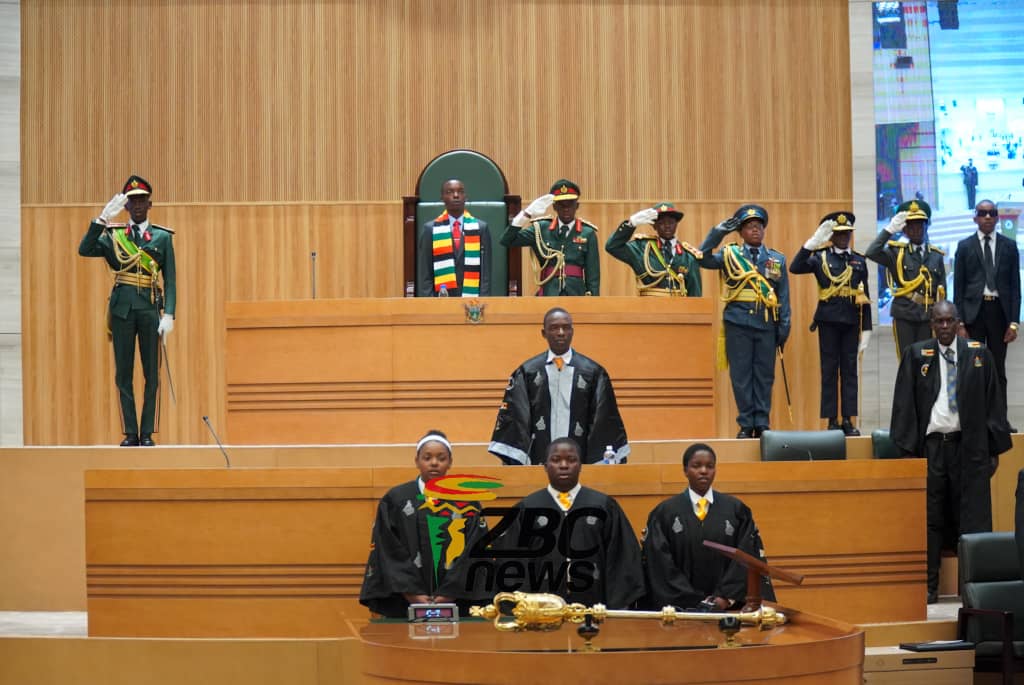
The remarks were made during the official opening of the 33rd Session of the Junior Parliament, held in Mt Hampden this Friday.
President Emmerson Mnangagwa once stated that, “A nation that ignores the voice of its children ignores its own future,” and the Child President, His Excellency Lionel Mazarire, together with junior parliamentarians expressed gratitude for the deliberate efforts made by the Second Republic in safeguarding and promoting children’s rights.
In his State of the Nation Address during the event, Child President Mazarire noted the milestones achieved by the government in ensuring the upholding of children’s rights.
“We have seen a deliberate effort by the government to enhance the rights of children and we are grateful. We have seen that the number of children getting basic education has increased and there are now policies that ensure children are protected from all forms of abuse. However, gaps are still there that need to be addressed. We are grateful that we are being given a chance to amplify our voices and we are being heard,” he said.
During the debate, junior parliamentarians acknowledged government efforts, while noting that gaps still exist especially for children with disabilities and those in rural areas.
“Children with disabilities still face a lot of challenges for instance many teachers cannot communicate in sign language and that is a disadvantage,” a junior parliamentarian said.
“Rural children still face challenges. Schools are far and they do not have access to ICT gadgets. We are being encouraged to take up science subjects but we do not have the resources,” another added.
“Health facilities are scarce, and the growing problem of drug and substance abuse among youth needs urgent attention,” another said.
The government is alive to the challenges that children face and is committed to ensuring that no child is left behind.
The Minister of Primary and Secondary Education, Honourable Torerai Moyo, revealed plans to construct more schools across the country and strengthen systems that support disadvantaged learners.
“We are working to expand access to education by building more schools, especially in remote areas. Support mechanisms are in place to cater for school fees for those who cannot afford to pay,” he said.
The Minister of Youth Empowerment, Development and Vocational Training, Honourable Tino Machakaire, added that youth empowerment remains a top priority.
Minister of Information Communication Technologies, Postal and Courier Services, Honourable Tatenda Mavetera, reiterated the government’s efforts to bridge the digital divide.
“We will make sure that every learner has access to ICT gadgets as we move with technological advancement. ”
Since the inception of the Second Republic, significant legislative reforms have been introduced to enhance child rights and these include the Marriages Act of 2022, which criminalises early marriages as well as the Education Amendment Act of 2020 which guarantees free basic education and protection for pregnant girls.
The Basic Education Assistance Module (Beam) now supports over 1.5 million learners with school fees, uniforms and stationery.

