



Story by Kenias Chivuzhe
THE e-learning initiative is reshaping education in rural Zimbabwe, thanks to the rural electrification programme and the Zimbabwe Learning Passport, which are helping to reduce the rural-urban digital divide.
The government and its partners have been instrumental in promoting digital learning, ensuring that students in remote areas have access to quality education.
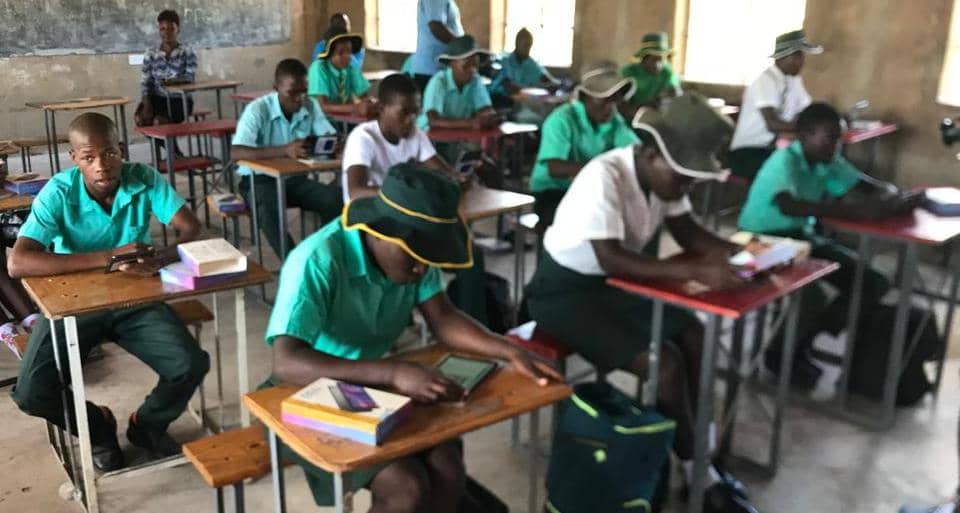
Students from Ndyarima primary and secondary schools in Buhera summed up the benefits of solarisation and digital learning platforms in enhancing the education delivery system.
“We are so excited that the electrification programme has improved our learning environment. We are now able to study in the evening thereby improving our pass rates,” a beneficiary said.
“This new system has made it possible to for us to easily access learning materials with the system also being able to provide answers. We can access materials from our teachers even if they are not there and with the help of these digital gadgets we are looking forward to passing our national exams,” a student said.
“These tablets have ensured we access books on our digital platforms. Ever since this new system was introduced, it is now easy to study on our own,” a pupil said.
Following the increase of pass rates from 0% in 2020 to 17.3 % in 2024 at Ndyarima secondary and 38.5 % in 2023 to 60 % in 2024 at Ndyarima primary school, authorities are convinced that digital learning platforms have a huge impact in learning outcomes.
“Electricity has improved learning conditions with learners able to study even during the evenings. The initiative is helping the local community,” SDC Chairperson for Ndyarima Primary School, Mr Jefter Pedzisai said.
“We are happy that our school has been electrified, and our aim is to procure more laptops. These initiatives have improved our pass rate from 38.53 % in 2023 to 60 % last year. The learning passport initiative is there but there are some challenges,” the school head at Ndyarima Primary School, Mr Wilforce Bashikwa said.
The governmentt is happy with the positive developments within the education sector and would want more partners to upscale the implementation of digital learning systems across the country.
“We are in Buhera and we were assessing the utilisation of the learning passport initiative and its uptake,” the Director of Communication and Advocacy in the Ministry of Primary and Secondary Education, Mr Taungana Ndoro said.
“We noted that the infrastructure is there including solarisation. We have seen students utilising tablets and computers, and we also witnessed an offline server. At Ndyarima Secondary there is a digital platform system that has made learning easy. Because of the positive impact, we are making a clarion call for partners to support the digital learning system as it has proved to be an effective learning tool.”
Designed and launched in March 2021 by the Ministry of Primary and Secondary Education (MoPSE), in partnership with UNICEF and Microsoft, the Zimbabwe Learning Passport is equipped with contents from the national curriculum developed by a selected group of senior teachers, with other materials developed by credible global sources.

