



Story by Tichaona Kurewa
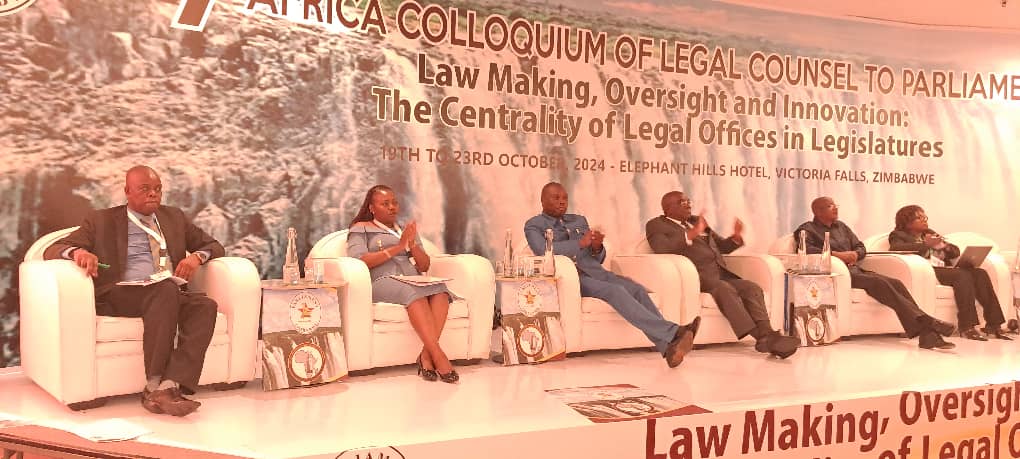
THE 7th Africa Colloquium of Legal Counsels to Parliament commenced in Victoria Falls this Sunday with delegates being rallied to critique international treaties and agreements for the benefit of the continent.
The Africa Colloquium of Legal Counsels to Parliament brings under one-roof legal counsels from African Parliaments in the spirit of Pan-Africanism in order to share legal experiences guided by the ever growing need to adopt innovative pathways in legal practice.
“Sometimes, some of these agreements and treaties are skewed against African interests. For example, foreign companies agree to extract crude oil from an African country and insert a clause indicating that the oil will be refined in the investor’s country of origin, only to sell the refined oil as petrol or diesel at high prices much to the chagrin of the local citizenry, this is economic colonialism.
“Members of this African Colloquium of Counsels to Parliaments must rally their legal experiences and save Africa from such economic imperialism by ensuring that international agreements and treaties vouch for Africa’s resources value addition and beneficiation in the spirit of Agenda 2063 and the Africa Continental Free Trade Agreement,” the Senate’s deputy president, Honourable Michael Nyambuya.
The use of emerging technologies was also singled out as a game changer in law making.
“There is now consensus amongst Counsels to Parliaments that there is need to acclimatise to the application of digital technologies which are driven by Artificial Intelligence (AI) in the law-making process. To that end, Counsels to Parliaments must be schooled in the phenomenon of AI which is the development of computer systems capable of performing tasks that typically require human intelligence, whereby machine learning, deep learning and natural language processing as tools in the digitalised law-making matrix that can be applied.
“The use of data analytics and algorithms for predictability of the legal impact of legislation are measures that command attention for Counsels to Parliaments. Ironically, the same application of AI must be deployed in such a manner as to ensure that this digital technology is applied responsibly and ethically in accordance with moral principles, societal values and inalienable human rights,” added Honourable Nyambuya.
The colloquium remains significant on the continent.
Africa Colloquium of Legal Counsels to Parliament’s president, Ms Elizabeth Hove said, “As we gather here to discover the convergence of law-making, oversight, and innovation, we recognise that legal offices in parliaments are not purely support structures; they are fundamental to the effectiveness of our legislative bodies. The complexities of governance continuously evolve, thus it is crucial that we progress with them. We must ensure that our offices remain the legal backbone of our legislative frameworks, providing the necessary guidance required to ensure that our laws are not only effective but also equitable.”
“As the custodians of parliamentary law-making processes, we have the responsibility to ensure that the legislation passed reflects not only the will of the people but also upholds constitutional integrity and adheres to international legal standards. This conference serves as an opportunity for us to improve our capacity to offer sound legal advice, and engage with citizens meaningfully. We are here to share best practices and to learn from one another how we can further sharpen our skills and adapt to new challenges,” noted Matabeleland North Minister of State for Provincial Affairs and Devolution, Honourable Richard Moyo.
Over the next three days, the colloquium will among other issues explore pressing matters such as the intricacies of drafting and processing private members’ bills, the relationship between parliamentary counsel in the law making process and post-legislative scrutiny for effective legislation.

