



Story by Bruce Chahwanda, Political Editor
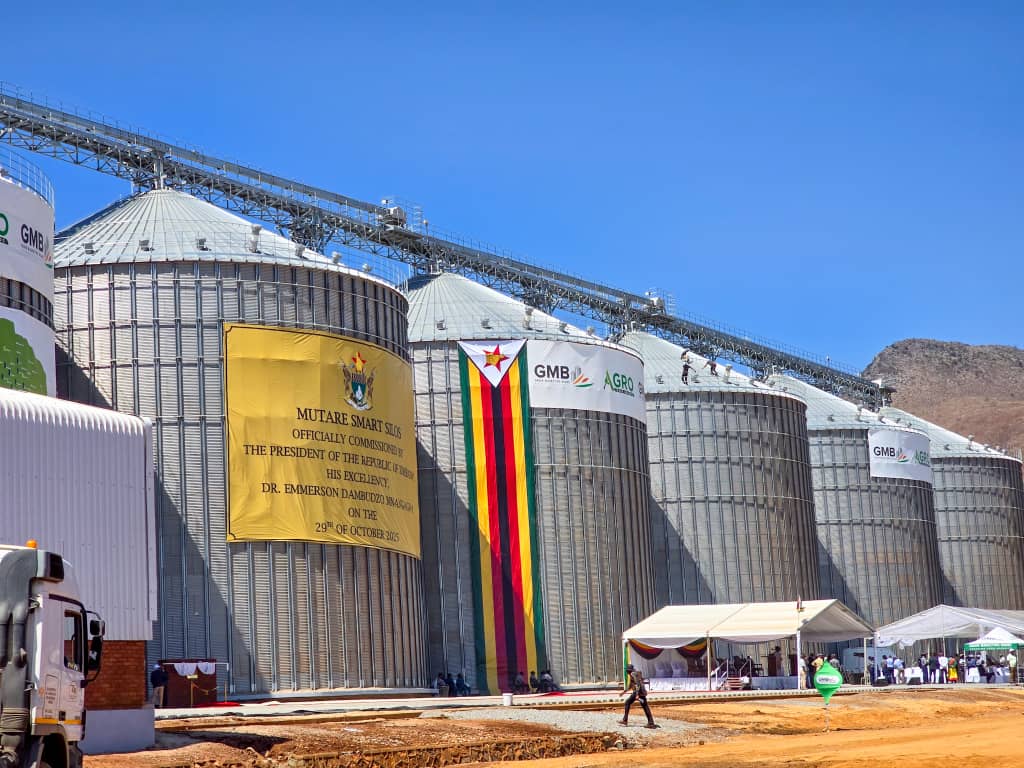
PRESIDENT Emmerson Mnangagwa has commissioned Artificial Intelligence powered Grain Marketing Board (GMB) silos in Mutare, placing Zimbabwe as a regional leader in food production through new technologies.
The high-tech facility, with a storage capacity of 56 000 tonnes, forms part of the Government’s drive to modernise the agricultural sector through emerging technologies under the Second Republic’s industrialisation and food security agenda.
Thousands of people gathered at the GMB depot in Mutare to witness the commissioning ceremony, which also marked the launch of the 2026-2030 Agriculture Food Systems and Rural Transformation Strategy.
President Mnangagwa said the adoption of Artificial Intelligence (AI) in grain management will revolutionise
“Through such initiatives, my administration is guaranteeing timely access to grain by all our people, especially in times of enhanced vulnerability. The impact of the Fourth Industrial Revolution towards reshaping industries, economic sectors, and society as a whole can not be over-emphasised.
“It is, therefore, pleasing that as we navigate this unavoidable new normal, our ministries, departments, and agencies are harnessing the power of emerging technologies for the benefit of both current and future generations. To this end, these modern silos are equipped with digital monitoring systems, automated grain handling technologies, and advanced quality control laboratories. Such contemporary systems enhance grain storage efficiency, reduce post-harvest losses, and ensure national food safety through improved risk monitoring and globally acclaimed management standards,” he said.
President Mnangagwa revealed the expansion of the national storage is also part of efforts to cement Zimbabwe’s position as a regional grain storage hub as designated by the World Food Programme.
“It is pleasing and a source of pride that our national agriculture capabilities, logistical and storage capacity are having a positive impact on the overall economic development of our country. This is despite the challenges of the illegal heinous economic sanctions and climate change induced droughts. The World Food Programme has expressed its readiness to collaborate with us in our quest to become a Regional Food Production, Storage and Logistics Hub.
“This should enable Zimbabwe central node in the seamless provision of the region’s food procurement and logistics needs, in line with international standards. In view of this development, my government stands ready to facilitate the capacitation of the Grain Marketing Board to be able to efficiently manage complex storage and supply chains. This includes storing and distributing grain, inputs, and other related items to destinations in real time, among other critical aspects,” he added.
President Mnangagwa also launched the Agriculture Food Systems and Rural Transformation Strategy 2026-2030 which was which was meant to boost agricultural productivity through collaboration.
“These must anchor increased value creation for the sector and strengthen the intricate nexus between agricultural development, modernisation, and industrialisation of the broader economy. It is my expectation that the valuable lessons learned and experience gained from the first phase of the Agriculture, Food Systems and Rural Transformation Strategy will be brought on board to further improve our agriculture sector.
“These strategy papers should ultimately help scale up agriculture production and productivity, as well as increased household incomes for a better quality of life of our people. I look forward to collaboration and synergies from stakeholders in the agriculture space, including farmers, the private sector, and development partners, as we implement this strategy for shared benefits. In this spirit, I urge us to continue working with unity of purpose, to fully unlock and maximise the potential of the sector, riding on our God given land and water resources, as well as the relatively good climate,” he highlighted.
Zimbabwe has increased the country’s irrigation hectarage to above 220 000 hectares, which will be expanded to nearly 500 000 hectares by 2030, with a number of dams under construction.

