



Story by Ian Zvoma, News Editor
THE Pan-African Parliament (PAP) president, Chief Fortune Charumbira, has challenged parliaments across the globe to shift from rhetoric to action in addressing pressing governance challenges, including climate change.
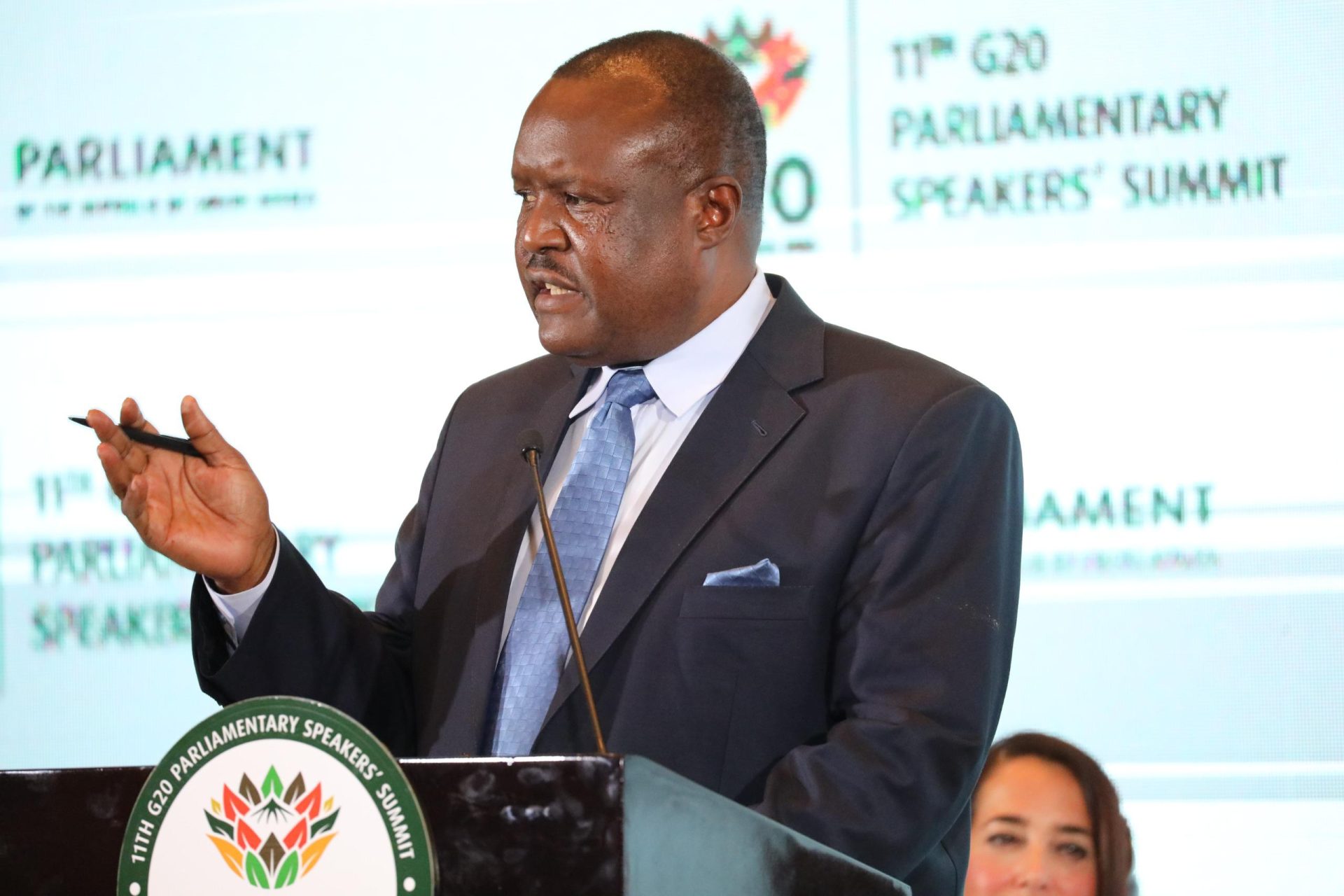
Delivering his keynote address at the official opening of the 11th Group of 20 (G20) Parliamentary Speakers’ Summit in Cape Town on Wednesday, Chief Charumbira said parliaments could not afford to remain passive observers in a rapidly changing global order.
“We are here not merely to bring a parliamentary dimension to global governance or build political support for international commitments, we are here as honourable speakers because the institutions we represent are at the heart of representative and participatory democracy. We are here because together, we represent the collective voice of our people.
“In a world of global crises and rapid change, from climate to conflict, from migration to innovation, in a changing world order, we are here because Parliaments cannot afford to be passive bystanders on issues that affect two-thirds of the world’s population. Our citizens expect us to not only represent their voices, but also to safeguard their rights and interests. When Speakers meet, we not only talk, but we also strategise, coordinate, and empower our institutions to act decisively for the benefit of our people” he said.
Chief Charumbira emphasised that the climate crisis is not only an environmental issue but also a matter of governance and justice.
“Climate change is not merely an environmental issue. It is a governance challenge and a question of justice. Africa contributes only a small fraction of global greenhouse gases, yet it is among those bearing the greatest burdens; drought, flooding, desertification, biodiversity loss, and food insecurity.”
“In this context, parliaments are uniquely positioned to craft and enact national laws, regulations and frameworks that mandate emissions reductions, renewable energy deployment, energy efficiency, and sustainable land‑use policies. We must also serve as conduits for citizens’ concerns, especially vulnerable and marginalised communities, ensuring that climate policies are equitable, just, and inclusive.
“These roles are not optional, they are essential if we are to transform commitments into results. This calls upon us to foster peer learning and exchange across parliaments,” Chief Charumbira said.
The PAP president also made a passionate plea for the reform of the global governance system for Africa to play an active and effective role in international affairs.
“As representatives of our peoples, we know that current international institutions were largely designed in a different era, one shaped by power balances, ideologies, and colonial divisions that do not fully
reflect the reality of our time, yet, many of those structures remain in place, even when the challenges we face are altogether new and demanding. When ordinary citizens around the world see that decisions being made about their lives are taken by bodies that do not adequately represent them, trust in global governance erodes. It undermines both the moral authority and efficacy of the international system.
“Africa bears a disproportionate share of many global problems yet, historically, has had less representation in the decision-making centres of global governance. Security, development financing, trade rules, global
norms, these are shaped often without Africa’s full participation or consideration. For Africa and the Global South, reform is not just desirable, it is indispensable.”
The 11th G20 Parliamentary Speakers conference comes at a time when South Africa is preparing to host the G20 Summit set for Johannesburg in Novemver. It will be the first G20 Summit to be held on African soil.

