




Story by Mercy Bofu-Matinha
GOVERNMENT says climate adaptation programmes being implemented in drought-prone communities are strengthening resilience to climate change while improving livelihoods.
For years, the Madzivire community in Bikita has battled recurring droughts, deforestation driven by illegal charcoal production and increasing human-wildlife conflict.
To address these challenges, Government and its partners secured funding under the Global Environment Facility Cycle Seven (GEF-7) programme, leading to the establishment of climate-smart infrastructure and sustainable livelihood initiatives.
The interventions include an automated weather station, solar-powered water infrastructure, farmer field schools and a tree nursery, projects that are improving food security, household incomes and environmental conservation while benefiting the wider community and schoolchildren.
Beneficiaries say the initiatives are already transforming their lives.
“For many years we struggled because of recurring droughts. Since this project was introduced, we now receive weather information that helps us decide when to plant. The solar-powered water system has also made it possible for us to irrigate our gardens throughout the year. We are now producing vegetables for our families and selling the surplus, which has improved our household incomes,” Mr Rwidzanai Rwaunda said.
“Illegal cutting down of trees used to be common because people depended on charcoal production for survival. Through this programme, we have learnt the importance of protecting our forests and restoring degraded land. We are grateful because these projects are changing both our mindset and our livelihoods,” Ms Sarah Chinanga said.
Minister of Environment, Climate and Wildlife, Honourable Evelyn Ndlovu, described the initiatives as critical to building resilience in vulnerable communities.
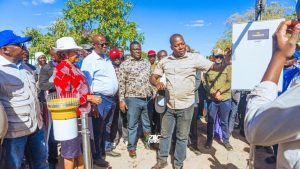
“The projects we are witnessing today are for sustainable livelihoods within the dry regions with funding from the Global Environment Facility Cycle Seven, and Government remains committed to scaling up similar initiatives across vulnerable communities in the country,” she said.
Development partners say the programme is meeting its objective of tackling land degradation while promoting climate-resilient livelihoods.
“The climate-smart infrastructure installed in this area is benefiting farmers who have already started adopting traditional grains, growing different trees and establishing community gardens. The information generated from this station is also benefiting neighbouring areas,” FAO Sub-Regional Coordinator for Southern Africa Mr Patrice Talla said.
National Project Coordinator – GEF-7 Ms Precious Magwaza said community participation has been key to the programme’s success.
“We are happy that the GEF project is implementing a wide range of interventions in Masvingo Province. The community is appreciating and participating in the project because its major goal is to improve livelihoods while ensuring the environment is protected,” she said.
The Global Environment Facility Cycle Seven programme targets vulnerable communities through integrated landscape management, climate adaptation and biodiversity conservation.

