



Story by Providence Maraneli
MATABELELAND South Province is making significant strides in advancing Science, Technology, Engineering and Mathematics (STEM) education, with government investing in the construction of laboratories and the deployment of science teachers to schools across the province.
Schools in previously marginalised communities are increasingly being transformed into digital learning hubs, with science and computer laboratories helping to bridge the gap between rural and urban schools.
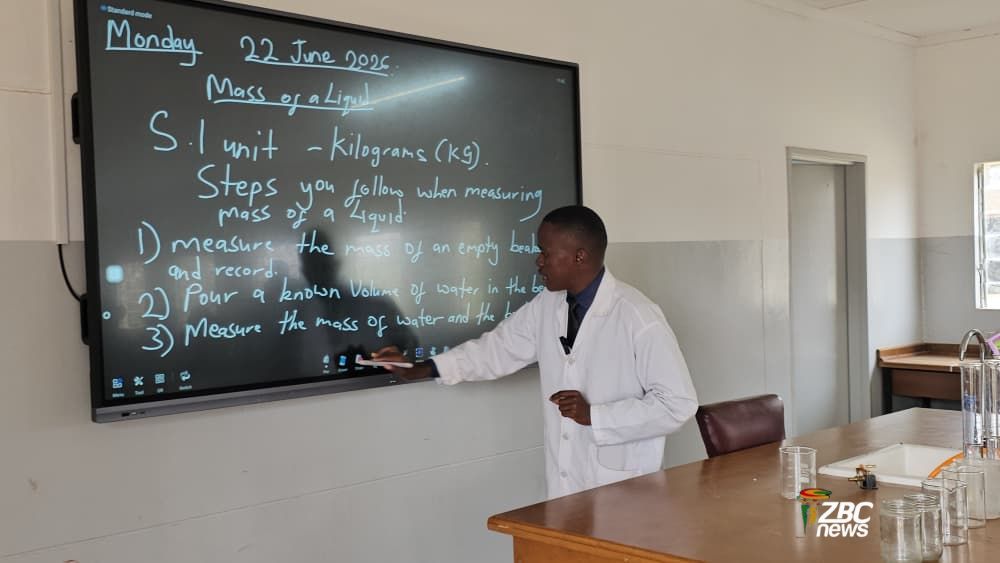
One such institution is Sitezi Secondary School in Gwanda District, where learners are now benefiting from improved learning facilities and practical science lessons.
As a science lesson unfolds at the school, learner participation reflects the positive impact of the new infrastructure and resources.
“It is now different. We can mix acids and do diffusion tests,” a learner said.
“We have all the apparatus needed in a laboratory. We no longer only read about them in books,” another learner said.
“We also have an interactive board that enhances our learning experience,” a pupil added.
To support the STEM drive, government is continuing to deploy science teachers to schools across the province, ensuring learners have access to quality instruction.
Statistics presented during the recent Matabeleland South Provincial Development Committee (PDC) meeting indicate that the province is nearing its target for science teacher deployment.
“The total number of science teachers in the province currently stands at 1 440 against a target of 1 500, which means we are at 90 percent of the science teachers required,” Science, Technology, Innovation and Human Capital Development Cluster representative, Mr Richard Moyo, said.
The construction of science and computer laboratories is expected to further increase the uptake of STEM subjects, which have traditionally recorded lower enrolment levels in some parts of the province.
Deputy Minister of Information, Publicity and Broadcasting Services, Honourable Omphile Marupi, commended the progress made in strengthening science education.
“We want to acknowledge the deployment of science teachers in our schools, especially in Gwanda South. To bridge learning gaps, teachers are conducting weekend lessons and the uptake of science subjects has improved tremendously,” he said.
Minister of State for Matabeleland South Provincial Affairs and Devolution, Honourable Albert Nguluvhe, said the province is benefiting from a major laboratory development programme.
“We received 40 science laboratories from the President and we are grateful for that support. By September, all the laboratories will be fully equipped, and this will go a long way in transforming our province,” he said.
As part of the 46th Independence Day legacy projects, Matabeleland South is constructing 40 science and computer laboratories, with most of the projects now at advanced stages of completion.
The developments are expected to strengthen STEM education and equip learners with the skills required to participate in Zimbabwe’s industrialisation and modernisation agenda.

