



Story by Wadzanai Mhombera, Assistant News Editor
ZIMBABWE and China are strengthening tourism and cultural cooperation as the two countries seek to unlock new opportunities for foreign currency generation, increase visitor arrivals and deepen economic ties through one of the world’s fastest-growing industries.

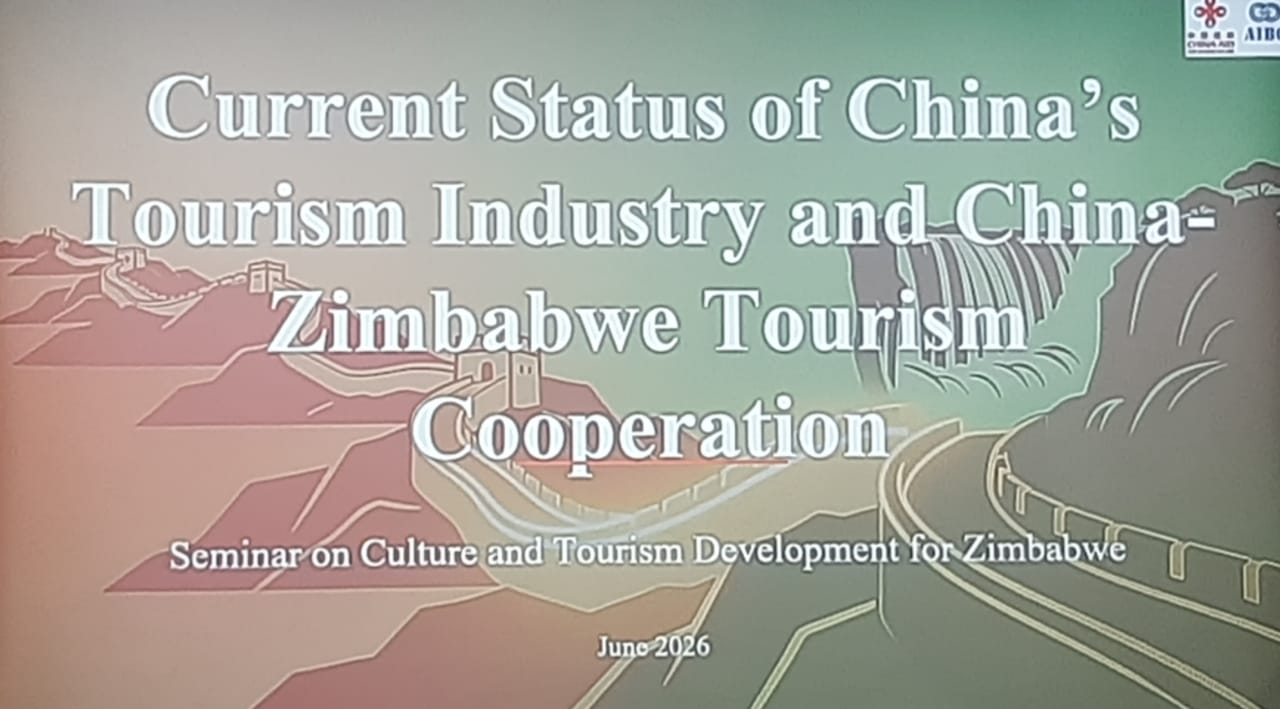
The renewed focus on tourism collaboration comes as experts from both nations meet at the ongoing Seminar on Culture and Tourism Development in Beijing, where tourism and cultural products have been identified as strategic sectors capable of driving sustainable economic growth and expanding revenue streams.
Participants at the seminar highlighted the need for Zimbabwe to transform its rich cultural heritage into marketable tourism products capable of attracting both domestic and international visitors.
“Zimbabwe must turn cultural products into attractive facilities that tourists will be willing to pay for and enjoy. Tourism concepts must be turned into actual products for consumption by tourists. Tourism is a low-hanging fruit for both economies,” a tourism professor in China, Professor Zhao Hongyu said.
China’s tourism recovery following the COVID-19 pandemic was cited as a model that Zimbabwe can learn from as it seeks to grow its tourism sector.
Statistics presented at the seminar showed that China’s domestic tourism market has rebounded strongly, recording growth of more than 16 percent year-on-year, with both urban and rural populations contributing significantly to travel activity and tourism revenue.
“The sector is growing the country’s revenue pursuit. Increasing earnings from tourism products is every country’s goal. The Chinese people have a strong passion for travel, something which Zimbabwe’s tourism can learn from and encourage such a culture. For example, year on year, there are over 1.5 billion trips by our rural population, earning the country over one trillion yuan (about US$150 billion). The urban people account for 49 billion trips annually, raking in over 5 trillion yuan (approximately US$700 billion),” Professor Hongyu said.
The seminar also examined strategies that have contributed to China’s growth in inbound tourism, including visa-free travel policies, improved connectivity and the use of digital technologies to enhance visitor experiences.
China’s inbound tourism sector has reportedly grown by more than 30 percent annually following the easing of COVID-19 restrictions.
Officials noted that expanding visa facilitation measures and improving travel convenience have played a significant role in attracting international visitors.
“Over 70 countries are now covered by this policy, with more countries set to be included gradually. It ensures a smooth process for tourists at ports of entry,” she said.
The adoption of smart technologies at ports of entry was also identified as a critical factor in improving efficiency and enhancing the visitor experience.
Zimbabwe has already embarked on modernisation initiatives at key entry points, including the Robert Gabriel Mugabe International Airport and the Beitbridge Border Post.
Professor Hongyu said China stands ready to support Zimbabwe in harnessing digital technologies to improve efficiency and service delivery within the tourism sector.
The seminar further underscored the importance of culture as a tourism asset, with delegates encouraging Zimbabwe to aggressively market its cultural industries, heritage and way of life to attract more visitors.
China’s tourism model includes more than 16 900 A-rated tourist attractions, over 7 100 registered museums, more than 3 200 smart-enabled public libraries and over 1 500 National Intangible Cultural Heritage facilities that preserve cultural traditions through modern technologies.
“Digital technology and artificial intelligence (AI) are being used to bring life to exhibitions at these sites. China also set up over 1 500 National Intangible Cultural Heritage facilities, preserving them through the use of AI,” said Professor Hongyu.
The 2024 Beijing Summit adopted the “Forum on China-Africa Cooperation- Beijing Action Plan (2025-2027)”, clearly stating that China supports all African countries with diplomatic relations with the Asian nation in becoming approved destinations for outbound group tours by Chinese citizens, thereby providing a high-level framework for China-Africa tourism cooperation.
China and Zimbabwe have signed a cooperation plan for jointly building the Belt and Road Initiative, making tourism collaboration an important part of bilateral strategic alignment and providing solid strategic support for the two countries’ tourism infrastructure development, route connectivity, and mutual market expansion.