



Story by Fairstars Mukungurutse
ZIMBABWE has been commended for having one of the most successful immunisation programmes in Africa, which has seen the country combating many public health threats.
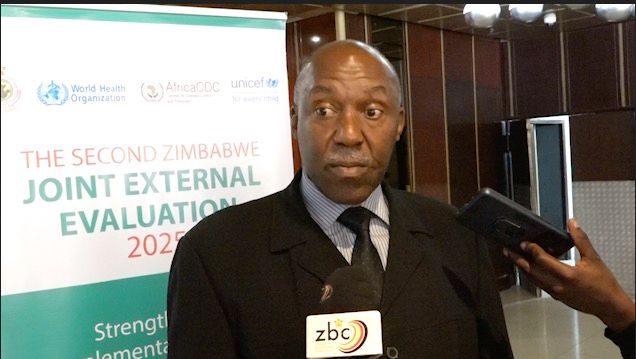
This came out during the launch of the 2025 Joint External Evaluation report held in Harare this Friday.
The country’s second Joint External Evaluation (JEE) report to assess the country’s capacity to prevent, detect and respond to public health threats has been released, with key indicators demonstrating a gradual improvement in the country’s health security.
Supported by the World Health Organisation and partners, the evaluation was based on 19 technical areas ranging from biosafety and surveillance to legislation and points of entry.
“Zimbabwe is doing very well on most of the indicators, but on immunisation and the surveillance systems, I am proud to let you know that immunisation had the best scores in the entire overall assessment of the joint external evaluation. We look at three indicators. One is the coverage with the measles vaccination. The second indicator we look at is how they are handling their vaccines. Lastly, the third indicator we look at is how they use vaccines whenever they have emergencies. In terms of disease surveillance, I mean, you guys have been around. You have seen how many outbreaks you have been able to detect. One, you were able to detect a polio outbreak. Second, you have been able to detect multiple cholera outbreaks. Third, you have been able to detect monkeypox. You can only do that if the surveillance system is functioning well,” Emergency Preparedness and Response World Health Organisation, Dr William Mbabazi said.
This positive trend indicates the government’s commitment to improving health service delivery.
“The Joint External Evaluation is a very important measure. It is like an audit to see how we have performed. They are supposed to do it once every five years. So, they did it now. The last one was in 2019 or so. What we do is to compare where we were in 2019. We were below 50 percent. And today, they were saying 54 percent. When you look at where we are coming from, it means we are doing well. We have seen the areas that they pointed to where we have not done well. Now, we have to focus on those areas to make sure that we improve our health delivery system,” Minister of Health and Childcare, Dr Douglas Mombeshora noted.
Regional programme lead for Africa Centres for Disease Control and Prevention (Africa CDC), Ms Batsirai Mbodza, applauded the government for undertaking the health assessment.
“We commend the government of Zimbabwe for its leadership, openness, and unwavering commitment to strengthening health security not only within its borders but also across the entire Southern Africa region and ultimately the African continent. This week marks the culmination of months of dedicated preparation, transparent dialogue, and intensive assessment, culminating in a robust and honest review of Zimbabwe’s core capacities under the International Health Regulations. To the government of Zimbabwe, your willingness to undergo this voluntary and rigorous process speaks volumes. It demonstrates a clear commitment to continuous improvement, accountability, and protecting the health and well-being of each Zimbabwean. Moreover, it shows a deep understanding that health security is a shared responsibility and that no country is safe until all countries are safe,” Regional Programme Lead for Africa CDC member, Ms Batsirai Mbodza added.
Zimbabwe has made significant strides in strengthening the health care system, including attainment of the UNAIDS HIV 95-95-95 target, reducing maternal mortality and modernising major referral hospitals through the Presidential Hospital Renovation Programme.

