



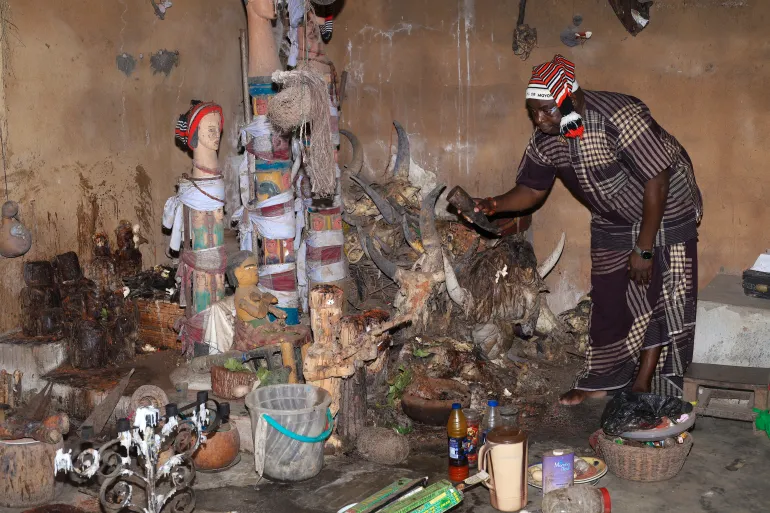
RELIGIOUS observers see a growing number of young people abandoning Christian churches in favour of Indigenous spirituality.
Since early childhood, Chidi Nwaohia’s life has swung like a pendulum between two spiritual paths: Christianity and African traditional religion.
His life was always marked by mystery, says the 59-year-old who was raised a devout nondenominational Christian in Amachi Nsulu, near Aba in southeast Nigeria.
Before he had turned a year old, he strayed overnight and went missing. “I was found the next morning in the same trench they searched the previous day,” he said.
Three days later, he had a sudden fit and fell gravely ill. His parents took him to a hospital, but when his condition did not improve, they approached a traditional healer for answers. The dibia (priest and medicine man) attributed his illness to the gods, saying it was a sign of Nwaohia’s inescapable destiny to lead his people in the ancient traditions of the Igbo people.
“The dibia said I was the reincarnation of my grandfather,” Nwaohia said. “His return to the earth as a powerful traditional priest was foretold [before he died].”
Such doctrine is not uncommon in cultures and spiritual practices across West Africa. But Nwaohia’s mother, due to her deep Christian faith, received the prophecy with doubt and kept it from her son.
When Nwaohia turned 17 in 1983, he was baptised. But on the day of the baptism, he had an accident. “While riding my motorbike home with the man who baptised me, I suddenly veered into the bush and sustained fleshly injuries, but my co-rider was unscathed,” he said, later coming to the conclusion that it was a sign he was on the wrong path.
But back then, Nwaohia was still ignorant of the prophecy, so at age 18, he became a Bible teacher at a church in his hometown.
After another road accident – a car crash in 1987 – left him with a limp and leg injuries he said would not heal despite years of hospital care, he took a friend’s advice and went to a medicine man for help. The wounds, the dibia told him, were signs that Nwaohia’s calling to the priesthood in the African traditional faith was due.
Nwaohia, then 23, told his mother what the dibia said. She finally revealed the prophecy she received about him many years ago. Although she was hesitant about it, he felt his path was now clearer, and gradually, he accepted his new spiritual role.
“People who identify and follow their true path will thrive, while those who stray will face difficulties until they find their way back,” said Nwaohia, who claims his leg injury healed on its own after he embraced his calling.
He was officially ordained a dibia in 1993, in an elaborate ceremony that included prayers, rituals of purification and vision, as well as frenzied dances, drumming and initiations. Other spiritualists offered Igbo prayers to Chukwu (the Supreme Being), Ndi Ichie (the ancestors), and the gods and spirits that control the physical and spiritual worlds, asking for acceptance, guidance, protection and blessings.
Christianity is the number one religion in Nigeria, a country of more than 200 million people. But in the years since Nwaohia changed his spiritual path, a growing number of young people have been moving away from monotheistic faiths towards Indigenous African beliefs, according to religious leaders and observers Al Jazeera spoke to.
There is a dearth of data and research on the issue, observers said, but they started noticing the trend in the early 2000s. Many attribute it to growing apathy towards Christianity, but some say pastors focusing on material wealth over spiritual wellbeing – something contrary to the Bible’s teachings – leads people to consider alternative religious options.
(Al JAZEERA AFRICA NEWS)

