



Story by Abigirl Tembo
THE Food and Agriculture Organisation (FAO) has praised Zimbabwe’s agricultural progress, highlighting the country’s potential to become a major player in the region.
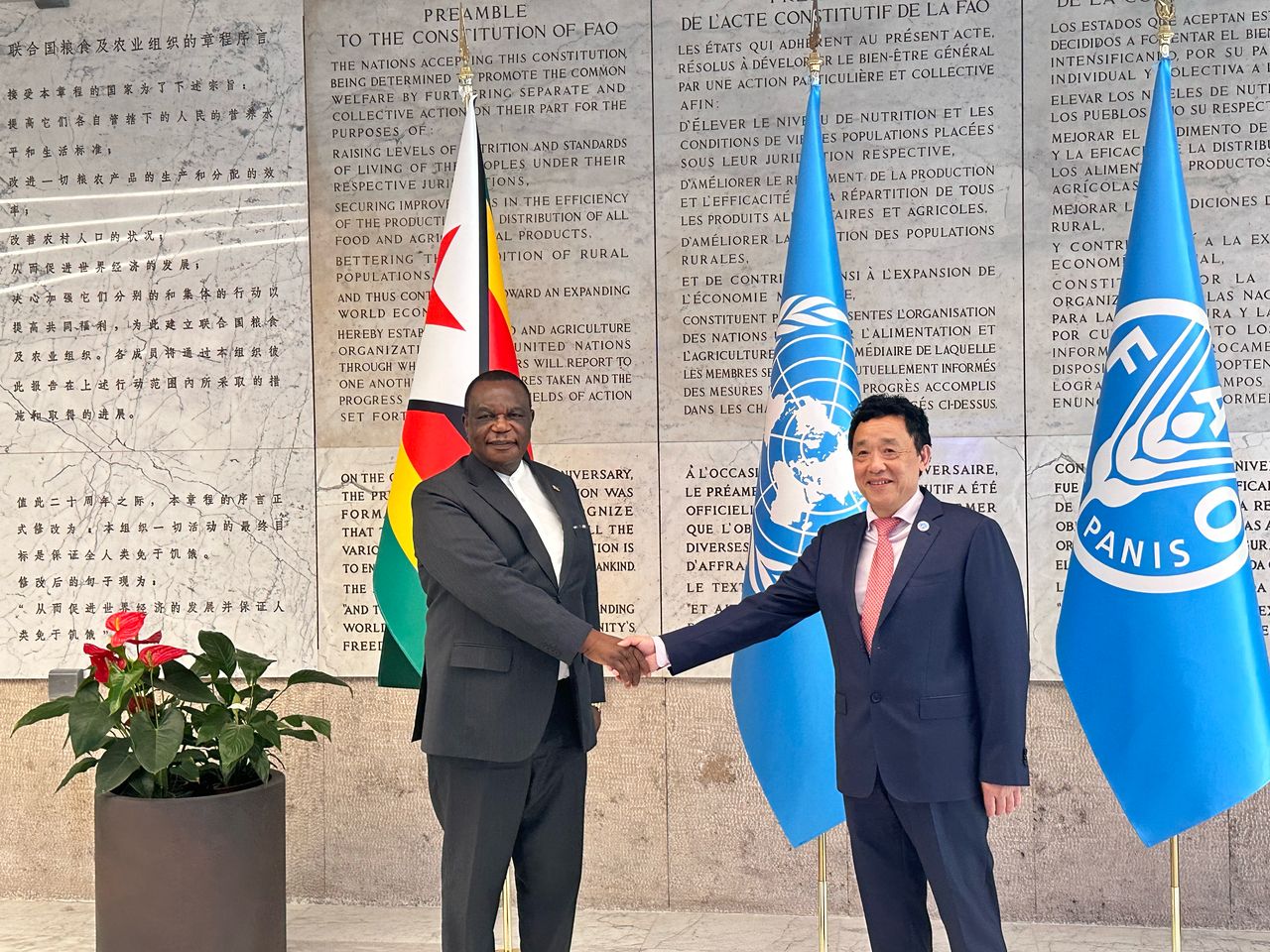
This Friday, Vice President General (Rtd) Dr Constantino Chiwenga visited the FAO Headquarters in Rome, where he held closed-door discussions with FAO Director-General Dr Qu Dongyu. Talks focused on enhancing food production, advancing food security, and meeting Sustainable Development Goal number two, which seeks to end hunger.
Following the meeting, Dr Dongyu commended Zimbabwe’s transformation in agriculture and expressed confidence in the country’s capacity to further thrive with appropriate policy support and investment.
“I deeply appreciate the Vice President for visiting FAO and acknowledging the work we’ve done in partnership with Zimbabwe. We are committed to ending hunger and supporting smallholder farmers. Zimbabwe has excellent soil, natural resources, and reliable rainfall, all favourable for a strong agri-food system. With sound policy, science, innovation and investment, Zimbabwe can turn its potential into reality,” said Dr Dongyu.
He further highlighted FAO’s commitment to supporting youth and women, while stressing the importance of international cooperation and knowledge sharing through innovation forums.
“We have created platforms to support countries of the Global South by encouraging more investment, promoting science and innovation, and providing technical assistance. Zimbabwe remains a responsible and engaged member of FAO, and I commend the leadership of both the President and Vice President. With political stability and a favourable environment for agroforestry, Zimbabwe has a bright future,” he added.
Vice President Chiwenga reaffirmed Zimbabwe’s commitment to deepening collaboration with FAO, particularly in enhancing value chains and driving rural industrialisation.
“Zimbabwe is one of the three countries selected for the Hand-in-Hand Initiative with FAO. We want to tap into FAO’s pool of over 11 000 agricultural experts to strengthen our value chains and agro-industry. Under the direction of His Excellency the President, we are moving towards rural industrialisation, where the village becomes a site of economic production, not just a place to retire,” said Dr Chiwenga.
He underscored the need for every village to grow suitable crops and rear livestock as part of a broader rural development strategy aimed at feeding into the national economy and boosting GDP contribution from agriculture.
“Whether it’s crops, fruit trees, or livestock, the goal is to create economies of scale at village, ward, or district level. When production is pooled, communities benefit collectively, and Zimbabwe’s economy grows. This is where we want to collaborate further with FAO, especially in areas like climate-proof agriculture, where they have already been of great assistance,” he said.
The Vice President’s visit to the FAO is part of a broader working visit to Italy, which will also include high-level engagements at the Vatican aimed at exploring investment opportunities in Zimbabwe’s education and healthcare sectors.

